Mancala on FunAI: How Our Rules Differ From What You Learned

Discuss this article with your favorite AI assistant
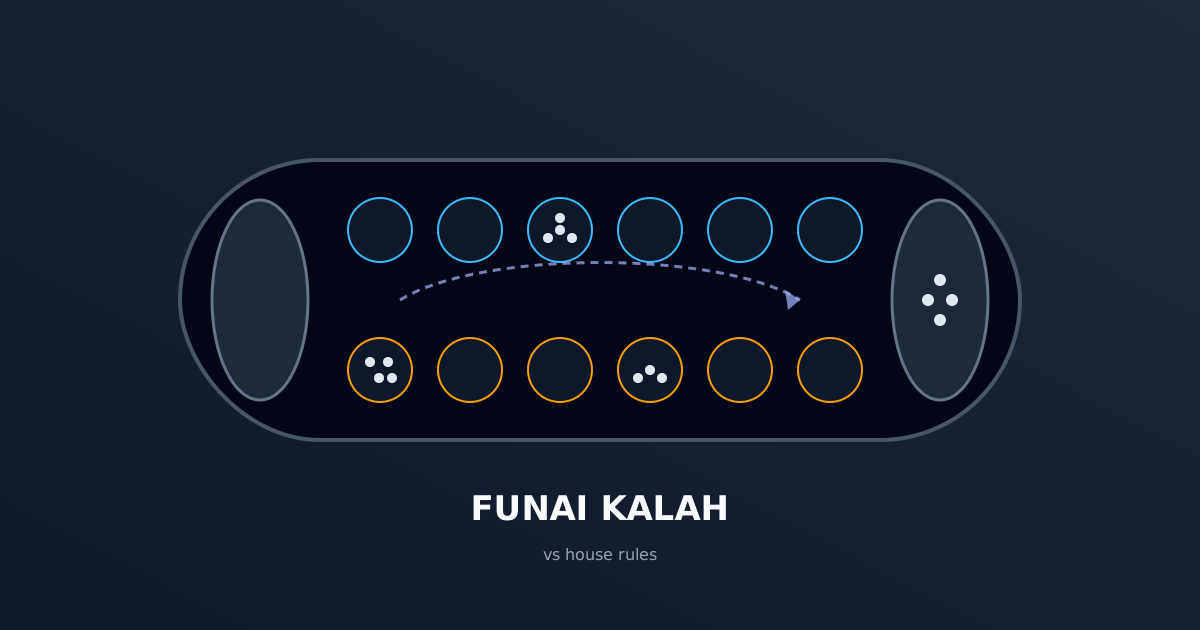
Direct Answer: FunAI Mancala uses Kalah (American Mancala): six pits per side, a store at each end, sowing counter-clockwise, skipping the opponent’s store, an extra turn when your last seed lands in your own store, and a capture when your last seed lands in an empty pit on your side — you take that seed plus the seeds opposite into your store. If the version you learned at home used different capture rules, clockwise sowing, or “all seeds stay until the end,” you are not wrong — you learned another member of the mancala family. Play the FunAI ruleset at Mancala.
Confused by a move that “should not” have captured? Start here, then open the board:
- Play Mancala on FunAI — Kalah rules, free, no login, vs AI or local two-player.
Why Mancala Rules Feel Personal
Almost nobody learns “mancala” from a single worldwide rulebook. People learn it from a wooden board at a relative’s house, a plastic travel set, a classroom kit, or a phone app that never named its variant. The family is huge — Oware, Bao, Congkak, Kalah, and dozens of regional games share the seed-sowing idea but disagree on the details that decide winners.
So when someone says “that’s not how mancala works,” they are usually comparing two honest memories. FunAI is not trying to declare every other house rule invalid. FunAI is trying to be clear and consistent about one popular Western ruleset: Kalah. This post is ruleset clarity for players who feel gaslit by the board — not an openings course, not a “is it solved?” essay, and not a how-to that pretends there is only one mancala.
If you already know Kalah and want practical play tips, the optional sibling Mancala Rules of Thumb is the strategy companion. Stay on this page when the confusion is “which rules are we even using?”
FunAI Kalah in Plain Language
Here is the FunAI board, described the way a player experiences it:
- Six pits on your side, six on theirs. You only sow from your own pits.
- Two stores (mancalas) at the ends — one belongs to you, one to your opponent. Seeds in your store are safe points toward winning.
- Start with four seeds in each pit (classic Kalah setup). Stores begin empty.
- On your turn, pick one of your non-empty pits. Pick up every seed in it and sow them one by one into the next pits, moving counter-clockwise.
- You drop a seed into your own store when you pass it. You never drop a seed into the opponent’s store — you skip it and continue.
- Extra turn: if your last seed lands in your own store, you play again.
- Capture: if your last seed lands in an empty pit on your side, and the opposite pit has seeds, you capture the opposite seeds plus that last seed into your store.
- End of game: when one player has no seeds left in their pits, remaining seeds on the other side move into that player’s store, then higher store total wins (equal stores are a draw).
Those bullets are the whole contract. Everything else people argue about — clockwise sowing, capturing on both sides, no extra turns, different seed counts — belongs to other variants or house rules.
Side-by-Side: FunAI Kalah vs Common House Rules
Use this table when two players say “mancala” and mean different games. Left column is what FunAI enforces. Right column is what many people remember from home or school.
| Rule point | FunAI (Kalah) | Common house / other variants |
|---|---|---|
| Pits per side | Always 6 | Sometimes 5, 6, or more; travel boards vary |
| Stores | One store at each end; yours collects points | Same idea in Kalah-like sets; some folk games score differently |
| Starting seeds | 4 per pit | 3, 4, or 5 depending on the set; “we always used 3” is common |
| Sowing direction | Counter-clockwise | Some households sow clockwise; direction must be agreed |
| Opponent’s store | Always skipped | Usually skipped in Kalah; confusion arises when people mix in other games |
| Last seed in own store | Extra turn | Some house rules ignore bonus turns entirely |
| Empty-pit landing | Capture opposite seeds + your landing seed into your store (own side only) | “Capture opposite only,” “no capture,” or Oware-style multi-pit takes |
| Landing in empty pit with empty opposite | No capture; the single seed stays | Same in most Kalah teaching; still a frequent “wait, why?” moment |
| Who may be captured | Only via landing on your empty pit | Some teach captures from either side; not FunAI Kalah |
| Game end | A player’s pits empty → leftover seeds scoop to the other store; compare totals | Some play until all seeds are stored by sowing alone; scooping rules differ |
If your childhood board matches the right column more than the left, you will feel “wrong” moves on FunAI until you re-map the habits. The board is not broken. The variant changed.
The Six Rules People Mix Up Most
1. Counter-clockwise is not optional here
On FunAI, sowing always runs the same way around the oval. If you grew up sowing the other direction, every capture pattern you memorized will feel mirrored. Before you blame the capture rule, check whether your mental map of “next pit” matches the board’s direction. One quiet practice game where you only watch the seeds travel — without hunting captures — fixes this faster than any argument.
2. Skipping the opponent’s store changes the count
Players who forget the skip often miscount by one and then swear the extra-turn rule is “random.” It is not. When a long sow passes the far store, that store does not eat a seed. Your last-seed landing pit shifts by one compared with a mistaken count that included it. Recount slowly on big moves until the skip becomes muscle memory.
3. Extra turns are earned, not given for “good play”
The only bonus-turn trigger on FunAI is last seed into your own store. Captures do not automatically grant another turn. Emptying a pit does not. Winning a big swing does not. If you chain turns, it is because you kept landing in the store — a planning skill, not a streak reward.
4. Captures need an empty landing pit on your side
The capture check is strict: your last seed must land in a pit that was empty (so after landing it holds exactly that one seed), that pit must be yours, and the opposite pit must hold at least one seed. Then both the opposite seeds and your landing seed go to your store. If the opposite pit is empty, nothing special happens. If you land in an opponent pit, nothing special happens from the empty-pit rule. This single sentence resolves most “the game stole my seed” complaints.
5. “I landed empty” is not enough
House rules sometimes treat any empty landing as magical. FunAI requires the empty pit to be yours. Landing in an empty opponent pit simply leaves a lonely seed there — often a gift for them later. That surprise is one of the biggest Kalah-vs-house-rule shocks.
6. Endgame scooping is part of the ruleset
When one side’s pits are all empty, FunAI ends the sowing war and scoops the remaining pit seeds into the other player’s store, then compares totals. Players who learned “keep going until every seed is sown into stores naturally” will feel the finish arrives suddenly. It is intentional Kalah timing: running your opponent out of moves is a real plan, not a glitch.
A Walkthrough Capture (No Jargon)
Imagine your side has an empty pit, and the pit directly across from it holds five seeds. You sow from somewhere on your side so that your final seed drops into that empty pit. Instantly:
- That final seed is sitting alone in your previously empty pit.
- The five opposite seeds are captured.
- All six seeds (five + your one) move into your store.
- Your turn ends unless some other rule said otherwise — and capture alone does not give a bonus turn.
Now change one detail: the opposite pit was empty too. You still land in your empty pit, but there is nothing to capture, so your lone seed stays. Same landing shape, different result — because FunAI requires something to take.
Change another detail: your last seed lands in an empty pit on their side. No FunAI capture. The seed stays there as a future problem or gift. If your house rules captured from either side, this is the moment the variants diverge hardest.
What FunAI Is Not Trying to Be
Naming the boundaries prevents false expectations:
- Not Oware. Oware’s capture patterns and relay sowing culture are different. Loving Oware does not make FunAI “wrong.”
- Not a regional folk rules encyclopedia. The site ships one clear digital ruleset so two strangers (or you and the AI) share the same physics.
- Not a strategy lecture first. Heuristics and openings live elsewhere. This page exists so strategy advice means the same moves for everyone reading it.
Once the ruleset is shared reality, optional reading like Mancala Rules of Thumb becomes useful instead of contradictory.
How to Relearn Fast If Your House Rules Differ
You do not need to forget your childhood game. You need a temporary overlay called “FunAI mode.” Try this short reset:
- Play one game where you only aim for extra turns — practice landing in your store on purpose. Ignore captures.
- Play a second game where you only watch empty pits on your side — ask before every sow: “Where does my last seed land?”
- Play a third game allowing captures — now combine store landings with empty-pit landings.
- Say the six FunAI facts out loud once before a friend joins: six pits, stores at ends, counter-clockwise, skip their store, store landing = extra turn, empty own pit + opposite seeds = capture into store.
After those three games, most “this app is broken” feelings evaporate. What remains is real Kalah tactics: counting, tempo, and refusing to gift empty pits.
Playing With Someone Who Learned Different Rules
Digital play removes mid-game renegotiation — FunAI will enforce Kalah whether your guest likes it or not. That is a feature for fairness, and a social risk if you do not warn them. A thirty-second preamble prevents tilt:
- “This is Kalah: extra turn on store, captures only from landing in your empty pit.”
- “We skip the other person’s store when sowing.”
- “If your home rules were different, blame the variant, not each other.”
Then open Mancala and let the animation teach. Watching seeds land is clearer than arguing from memory.
Why Clarity Matters More Than Nostalgia
Mancala’s strength is that children and adults can share a board. Its weakness is that the word “mancala” hides a forest of rules. Online, hidden disagreement becomes accusation: cheating, bugs, “cheap” captures. Publishing a side-by-side ruleset is the adult move. FunAI’s job is to pick one coherent physics engine and stick to it. Your job, as a player, is to know which physics you entered.
Nostalgia still matters. Keep playing your aunt’s clockwise version at holidays. Just do not expect FunAI to emulate every living-room treaty. When you want a stable online ruleset you can practice against an AI or a friend without a referee, Kalah-on-FunAI is the contract.
Quick Reference Card
Screenshot this mentally before you queue a game:
- 6 pits each · stores at ends · 4 seeds per pit to start
- Sow counter-clockwise · skip opponent store
- Last seed in own store → extra turn
- Last seed in empty own pit → capture opposite + that seed into store (if opposite has seeds)
- Side empty → scoop remaining pits to the other store → compare totals
That card is the entire FunAI difference from “what you learned,” summarized.
Frequently Asked Questions
What mancala rules does FunAI use?
Kalah (American Mancala): six pits per side, stores at both ends, counter-clockwise sowing, skip the opponent’s store, extra turn on landing in your store, and empty-own-pit captures of the opposite seeds plus your landing seed.
Why didn’t I get a capture when I landed in an empty pit?
On FunAI the empty pit must be on your side, and the opposite pit must contain seeds. Landing empty on their side does not capture. Landing empty on your side across from an empty pit also does not capture.
Do captures give an extra turn?
No. Only landing your last seed in your own store grants another turn. Captures score seeds; they do not extend the turn by themselves.
We always sowed clockwise at home. Is FunAI wrong?
No — you learned a different house convention. FunAI standardizes on counter-clockwise Kalah so every online game shares the same direction.
How many seeds start in each pit?
Four. If your set used three or five, totals and timing will feel different even when capture rules match.
Where can I play with these rules?
Right here: Play Mancala on FunAI. For play heuristics after the rules click, see Mancala Rules of Thumb.
Summary and Key Takeaways
- FunAI Mancala is Kalah, not “every mancala you’ve ever seen.”
- Core facts: 6 pits, end stores, counter-clockwise, skip opponent store, store landing = extra turn, empty own pit captures opposite + that seed.
- Most confusion is variant clash, not a broken board — use the side-by-side table to translate house rules.
- This post is ruleset clarity; strategy companions are optional and separate.
- Agree on the FunAI contract, then play at /games/mancala.
Play FunAI Kalah Now
Same rules every time — six pits, stores, captures, and extra turns, free in the browser with no login.
Play MancalaRules clear? Next: practical habits in Mancala Rules of Thumb.