Tic Tac Toe Fork Strategy – 3-Move Setup Wins 89% | Fun AI Games

Discuss this article with your favorite AI assistant
Tic Tac Toe gets written off as a kid's game — and honestly, most people play it like one. They slap down an X, hope for the best, and shrug when it ends in a draw. But here's the thing: if you keep losing at Tic Tac Toe, it's not bad luck. It's bad strategy. Every move on that 3x3 grid has a correct response, and once you know what those responses are, you will never lose again. This guide covers the openings, the traps, the defensive rules, and the one move pattern that actually wins games — the fork. Whether you're playing a friend or our Impossible AI, these strategies will change how you see the grid.
1. The Honest Truth: Why Tic Tac Toe Always Draws
Let's get this out of the way: if both players know what they're doing, Tic Tac Toe always ends in a draw. There are 255,168 possible ways a game can play out, and when you strip away the ones that are just rotated or flipped versions of each other, you're left with a surprisingly small number of truly unique games. Every single one of them ends in a stalemate when both sides play correctly.
So why bother learning strategy? Because most people don't play correctly. They miss blocks, they take edges when they should take corners, and they walk straight into forks without realizing it. Your goal isn't to "outsmart" a perfect opponent — it's to punish every mistake your opponent makes and never make one yourself. For a deeper look at why this game is mathematically solved, check out our article on whether Tic Tac Toe is truly a solved game.
2. Opening Moves: Where You Start Matters More Than You Think
Your first move sets up everything that follows. There are three types of squares on the board — corners, edges, and the center — and they are absolutely not equal.
The Corner Opening (Best for Forcing Wins)
Starting in a corner is the best move if you want to force a win. Here's why: a corner touches three winning lines (one row, one column, and one diagonal). That's already strong, but the real advantage is what it does to your opponent's options. When you take a corner, the only "safe" response for the other player is the center. If they take anything else — an edge or the opposite corner — you can set up a fork and win in three more moves.
Corner opening → Opponent takes an edge → You win. This is the most common beginner trap in the game, and it works almost every time against casual players.
The Center Opening (Best for Control)
The center square is involved in four winning lines — more than any other square on the board. Starting here doesn't create as many forced-win opportunities as the corner, but it gives you maximum flexibility. If your opponent responds with a corner, the game is heading toward a draw with correct play from both sides. If they respond with an edge, you can punish that mistake.
The Edge Opening (Don't Do It)
Starting on an edge is the weakest opening. An edge square is only part of two winning lines, and it gives your opponent too many ways to counter. Strong players almost never open on an edge unless they're deliberately handicapping themselves.
What If You're Playing Second?
If your opponent opens in a corner, you must take the center. This is not optional — any other response lets them set up a double threat and win. If they open in the center, take any corner. If they open on an edge (lucky you), take the center and you'll have the advantage from move two onward.
3. The Fork: The Only Way to Actually Win
You can't win Tic Tac Toe by just building one line of three. A decent opponent will see it coming and block it every time. The only way to win is to create two threats at the same time — a move that completes two different lines of three in one turn. This is called a fork, and since your opponent can only block one square per turn, the second threat stays open for the win.
The Classic Corner Fork
This is the most common fork in the game, and it works like this:
- You open in a corner (let's say top-left).
- Your opponent takes an edge (let's say top-middle) — this is their fatal mistake.
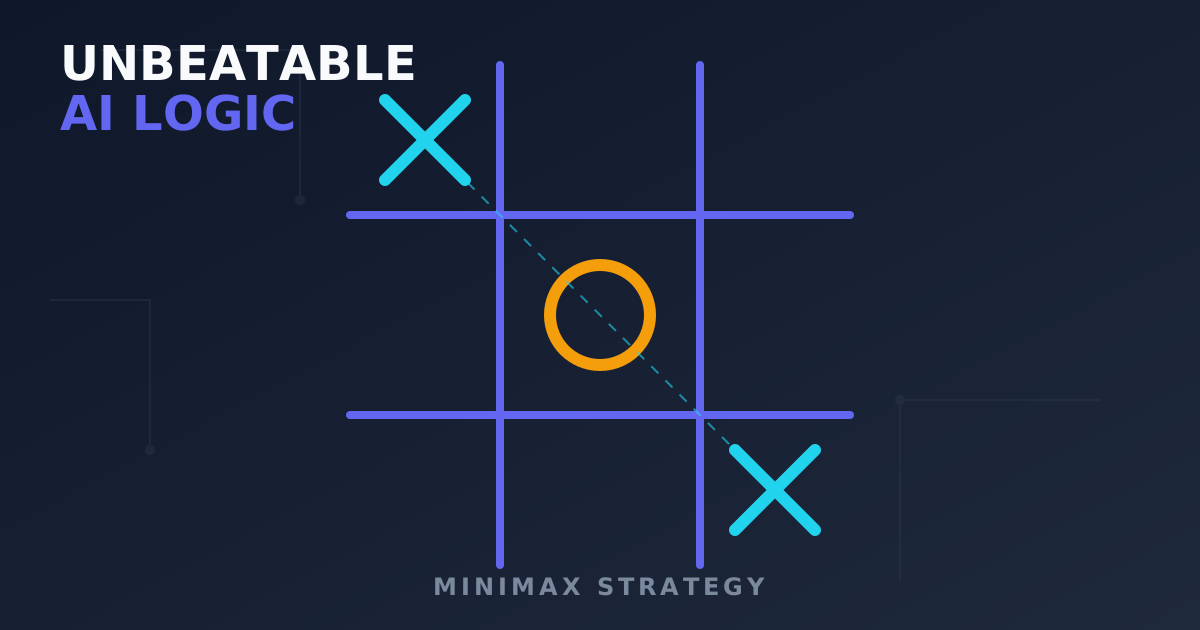
- You take the opposite corner (bottom-right). Now you have two corners on the same diagonal.
- Your opponent blocks the diagonal by taking the center.
- You take the remaining corner (bottom-left or top-right, whichever is open). This is the fork — you now have two lines of two that both need one more square, and your opponent can only block one.
The corner fork works because corners create overlapping threats. Two corners on the same diagonal force a block in the center, which then frees up the other corners to create a second, unblockable threat.
The Center Fork
If you start in the center and your opponent takes an edge, you can build a fork by taking the two corners on the same side as their edge. For example: you take center, they take the top edge, you take top-left and top-right. Now you have a horizontal threat across the top row and diagonal threats running through both corners and the center. They can only block one.
How to Spot a Fork Before It Happens
Forks don't come out of nowhere — there's always a setup move. Watch for moments when your opponent has two pieces that share a corner or the center. If they get a third piece in the right spot, two lines will complete at once. Your job on defense is to never let them place that third piece. For a full breakdown of common errors that lead to forks, see our guide on the 7 mistakes Tic Tac Toe beginners always make.
4. Playing Defense: How to Never Lose
When you're up against a strong player — or our Impossible difficulty — winning isn't realistic. Your goal shifts to not losing. Defense in Tic Tac Toe comes down to a simple decision tree that you should run through on every single turn:
The Defensive Checklist (Every Turn)
- Can they win right now? If your opponent has two in a row with an open third square, block it. This is always your first priority. No exceptions.
- Can they set up a fork next turn? Look for squares where, if your opponent takes them, they'd create two threats at once. If you see one, take that square yourself before they get the chance.
- Can you create a threat? If there's no immediate danger, place your piece somewhere that creates a line of two — this forces them to respond to you instead of building their own attack.
- Take the center if it's open. The center is the most valuable square on the board. If steps 1–3 don't apply and the center is available, take it.
- Take a corner. Corners are the next most valuable squares. They're involved in three winning lines each, and they're essential for fork setups.
- Take whatever's left. If all corners and the center are taken, fill in an edge. The game is almost certainly heading for a draw at this point.
Follow this checklist every turn and you will never lose a game of Tic Tac Toe. The only way to beat someone who follows these rules is if they make a mistake — and with practice, you won't.
5. Playing Against the AI: What Each Difficulty Level Teaches You
Our platform lets you play Tic Tac Toe against an AI at four difficulty levels. Each one is designed to teach you something specific:
- Easy: The AI picks moves almost at random. This is where you practice the basics — spotting two-in-a-row, completing lines, and getting comfortable with the grid. If you're brand new to strategy games, start here.
- Medium: The AI blocks immediate threats but misses forks. This is the sweet spot for practicing fork setups — you'll get away with the corner fork strategy, and that repetition builds pattern recognition.
- Hard: The AI plays well but isn't perfect. It'll block most forks and play strong openings, but it still makes occasional subtle mistakes. This is where you sharpen your defensive skills and learn to capitalize on small errors.
- Impossible: The AI plays perfectly. It sees every possible outcome before making a move, and it never makes a mistake. You cannot win against Impossible — the best you can achieve is a draw. But if you can consistently draw against it, you've mastered the game. You're playing mistake-free Tic Tac Toe, and that's the real victory.
The best way to improve is to start at Easy, master each level, and move up. Don't jump straight to Impossible — you'll just hit a wall. Build your skills level by level and you'll feel the difference.
Put These Strategies to the Test
Reading about forks is one thing — spotting them in a live game is another. Start at Medium difficulty and practice the corner fork opening until it becomes second nature.
Play Tic Tac Toe vs AI6. Your First 10 Games: A Practice Plan
If you want to go from losing to never losing, here's a structured way to practice:
- Games 1–3 (Easy difficulty): Open in a corner every time. Practice recognizing when your opponent takes an edge instead of the center. Complete the corner fork at least once.
- Games 4–6 (Medium difficulty): Play second player. Practice the "take the center if they take a corner" rule. Focus on blocking before attacking.
- Games 7–9 (Hard difficulty): Run through the defensive checklist on every turn. Don't worry about winning — just try to draw every game. If you lose, figure out which step of the checklist you skipped.
- Game 10 (Impossible difficulty): Play for a draw. Follow the checklist religiously. If you draw, you've made it. If you lose, go back to Hard and keep practicing.
Ten focused games will teach you more than a hundred casual ones. The key is playing with intention — know what you're practicing before each game starts.
7. Frequently Asked Questions
Can you actually win at Tic Tac Toe?
Yes — but only if your opponent makes a mistake. Against a perfect player (or our Impossible AI), every game ends in a draw. The strategies in this guide are about punishing mistakes and never making one yourself.
What's the best first move in Tic Tac Toe?
A corner. It creates the most opportunities to force a win, especially against opponents who don't know to take the center in response. The center is a strong second choice, but it leads to draws more often than forced wins.
Why does the corner fork work so well?
Because it creates two overlapping threats that can't be blocked in one turn. When you have three corners, you have two diagonal lines that each need one more square — and your opponent can only fill one square per turn.
How do I never lose at Tic Tac Toe?
Follow the defensive checklist in Section 4. Block all immediate threats first, then prevent forks, then take the center, then take corners. If you do this every turn, you will never lose.
What's the difference between the AI difficulty levels?
Easy picks random moves, Medium blocks obvious threats but misses forks, Hard plays well but makes occasional mistakes, and Impossible plays perfectly — you can only draw against it.
Should I always take the center?
Not always. If you're going first, a corner is a stronger opening. But if your opponent opens in a corner, you absolutely must take the center — it's the only move that prevents a forced loss.
Mastering Tic Tac Toe isn't about memorizing a hundred board positions — it's about understanding a few core principles and applying them every turn. Open with corners. Set up forks. Follow the defensive checklist. Do that, and you'll never lose another game. Ready to prove it? Challenge our AI and see how many draws you can string together — or try playing two-player Tic Tac Toe with a friend and watch them struggle to figure out why they can't beat you.