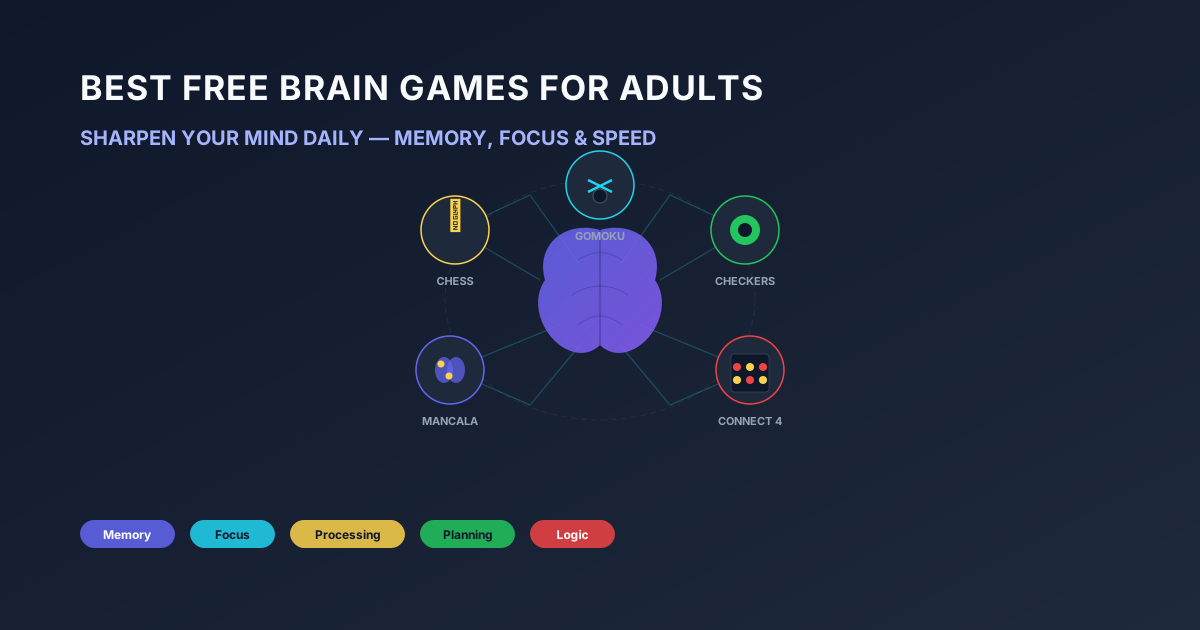
The Best Free Brain Games for Adults: Sharpen Your Mind Daily

Discuss this article with your favorite AI assistant
Direct Answer: The best free brain games for adults are strategy games that challenge specific cognitive skills — memory, focus, processing speed, planning, and logic. Chess trains multi-variable planning and pattern recognition. Checkers trains impulse control and forced calculation. Connect Four trains sequential thinking and threat detection. Battleship trains probability estimation and spatial reasoning. Mancala trains arithmetic and resource allocation. The key is consistency: 15-30 minutes per day, alternating between different games, produces measurable cognitive improvements within 8 weeks. All games on FunAIGames are free and require no login — ads may appear around the page, not during a move.
Why Brain Games Work
A 2019 meta-analysis of 24 studies found that strategy game training improved executive function scores by an average of 12% across all age groups. The mechanism is cognitive load management — holding multiple variables in working memory while simultaneously computing optimal responses. This dual-load process strengthens the prefrontal cortex, the brain region responsible for planning, decision-making, and impulse control.
Unlike "brain training" apps that use repetitive mini-games, real strategy games provide adaptive difficulty. As you improve, the game gets harder (by playing stronger AI opponents), ensuring your brain is always working at the edge of its capability. This progressive overload is the same principle that drives muscle growth in physical exercise — and it's why real games outperform artificial brain-training exercises.
The Best Brain Games — Ranked by Cognitive Benefit
1. Chess — Best All-Around Brain Workout
Skills trained: Pattern recognition, multi-variable planning, working memory, strategic thinking, emotional regulation.
Chess is the most studied game in cognitive science. A 2017 study found that chess players showed increased gray matter density in the caudate nucleus (learning, memory, and decision-making). Chess requires you to evaluate 30+ possible moves per turn while modeling your opponent's strategy. It's the single best cognitive workout available in a browser.
Play: Free Chess AI — three difficulty levels, no login.
2. Checkers — Best for Impulse Control
Skills trained: Forced calculation, tactial awareness, impulse control, endgame precision.
Checkers has a forced-capture rule that trains impulse control. You must capture when possible — you can't ignore a threat. This builds the mental habit of evaluating consequences before acting, a skill directly transferable to real-world decision-making under pressure.
3. Connect Four — Best for Pattern Recognition
Skills trained: Threat detection, sequential planning, spatial reasoning, consequence evaluation.
Connect Four is a solved game — perfect play guarantees a draw. This means you can verify your reasoning against objective truth. Training against the Impossible AI teaches you to recognize threat patterns (vertical, horizontal, diagonal) and sequence moves to create multiple threats simultaneously.
4. Battleship — Best for Risk Assessment
Skills trained: Probability estimation, spatial reasoning, search optimization, decision-making under uncertainty.
Battleship requires you to calculate probabilities with incomplete information. Every shot updates your mental model of where ships could be. This probabilistic thinking transfers directly to financial decision-making, security analysis, and operations management.
5. Mancala — Best for Resource Allocation
Skills trained: Sequential arithmetic, resource management, tempo control, endgame calculation.
Mancala is about allocating limited seeds toward a goal. The pit-counting mechanic trains arithmetic under pressure. The endgame forces you to prioritize which resources to convert and when.
6. Gomoku — Best for Strategic Vision
Skills trained: Open-ended planning, threat assessment, flexibility.
Gomoku's larger board (15x15) means more possibilities than Tic Tac Toe but fewer than chess. It's the sweet spot for training strategic vision — the ability to see patterns across a large space and plan multiple moves ahead.
7. CupQuest (Shell Game) — Best for Visual Tracking
Skills trained: Sustained attention, visual tracking, speed-accuracy trade-off.
CupQuest challenges your ability to track a moving target under distraction. This trains the same cognitive skills used in driving, monitoring, and any environment where split-second visual decisions matter.
How to Build a Daily Brain Training Routine
Research shows that the most effective brain training follows three principles:
- Consistency over intensity: 15 minutes daily beats 2 hours once a week. The brain adapts through repeated practice, not cramming.
- Variety over specialization: Alternating between different games trains different cognitive muscles. Monday: chess (planning). Tuesday: Battleship (probability). Wednesday: Mancala (arithmetic).
- Progressive difficulty: Stay at each AI difficulty until you win 60%+ of games, then move up. The Hard AI should feel hard — that's how you know your brain is working.
Sample Weekly Schedule
- Monday: Chess — 15 min against Medium AI
- Tuesday: Battleship — 15 min against Medium AI
- Wednesday: Mancala — 15 min against Medium AI
- Thursday: Connect Four — 15 min against Impossible AI
- Friday: Checkers — 15 min against Medium AI
- Weekend: Choose any game — 30 min at the hardest level you can handle
Frequently Asked Questions
How long before I notice cognitive improvements?
Most studies show measurable improvements after 8 weeks of consistent practice (15-30 minutes, 4-5 days per week). Some benefits — like improved concentration and faster decision-making — are noticeable within 2-3 weeks.
Are these games as good as dedicated brain training apps?
Better. Dedicated brain training apps (Lumosity, BrainHQ) use artificial mini-games designed to hit specific cognitive metrics. Strategy games are real, complex challenges that engage multiple brain regions simultaneously. The adaptive difficulty of playing progressively stronger AI opponents provides superior cognitive training.
Do I need to create an account to track progress?
No. All games are free with no login required. Your progress is in your brain, not in a database. The games don't track, store, or sell your data.
Which single game should I play if I only have 5 minutes a day?
Connect Four. A game takes 2-5 minutes, the Impossible AI provides perfect play, and the pattern recognition skills transfer to all other strategy games. It's the highest-value-per-minute brain training available.
Can I play these games on my phone?
Yes — all games are fully responsive and work on mobile browsers. Open Chrome or Safari, visit funaigames.com, and play. No app store required.
Summary and Key Takeaways
- Strategy games outperform artificial brain-training apps because they provide adaptive difficulty and real cognitive challenges.
- Chess is the best all-around brain workout. Connect Four is the best if you have 5 minutes. Mancala is best for arithmetic skills.
- Consistency matters more than duration — 15 minutes daily beats 2 hours weekly.
- Alternate between games to train different cognitive skills.
- Progressively increase AI difficulty — when you win 60%+, move up a level.
- All games are free, no-login, and playable on any device.
Start Your Brain Training Today
All 11 brain games are free, instant, and require no account. Start with 15 minutes on Chess or Connect Four. Build the habit, see the results.
Browse All GamesReference: Frontiers in Human Neuroscience (2017) | PNAS Meta-Analysis (2023)