How to Play Snakes and Ladders Online: Complete Game Guide

Discuss this article with your favorite AI assistant
Direct Answer: Snakes & Ladders is a pure luck-based race game for 2-4 players. Roll a die, move your token from square 1 to 100. Land on a ladder — climb up. Land on a snake — slide down. First player to reach square 100 exactly wins. There is no strategy, only luck. The board has 100 squares in a boustrophedon (snake-like) numbering pattern, 9 ladders that help you advance, and 10 snakes that set you back. Our online version supports 2, 3, or 4 players with AI opponents. The game is about the joy of uncertainty — anyone can win regardless of skill.
The Board Layout
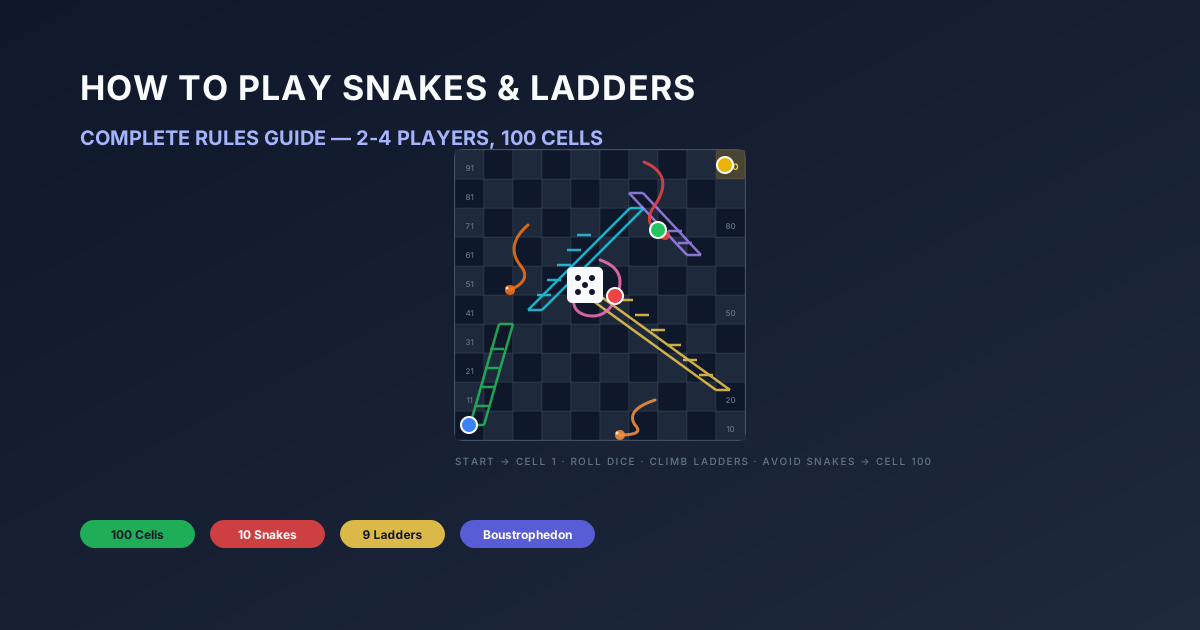
The Snakes & Ladders board is a 10x10 grid with 100 squares numbered from bottom-left to top-right in a boustrophedon pattern. "Boustrophedon" comes from ancient Greek meaning "ox-turning" — the direction alternates every row. Row 1 (bottom) runs left to right (1-10), row 2 runs right to left (11-20), row 3 runs left to right (21-30), and so on. This creates the visual snake-like path that gives the game its partial name.
Our Snakes & Ladders board is rendered as a clean SVG with rathians (snake heads) and ladder rails clearly visible. Each snake has a distinctive color and the ladders are marked with traditional rung patterns.
How to Play — Step by Step
Setup
Choose 2, 3, or 4 players. In single-player mode, you play against AI opponents. Each player places their token at square 0 (off the board). Player 1 goes first.
Gameplay
- Roll the die — click to roll a 6-sided die (1-6).
- Move your token — advance your token by the number rolled. If your token is off the board, a roll of 1 moves you to square 1, 2 to square 2, etc.
- Check for ladder or snake — if you land on a square with a ladder base, climb to the ladder top. If you land on a snake head, slide down to the snake tail.
- Exact roll to win — to reach square 100, you must roll the exact number needed. If you roll more than needed, your token bounces back (overshoot rule). For example, if you're on square 98 and roll a 5, you move to 99, 100, then bounce back 3 to 97.
Winning
First player to land exactly on square 100 wins. The game ends immediately when one player reaches the finish. There's no tiebreaker — first to arrive wins outright.
This site’s board is not one printed layout
Many household sets print the same snakes and ladders every time. Fun AI Games does not. Each match draws 9 ladders and 10 snakes from a larger pool, so the list below is a typical printed set you may know from other boards — not a promise of tonight’s coordinates. You cannot memorize square 99. That is the point of the digital version: luck stays luck, and nobody wins by having the poster on the wall.
All Snakes and Ladders Positions
Ladders (climb up):
- Square 2 → 38
- Square 7 → 14
- Square 8 → 31
- Square 15 → 26
- Square 21 → 42
- Square 28 → 84
- Square 36 → 44
- Square 51 → 67
- Square 71 → 91
Snakes (slide down):
- Square 16 → 6
- Square 46 → 25
- Square 49 → 11
- Square 62 → 19
- Square 64 → 60
- Square 74 → 53
- Square 89 → 68
- Square 92 → 88
- Square 95 → 75
- Square 99 → 80
House rules people bring from other sets
Table versions disagree. Some require a 6 to enter the board; ours starts tokens with any roll from square 0. Some grant an extra roll on 6; ours does not — a 6 is just six steps. Some bounce back past 100; we do. Some skip bounce-back and demand an exact roll while staying put; that variant is slower. If you play with people who learned a different living-room rule, agree before the first roll. The online engine will not pause for a house-rule argument.
Chutes and Ladders is the same race with different art. Indian moksha patam used the snakes as moral lessons. None of that changes the click: roll, move, climb or slide. Do not invent “strategy” by hovering over squares — there is no choice of token and no alternate route.
Why Snakes & Ladders Has No Strategy
This is important: Snakes & Ladders is a game of pure chance. There are zero decisions to make — no choice of which token to move (you only have one), no alternative routes, no tactical options. Every move is determined entirely by the dice. That is why it sits next to Chess on this site instead of replacing it: mixed groups can finish a game without studying theory. Anyone in the room can win on a given race. If you want decisions, open Checkers or Chess after this one.
What it still teaches is patience with variance: a slide from the last rows is allowed by the rules, not a personal failure. Counting the remaining squares to 100 is useful so you understand bounce-back, not so you can “play around” a snake.
2-Player vs 3-Player vs 4-Player
The game length scales with player count. A 2-player game takes about 5-8 minutes. A 3-player game takes 8-12 minutes. A 4-player game takes 10-15 minutes. More players means more chances for someone to get lucky and win, but also more waiting between turns. Our AI opponents play instantly, so the wait is minimal even with 4 players.
Frequently Asked Questions
Can I play Snakes & Ladders with friends?
Our version supports playing with AI opponents. For real multiplayer, try our online multiplayer games.
Is there a strategy to win at Snakes & Ladders?
No. Every move is determined by the dice. The game is designed to be purely luck-based. That's the point — it's a game where a 4-year-old can beat an adult on any given day. If you want strategy, try Chess or Checkers.
How long does a game take?
5-15 minutes depending on player count. The game can end quickly if someone gets lucky with ladders, or stretch out if the dice keep landing on snakes.
What's the most painful snake?
Square 99 → 80. Being one square away from victory and sliding 19 squares back is the classic Snakes & Ladders heartbreak moment. Square 49 → 11 is also brutal (38 squares lost).
Summary and Key Takeaways
- Pure luck-based race game — no strategy, no decisions.
- 100 squares in boustrophedon numbering (alternating direction each row).
- 9 ladders advance you, 10 snakes set you back.
- Exact roll required to reach square 100 (bounce-back overshoot rule).
- 2-4 players, 5-15 minute games.
- Perfect for a mixed-skill table that wants a race, not a lesson.
Play Snakes & Ladders — Free, No Login
Ready to test your luck? Play with 2, 3, or 4 players against AI opponents. Clean board, instant play.
Play Snakes & Ladders