How to Play Checkers Online: Complete Beginner's Guide

Discuss this article with your favorite AI assistant
Direct Answer: Checkers (also called English Draughts) is a two-player strategy game played on an 8x8 board with 12 pieces per player. Red moves first. Pieces move diagonally forward one square. To capture an opponent's piece, you jump over it diagonally into an empty square behind it. Captures are forced — if you can capture, you must. Multiple captures (chains) are possible in a single turn. When a piece reaches the opponent's back row, it becomes a King and can move diagonally in any direction. The first player to capture all opponent pieces or block them from moving wins. On FunAIGames, you can play with forced captures enabled or disabled.
The Board and Setup
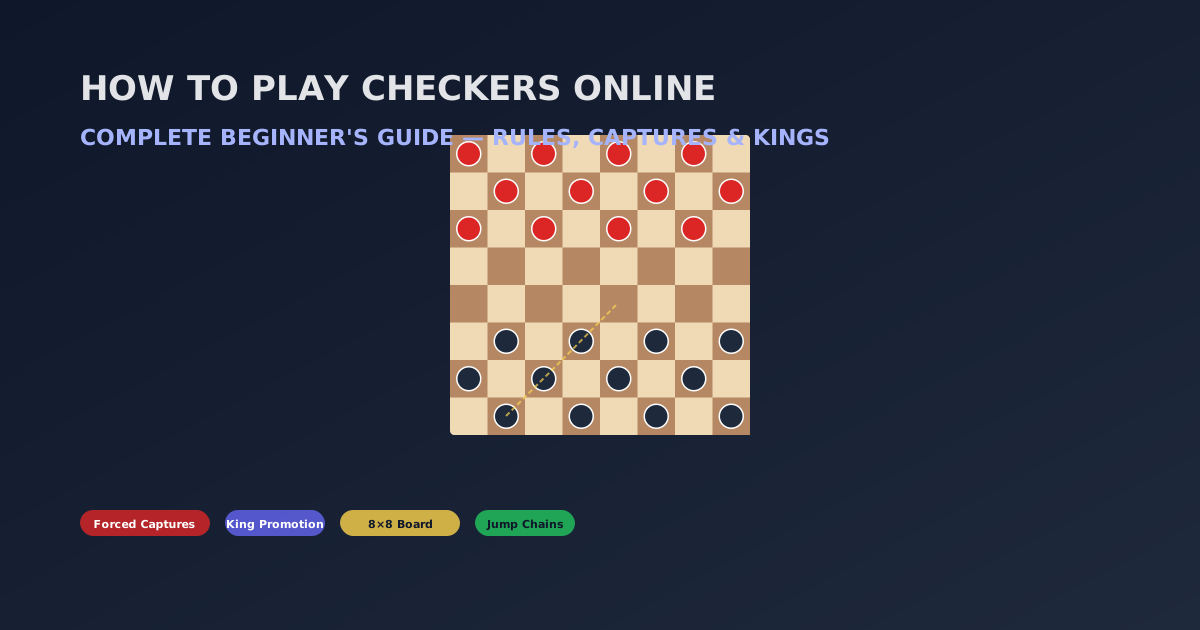
The checkers board is an 8x8 grid with alternating light and dark squares. Each player has 12 pieces placed on the dark squares of the first three rows. Red occupies rows 1-3 (top of the board), black occupies rows 6-8 (bottom). The dark squares are the only squares used in play — light squares are never occupied. This means all movement happens diagonally on 32 of the 64 squares.
Play on our online Checkers board — a clean, responsive SVG board with pieces that highlight valid moves.
How to Play — Step by Step
Step 1: Movement
On your turn, choose one of your pieces and move it diagonally forward (toward the opponent's side) to an adjacent empty dark square. Pieces can only move forward — they cannot move backward unless they are Kings.
Step 2: Capturing (Jumping)
If an opponent's piece is on a diagonal square adjacent to your piece and the square beyond it is empty, you must jump over the opponent's piece to capture it. The captured piece is removed from the board. This is called a "jump."
Step 3: Forced Captures (Mandatory)
In standard checkers rules, captures are mandatory. If you can make a capture, you must — you cannot choose to make a non-capturing move instead. This is critical because it means you cannot purposefully avoid a bad trade. The FunAIGames Checkers has a toggle for forced captures — turn it on for tournament rules or off for casual play.
Step 4: Multiple Captures (Chains)
If, after making a capture, your piece lands on a square where it can make another capture, you must continue jumping. A single turn can involve multiple consecutive captures. The chain ends when no more captures are possible. You can adjust your direction after each jump — including turning mid-chain.
Step 5: King Promotion
When a piece reaches the opponent's back row (row 8 for red, row 1 for black), it becomes a King. Kings can move and capture diagonally in any direction (forward and backward). This makes Kings significantly more powerful — they can attack from both directions and control more of the board. A King is crowned immediately upon reaching the back row and can continue its turn as a King (including making additional captures in any direction).
Step 6: Winning
You win by either: (1) capturing all 12 of your opponent's pieces, or (2) leaving your opponent with no legal moves — all their pieces are either captured or blocked. The game is a draw if neither player can force a win (known as a "stalemate" in checkers, which happens when both players have kings and neither can break through).
Easy vs Medium vs Impossible
Easy leaves hanging jumps and slow king hunts — use it to learn forced captures without getting farmed. Medium starts to chain. Impossible searches further and will take every gift. Climb only after you win three Easy games in a row with forced captures on. Difficulty is not the same as the forced-capture toggle: you can play Impossible with optional jumps, but then you are not practicing the rules the openings articles assume.
Key Rules Summary
- Movement: One square diagonally forward. Only on dark squares.
- Capture: Jump over an adjacent opponent piece into an empty square beyond. The captured piece is removed.
- Forced capture: If you can capture, you must. No optional captures.
- Multiple jumps: After a capture, if another capture is available from the landing square, you must continue.
- King promotion: Reaching the opponent's back row makes your piece a King (moves any direction).
- Crowning: A piece that promotes can continue capturing in the same turn (any direction).
- Win: Capture all opponent pieces or block all their moves.
Your first three games vs the AI
Game one: leave forced captures on so the rules match what books and our openings post assume. Play Easy. Goal: do not leave a double jump. If a piece can be taken, assume it will be taken.
Game two: still Easy. Goal: keep at least two men on your back row until the midgame so the AI cannot king for free. Spreading the front row is how you avoid a single chain wiping four pieces.
Game three: if you won both, try Medium. Goal: offer a capture that pulls an enemy man onto a square where you recapture. That is the basic forced-exchange idea. If you lost both, stay on Easy and read the center-control openings guide after the match, not during it.
Common Beginner Mistakes
- Stacking pieces: Keeping all your pieces in the back rows leaves you vulnerable. A chain capture can take 3-4 pieces. Spread out.
- Ignoring forced captures: Forgetting that your opponent is forced to capture if you create an opportunity. Set up forced captures that leave them in bad positions.
- Underestimating kings: A single king can control multiple diagonals. If your opponent gets a king while you have none, you're at a significant disadvantage.
- Abandoning the back row: Keep your back row intact as long as possible. It prevents your opponent from getting kings — they need to reach your back row to promote.
Frequently Asked Questions
Is checkers harder than chess?
Checkers has a simpler ruleset but is still strategically deep. The game was "solved" in 2007 — perfect play leads to a draw. In practice, human players make mistakes, and checkers is a challenging tactical game. Chess has more pieces, more moves, and a much larger game tree, making it objectively more complex.
Can I play checkers with forced captures turned off?
Turn it off only if everyone at the table agrees they want optional jumps. It is not a “beginner mode” that changes the AI strength — it changes the rules. For a first online session, leave it on so the engine’s highlights match tournament checkers.
What's the best first move in checkers?
The most common opening moves involve advancing your center pieces (the pieces at rows 3-4 on the board). Avoid advancing your edge pieces early — they can be trapped. For detailed opening strategy, see our Checkers Openings Guide.
How many pieces does checkers have?
Each player starts with 12 pieces. 24 total on the board. After captures, the game becomes a battle of attrition where material advantage (having more pieces) is usually decisive.
Summary and Key Takeaways
- 8x8 board, 12 pieces per player. Red moves first.
- Move diagonally forward one square. Jump over opponent pieces to capture.
- Captures are forced — if you can capture, you must.
- Multiple captures in one turn are possible (chain jumps).
- Reach the back row to promote to King (moves any direction).
- Win by capturing all pieces or blocking all moves.
- Keep your back row intact to prevent opponent kings. Spread your pieces to avoid chain captures.
Play Checkers — Free, No Login
Practice your new skills against AI opponents at three difficulty levels. Toggle forced captures on or off.
Play CheckersDeepen your game with Checkers Openings, Forced Captures, and Checkers Endgame.