5 Chess Endgame Patterns Every Player Should Know

Discuss this article with your favorite AI assistant
Direct Answer: Five chess endgame patterns account for 90% of practical endgames: (1) King and pawn vs king — the most common endgame, decided by who controls the key square in front of the pawn. (2) Opposition — the fundamental king vs king maneuver that determines whether you promote or draw. (3) Rook endgames: Lucena and Philidor — the two most famous rook endgame positions, one winning and one drawing. (4) Bishop vs knight endgames — knowing when the bishop dominates the knight and vice versa. (5) Basic checkmates — how to checkmate with king + queen, king + rook, and king + two bishops. Mastering these five patterns turns endgames from guesswork into calculation.
Pattern 1: King and Pawn vs King
This is the most common endgame in chess. One player has a king and a pawn; the other has only a king. The result depends entirely on whether the pawn can promote before the defending king captures or blocks it.
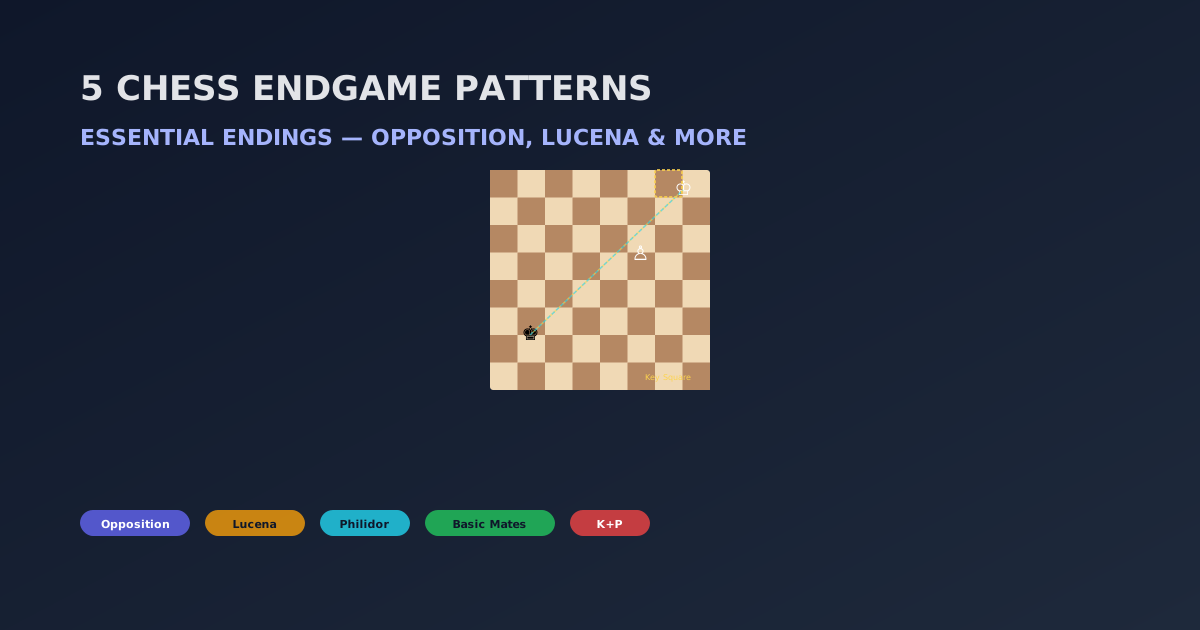
The Square Rule: Draw an imaginary diagonal line from the pawn to the 8th rank. If the defending king can enter this "square" before the pawn reaches the promotion square, the game is a draw. If the pawn is outside the king's reach, it promotes and wins.
Key square control: The attacking king must occupy the key square (the square two ranks ahead of the pawn on the same file, or the squares adjacent to it) to force promotion. If the defending king controls the key square, the game is a draw.
Practice this against Chess Easy AI — set up the position and see if you can promote.
Pattern 2: Opposition
Opposition is the most important king maneuver in endgames. When two kings face each other on the same file or diagonal with an odd number of squares between them, the player who didn't make the last move has the opposition.
Why it matters: Having the opposition means you can force the opponent's king to move sideways, giving you access to key squares. In king + pawn vs king endgames, the player with the opposition can promote the pawn; the player without it must settle for a draw.
How to take the opposition: Place your king so that the opponent's king must move. If they're on e5 and you're on e3 (one square apart on the same file), it's their turn — you have the opposition. In endgames, always ask: "Do I have the opposition?" If yes, you dictate the pace. If no, find a way to take it.
Pattern 3: Rook Endgames — Lucena and Philidor
Rook endgames are the most common endgame type at higher levels. Two positions every chess player must know:
Lucena Position (Winning for the attacker)
The Lucena position occurs when the attacking king is on the promotion square with a pawn on the 7th rank, protected by a rook. The defending king is cut off from the action. The winning technique: "build a bridge" — move your rook out to block checks from the defending rook, then march your king out of the corner.
The key insight: the Lucena is always winning if you know the bridge technique. Without it, you'll shuffle your king forever and potentially lose.
Philidor Position (Drawing for the defender)
The Philidor position is the defender's counterpart. When the defending king is in front of the pawn and your rook is on the 3rd rank, the game is a draw regardless of who moves. The defending rook checks the attacking king from the back, and the king stays in front of the pawn.
Knowing the difference between Lucena (win) and Philidor (draw) is the single highest-ROI endgame study you can do — it comes up in 1 in every 5 rook endgames.
Pattern 4: Bishop vs Knight Endgames
In endgames, the bishop and knight each have advantages depending on the position.
- Bishop advantage: Open positions with pawns on both sides of the board. The bishop's long-range diagonals dominate. Also strong when the opponent's pawns are on the same color as the bishop (they block the bishop's movement, which sounds bad — but it actually gives the bishop targets and restricts the opposing king).
- Knight advantage: Closed positions with pawns on one side of the board. The knight's ability to jump over pieces and change colors makes it superior when pawns block the bishop's diagonals.
The general rule: bishops are better open, knights are better closed. In endgames with equal material, a bishop pair is significantly stronger than a knight + bishop.
Pattern 5: Basic Checkmates
Every chess player should know these four basic checkmates without thinking:
- King + Queen vs King: The simplest mate. Use your queen to confine the enemy king to the edge or corner, then bring your king close for support. Avoid stalemate by leaving the king one escape square.
- King + Rook vs King: More delicate than queen. Use your rook to cut the board in half, then shrink the box one rank/file at a time. Bring your king in to support. The "box technique" always works.
- King + Two Bishops vs King: Requires precision. The bishops work together to control squares of both colors. Push the king to the corner using your bishops to control diagonals and your king to block escapes.
- King + Bishop + Knight vs King: The hardest basic mate (50 moves maximum). Requires a specific pattern — push the king to the corner of the same color as your bishop. Very few players know this pattern; most settle for the 50-move draw.
How to Practice Endgames
The best way to learn endgames is to practice specific positions against AI:
- Set up a king + pawn vs king position and try to promote against the Easy AI
- Set up a queen vs king position and practice checkmating under 10 moves
- Set up a rook endgame and try to force the Lucena or Philidor depending on your side
- Progress to Medium AI once you can consistently win each position
The Hard AI plays near-perfect endgames. When you can draw or win endgames against Hard AI, you're ready for tournament-level play.
Frequently Asked Questions
How long does it take to learn endgames?
The five patterns in this guide cover 90% of practical endgame situations. With 30 minutes of focused practice per day, you can master them in 2-3 weeks. The basic checkmates can be learned in a single session.
What's the most important endgame for beginners?
King and pawn vs king with opposition. It comes up in almost every game (most games simplify to this), and understanding it teaches the fundamental endgame concept of "key squares" that applies to all other endgames.
Why do I keep losing winning endgames?
Three common reasons: (1) You don't know the checkmating pattern (especially with rook alone). (2) You advance your pawn too early and the defending king catches it. (3) You move your king to the wrong square and lose the opposition. Study the Lucena and Philidor — those two positions alone will save you dozens of half-points.
Summary and Key Takeaways
- Five essential patterns: K+P vs K, Opposition, Lucena/Philidor, Bishop vs Knight, Basic Mates.
- King + pawn vs king: use the Square Rule and control the key square.
- Opposition: the fundamental king maneuver — whoever has it forces the pace.
- Lucena is winning (bridge technique), Philidor is drawing (rook on 3rd rank).
- Bishops are better open; knights are better closed.
- Practice basic checkmates until they're automatic — K+Q, K+R, K+BB, K+B+N.
Practice Your Endgames
Set up endgame positions against our Chess AI. Start with K+P vs K on Easy, then work your way up to rook endgames against Hard.
Play ChessMaster the opening with Chess Opening Principles and 5 Chess Traps.