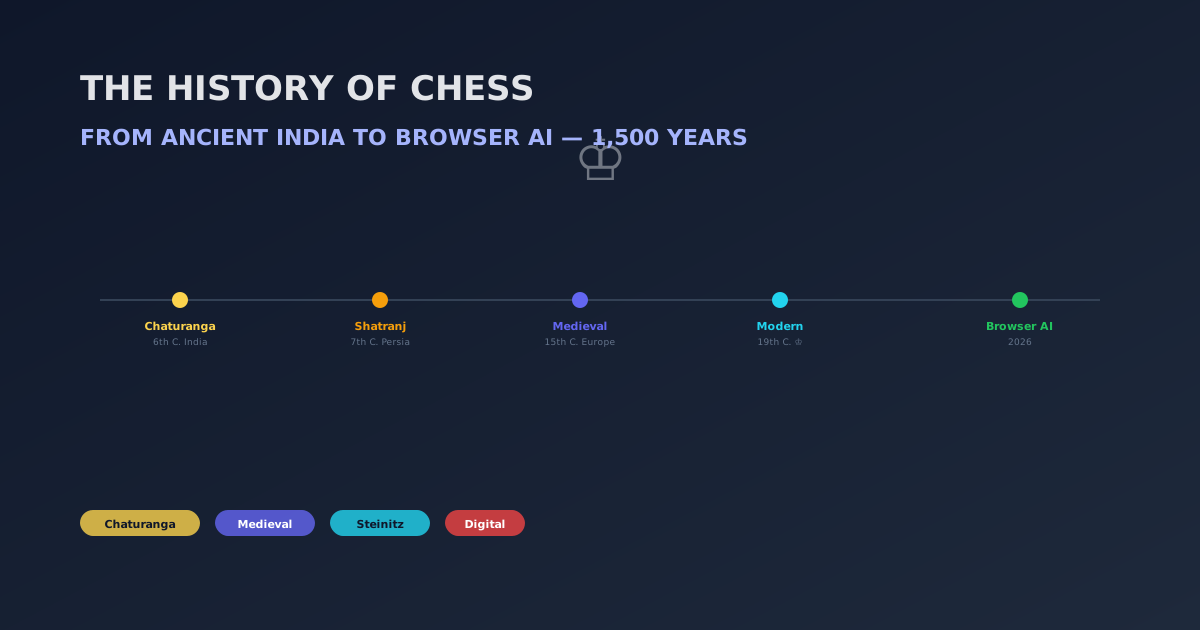
The History of Chess: From Ancient India to Browser AI

Discuss this article with your favorite AI assistant
Direct Answer: Chess originated in India around the 6th century AD as Chaturanga — a four-player war game simulating the four divisions of the Indian army: infantry, cavalry, elephants, and chariots. It spread to Persia (becoming Shatranj), then to the Islamic world, and finally to medieval Europe where it evolved into the game we know today. The modern rules were standardized in the 19th century, and the first official World Chess Championship was held in 1886. Today, chess is played by over 600 million people worldwide, has been solved by computers (Deep Blue defeated Kasparov in 1997), and is now available as a free browser game with AI opponents that play at grandmaster level on demand.
Chapter 1: Chaturanga — The Birth of Chess in India (6th Century)
The earliest known predecessor of chess was Chaturanga, which flourished in the Indian subcontinent around the 6th century AD. The name means "four divisions of the military" — infantry, cavalry, elephants, and chariots, which correspond to the modern pawn, knight, bishop, and rook. Chaturanga was a game of strategy played on an 8x8 board called an ashtapada.
The key innovation of Chaturanga over earlier board games was that different pieces had different movement capabilities. This was revolutionary — before Chaturanga, most board games (like Senet in Egypt or Go in China) used identical pieces with identical movement rules. The idea that a piece could have a unique "role" on the board was the conceptual breakthrough that led to modern chess.
Chapter 2: Shatranj — Chess Travels to Persia (7th-9th Centuries)
Chaturanga spread to the Sassanid Persian Empire through trade routes, where it became Shatranj. The Persians introduced two key innovations: (1) saying "Check" — from the Persian shah (king), literally "attack the king" and (2) "Checkmate" — from shah mat, "the king is dead." The Persians also wrote the first known chess treatise — a manuscript by the scholar Jabir ibn Hayyan describing strategy and problems.
After the Islamic conquest of Persia in the 7th century, chess spread across the Islamic world. Islamic scholars studied chess deeply, writing hundreds of manuscripts on chess problems, endgame studies, and opening theory. The game was particularly popular in the Abbasid Caliphate (Baghdad), where caliphs sponsored chess tournaments among the court's best players.
Chapter 3: Medieval Europe — The Transformation (11th-15th Centuries)
Chess reached Europe through two routes: Islamic Spain (Al-Andalus) and the Byzantine Empire. By the 11th century, chess was firmly established in European courts, where it underwent its most dramatic transformation.
The two most important rule changes happened in 15th century Europe:
- The Queen became the most powerful piece: Originally the ferz (advisor), which could only move one square diagonally, the queen was transformed to move any number of squares in any direction. This made chess faster and more exciting, earning it the name Regina (Queen's chess) in Italy.
- The Bishop gained range: Originally the elephant, which could jump two squares diagonally (like a knight restricted to diagonal), was extended to move any number of squares diagonally.
These changes created "modern chess" — a game of speed, tactics, and combination rather than the slow, positional game of the Middle Ages. The new rules spread across Europe within decades, faster than any previous chess innovation.
Chapter 4: The Romantic Era and Standardization (18th-19th Centuries)
The 18th and 19th centuries were the "Romantic Era" of chess, when attacking play and brilliant sacrifices were prized above all else. The most famous game of this era, the "Immortal Game" (Anderssen vs Kieseritzky, 1851), features a legendary queen sacrifice and checkmate in 23 moves.
Key milestones:
- 1849: The Staunton chess set (the modern standard design) was patented. Its functional, non-ornate design became the tournament standard and remains the default chess piece style worldwide.
- 1851: The first international chess tournament was held in London. Howard Staunton organized it, and Adolf Anderssen won.
- 1886: The first official World Chess Championship match: Wilhelm Steinitz vs Johannes Zukertort. Steinitz won, becoming the first world champion and later the "father of modern chess" for his positional theories.
- 1857-1894: Paul Morphy (American, 1857-1859 dominant run) and Wilhelm Steinitz (first world champion, 1886-1894) established the foundations of modern chess strategy: center control, pawn structure, piece activity.
Chapter 5: The Modern Era and the Soviet School (20th Century)
The 20th century was dominated by the Soviet chess school, which treated chess as a science to be systematically studied. The Soviet government funded chess training from a young age, producing a line of world champions that included Mikhail Botvinnik, Mikhail Tal, Tigran Petrosian, Boris Spassky, Anatoly Karpov, and Garry Kasparov.
The 1972 World Chess Championship match between Bobby Fischer (USA) and Boris Spassky (USSR) — the "Match of the Century" — was the peak of Cold War chess. Fischer's victory broke the Soviet monopoly and sparked a chess boom in the West that lasted years.
Chapter 6: The Digital Age — Deep Blue to Browser AI (1997-Present)
On May 11, 1997, IBM's Deep Blue defeated world champion Garry Kasparov in a six-game match — the first time a computer had defeated a world champion under tournament conditions. This was a watershed moment not just for chess but for artificial intelligence.
Since then, chess engines have advanced exponentially. Stockfish (the current strongest engine) operates at a rating of ~3600, far above the human peak of ~2850. But the most important development for everyday players has been the availability of AI opponents in browser-based chess games.
Today, anyone can play chess against AI at any difficulty level — from beginner-friendly Easy AI that makes occasional mistakes to Hard AI that plays at master level. The AI on FunAIGames Chess uses minimax search with alpha-beta pruning and piece-square tables, bringing 1,500 years of chess evolution into your browser with zero downloads or login required.
Frequently Asked Questions
Who invented chess?
No single person invented chess. It evolved over centuries, originating in India as Chaturanga around the 6th century AD. The game was refined by Persians, Arabs, and Europeans over 1,000+ years. The modern rules were finalized in 15th century Europe with the introduction of the powerful queen and the extended bishop.
Is chess a solved game?
No. Chess has approximately 10^123 possible games (the Shannon number), making it computationally infeasible to "solve" in the way that Connect Four or checkers have been solved. Engines like Stockfish are vastly stronger than humans but cannot play perfectly — they approximate optimal play through search and evaluation. The game remains open for human creativity and discovery.
What was the most famous chess game ever played?
The most famous is the "Immortal Game" (Anderssen vs Kieseritzky, 1851), a 23-move masterpiece featuring multiple queen sacrifices. In the modern era, Game 6 of the 1972 Fischer vs Spassky match (Fischer's queen sacrifice) is widely considered the most important game ever played — it changed the course of world chess.
How strong is FunAIGames chess AI compared to historical players?
The Hard AI plays at approximately club level (~1800-2000 Elo). It's stronger than Romantic-era players like Anderssen (whose attacking style would founder on modern defensive calculation) but weaker than modern grandmasters. The Medium AI (~1400-1600) is comparable to a strong club player. The Easy AI (~800-1000) is perfect for beginners.
Summary and Key Takeaways
- Chess originated in India as Chaturanga (6th century AD) — the first game with specialized piece movements.
- Persians introduced "check" and "checkmate"; the Islamic world preserved and studied chess during Europe's Dark Ages.
- 15th century Europe transformed chess by giving the queen unlimited movement — creating the modern game.
- The Romantic Era (18th-19th centuries) prized attacking brilliance; Wilhelm Steinitz founded modern positional chess.
- Deep Blue defeating Kasparov (1997) was a watershed moment for AI and chess.
- Today, browser-based chess AI makes the 1,500-year-old game accessible to anyone, at any skill level.
Play Chess — 1,500 Years of History in Your Browser
From Chaturanga to browser AI — chess has never been more accessible. Play free, no login, three difficulty levels.
Play ChessLearn the game with How to Play Chess and master traps with 5 Chess Traps.