How to Play Chess: Complete Beginner's Guide to Rules & Strategy

Discuss this article with your favorite AI assistant
Direct Answer: Chess is played on an 8×8 board with 16 pieces per side. Each piece type moves differently: pawns forward one (two on first move, capturing diagonally), knights in an L-shape (jumping over pieces), bishops diagonally, rooks in straight lines, the queen any direction (straight or diagonal), and the king one square any direction. The goal is to checkmate the opponent's king — trap it so it cannot escape capture. Special rules include castling, en passant, and pawn promotion. To win consistently against AI, follow three core principles: control the center, develop all your pieces before attacking, and castle your king to safety.
Chess Basics: The Board and Setup
Chess is a two-player strategy board game played on an 8x8 grid of 64 squares, alternately colored light and dark. Each player starts with 16 pieces: one king, one queen, two rooks, two bishops, two knights, and eight pawns. The board is set up so that each player has a light square on their bottom right corner.
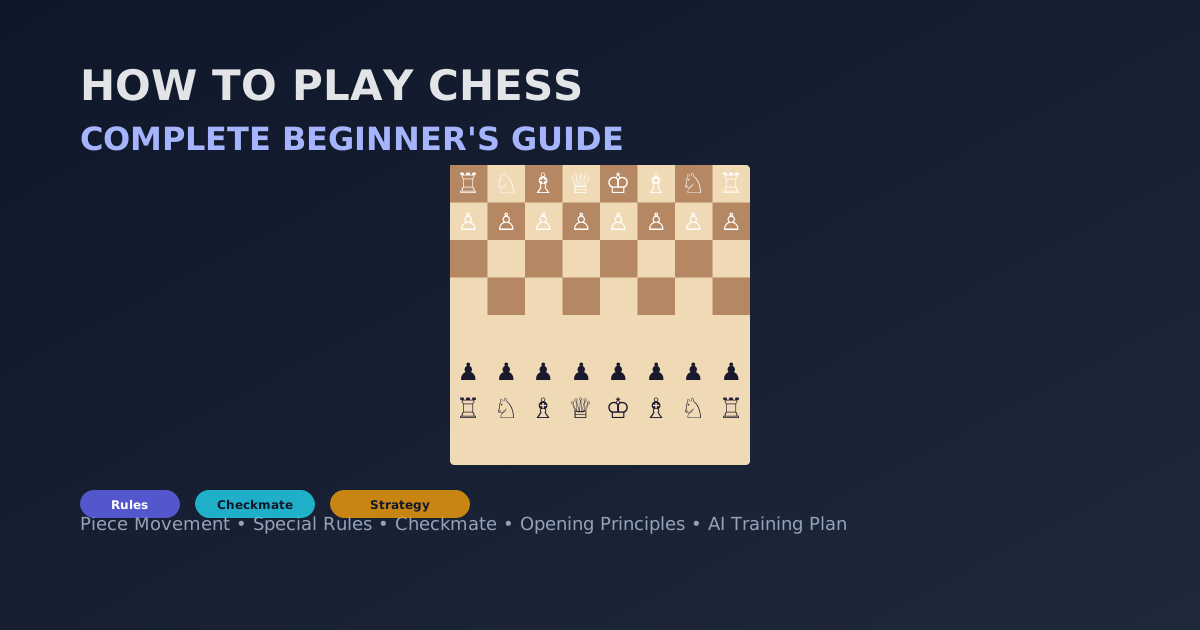
Starting position notation: White pieces occupy ranks 1 and 2 (bottom), Black pieces occupy ranks 7 and 8 (top). From left to right on the back rank: rook, knight, bishop, queen, king, bishop, knight, rook. The queen always starts on her own color — white queen on a light square (d1), black queen on a dark square (d8).
Play Chess Online to practice — the AI handles all rules, so you can focus on learning.
How Each Piece Moves
The Pawn ♙♟
Pawns are your foot soldiers. They move forward one square, but capture diagonally. On their very first move only, a pawn can advance two squares forward. Pawns cannot move backward or sideways. If a pawn reaches the opposite end of the board (rank 8 for white, rank 1 for black), it promotes — you exchange it for any piece except a king (almost always a queen). This is why pawns are the most strategically important pieces in the endgame.
The Knight ♘♞
Knights move in an L-shape: two squares in one direction, then one square perpendicular. Knights are the only pieces that can jump over other pieces. This makes them excellent for creating forks — attacking two pieces at once. A knight in the center controls up to 8 squares. A knight on the edge controls only 4. On the corner, only 2.
The Bishop ♗♝
Bishops move diagonally any number of squares. Each bishop stays on its starting color for the entire game — one bishop moves only on light squares, the other only on dark squares. This is why bishops are pair-dependent: a pair of bishops working together control both colors, but a single bishop controls only half the board. Bishops excel in open positions where diagonals are clear.
The Rook ♖♜
Rooks move horizontally or vertically any number of squares. They are most powerful on open files (columns with no pawns). Rooks are worth 5 points (compared to 3 for a bishop or knight) because they control entire ranks and files. Two rooks on the 7th rank can deliver checkmate by themselves — one of the most devastating attacking patterns in chess.
The Queen ♕♛
The queen combines the power of a rook and a bishop — she moves any number of squares in any direction (straight or diagonal). Worth 9 points, the queen is the most powerful piece on the board. However, beginners should avoid bringing the queen out too early. An early queen can be attacked by developing your opponent's pieces, forcing you to waste moves retreating while they build their position for free.
The King ♔♚
The king moves one square in any direction. The king can never move into check (a square attacked by an opponent's piece). If your king is in check (under attack), you must get out of check immediately — by moving the king, blocking the attack, or capturing the attacking piece. If you cannot escape check, it's checkmate and the game ends. The king is also involved in castling (see special rules).
How to Win: Checkmate Patterns
Checkmate occurs when the opponent's king is in check and cannot escape. Here are the most common checkmate patterns every beginner should know:
- Scholar's Mate (4-move checkmate): White attacks f7 with queen and bishop. Black's weakest square is f7 (only defended by the king). Qh5 and Bc4, targeting f7. If Black doesn't defend, Qxf7# is checkmate.
- Back Rank Mate: A king trapped behind its own pawns is mated by a rook or queen on the back rank. Always create an "escape square" for your king by moving one of your pawns.
- Two Rook Mate: Two rooks working together can force checkmate by alternating checks along adjacent ranks. One rook checks, the other restricts the king's escape. This is the easiest checkmate to learn.
- Queen and King Mate: The queen alone cannot checkmate — she needs the king's help. Place your queen a knight-move away from the opponent's king, then bring your king closer to support.
Practice these checkmate patterns against the Chess AI at Easy difficulty until they become automatic.
Special Rules You Must Know
Castling
Castling is the only move where you move two pieces at once — your king and a rook. The king moves two squares toward the rook, and the rook jumps over the king to the square next to it. Castling gets your king to safety and activates your rook. You cannot castle if: the king or rook has already moved, the king is in check, the king would pass through check, or any piece is between the king and rook.
- King-side castling (0-0): King moves e1→g1, rook moves h1→f1. Takes only 2 moves to set up and is the most common.
- Queen-side castling (0-0-0): King moves e1→c1, rook moves a1→d1. Takes longer but can be more aggressive.
En Passant (French: "in passing")
If your opponent moves a pawn two squares forward and lands next to one of your pawns, you can capture it as if it had moved only one square. You must make this capture immediately — the opportunity expires after your next move. En passant exists to prevent pawns from bypassing enemy pawns by using the two-square advance.
Pawn Promotion
When a pawn reaches the opposite end of the board, it must be promoted — you replace it with a queen, rook, bishop, or knight of your color. Choose a queen in 99% of cases (underpromotion to a knight is occasionally useful to deliver checkmate or avoid stalemate).
Point Values and Material
Chess pieces have standard point values. These help you evaluate trades — if you trade your bishop (3 points) for your opponent's rook (5 points), you gain a 2-point advantage:
- Pawn: 1 point
- Knight: 3 points
- Bishop: 3 points
- Rook: 5 points
- Queen: 9 points
- King: priceless (losing it loses the game)
A "material advantage" of +3 points (a knight or bishop up) is usually enough to win, provided you convert correctly. A +1 advantage (one pawn up) is a smaller edge that requires good technique to convert, especially in the endgame.
The Three Phases of a Chess Game
Every chess game progresses through three phases:
- Opening (Moves 1-10): Develop your pieces, control the center, castle your king. Don't move the same piece twice unless forced. Don't bring your queen out early. See: 7 Opening Rules for Beginners
- Middlegame (Moves 10-30): Attack weaknesses, execute tactics (forks, pins, skewers), improve piece activity. Look for checkmate patterns. The middlegame rewards calculation and pattern recognition.
- Endgame (Moves 30+): Convert your advantage. Activate your king — in the endgame, the king becomes a fighting piece. Push passed pawns. Trade pieces to simplify winning positions, not losing ones.
Each phase requires different thinking. Beginners should focus on the opening first: if you reach move 10 with a good position, the rest becomes significantly easier. Our opening principles guide covers this in detail.
5-Step Training Plan to Beat the Chess AI
This progressive training plan takes you from complete beginner to beating the Chess AI at every difficulty level:
Step 1: Learn Piece Movement (Easy AI, 5 games)
Play 5 games against Easy AI with no time limit. Your only goal: make legal moves. Don't worry about winning. Focus on moving each piece type at least once per game. If you're unsure about a move, try it — the AI will show you the consequences.
Step 2: Learn Scholar's Mate Defense (Easy AI, 10 games)
Easy AI often attempts Scholar's Mate. Learn the defense: move your e-pawn forward (e5), then develop your knight to f6 to defend f7. Practice this until you can counter Scholar's Mate without thinking. Then use the same pattern aggressively — the AI will fall for it.
Step 3: Practice Opening Principles (Medium AI, 10 games)
For each game, write down your first 5 moves before playing them. Check: Did you control the center? Did you develop a new piece each move? Did you castle by move 8? The Medium AI punishes poor openings, so this is where solid opening habits develop. Review the 7 opening rules before each game.
Step 4: Learn Basic Tactics (Medium AI, 15 games)
Learn the four essential tactics: forks (one piece attacks two), pins (a piece cannot move without exposing a more valuable piece behind it), skewers (a valuable piece is attacked and must move, exposing a less valuable piece behind it), and discovered attacks (moving one piece reveals an attack from another). Practice each tactic type for 3-4 games before combining them.
Step 5: Endgame Conversion (Hard AI, 10 games)
The Hard AI defends tenaciously but often reaches slightly worse endgames. Practice converting a +1 or +2 material advantage into a win. Learn the king and pawn endgame basics: the opposition, the square rule, and key squares. Our full training plan has detailed techniques for each difficulty.
Common Beginner Mistakes
- Moving the same piece twice in the opening: Each move should develop a new piece or control the center. Moving a piece twice wastes tempo.
- Bringing the queen out early: The queen is a target in the opening. Develop bishops and knights first, then bring out the queen when the position is stable.
- Neglecting king safety: Castle by move 7-8 in most openings. An uncastled king in the middlegame is a magnet for tactics.
- Trading pieces without thinking: Every trade changes the position. Ask: "Does this trade improve my position or my opponent's?"
- Playing too fast: Chess rewards patience. Before every move, check: "Does my opponent have a threat?" This one habit will double your win rate at beginner level.
Frequently Asked Questions
What is the best first move in chess?
The most recommended first move for beginners is 1.e4 (moving the e-pawn two squares forward). It controls the center immediately, opens lines for the queen and bishop, and leads to the most intuitive positions. 1.d4 is equally strong but leads to more closed, positional games. Avoid moving pawns on the edge (a4, h4) as your first move — they control nothing in the center.
How many moves does a chess game typically last?
A typical beginner chess game lasts 20-30 moves. Against the Easy AI on funaigames.com, games average 15-25 moves. Against Medium AI, 30-45 moves. Against Hard AI, 50+ moves. As you improve, games get longer because both players defend better, not because attacks take longer — better defense means you need more moves to break through.
Is chess hard to learn?
Chess is easy to learn but hard to master. You can learn the rules in 15 minutes and play your first game immediately. The AI handles all the rules — try a game right now. Mastering strategy takes years, but reaching a level where you can beat Easy and Medium AI takes only a few weeks of consistent practice.
Can you win chess without losing any pieces?
Yes — this is called a "pure checkmate" or "clean" game. The most famous example is Scholar's Mate (checkmate in 4 moves). Beginners can often win without losing pieces against weaker opponents by executing a quick attack. Against the Easy AI, you can achieve this by following the opening principles and looking for early checkmate patterns.
What is the difference between check, checkmate, and stalemate?
Check means your king is under attack — you must escape immediately. Checkmate means your king is in check and cannot escape — you lose. Stalemate means your king is not in check but you have no legal moves — the game is a draw. Stalemate is a common beginner mistake: when you have a winning position, make sure you don't accidentally stalemate your opponent by leaving them with no legal moves.
How do I get better at chess fast?
The fastest improvement path for beginners: (1) Learn opening principles — control the center, develop pieces, castle early. (2) Practice tactics — do 5-10 puzzles daily focusing on forks and pins. (3) Analyze your losses — after each loss, find the move where you made your biggest mistake. (4) Play against the AI at progressively harder levels — the AI doesn't tire and offers instant feedback on every move. Start with our Free Chess Game.
Summary and Key Takeaways
- Chess is played on an 8x8 board — 16 pieces per side, 6 piece types, one goal: checkmate.
- Pawns move forward 1 (2 on first move), capture diagonally, and promote on the last rank.
- Knights move in an L-shape and can jump over pieces — use them for forks.
- Bishops move diagonally and stay on their starting color — need both to control the full board.
- Rooks move straight — worth 5 points, most powerful on open files.
- Queen moves any direction — worth 9 points, don't bring her out too early.
- King moves one square — castle early for safety.
- Three special rules: castling, en passant, pawn promotion — learn these before your first game.
- Three game phases: opening (moves 1-10), middlegame (10-30), endgame (30+).
- Follow the 5-step training plan: Learn movement → Scholar's Mate defense → Opening principles → Basic tactics → Endgame conversion.
Play Chess Online — No Login, No Download
Practice everything you've learned against our Chess AI. Easy difficulty lets you learn piece movement. Medium teaches you positional play. Hard challenges your tactical accuracy.
Play Chess NowWant to go deeper? Read our Chess Opening Principles Guide and How to Beat Chess AI Training Plan.