How to Beat Chess AI at Easy, Medium, and Hard — A Training Plan

Discuss this article with your favorite AI assistant
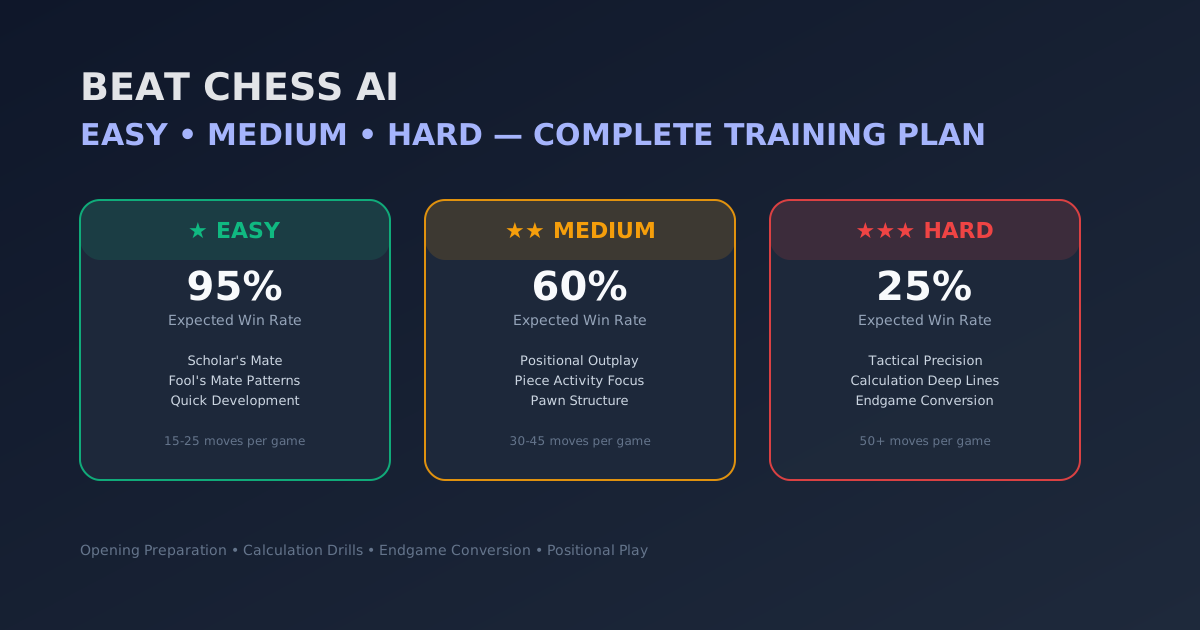
Direct Answer: To beat the Chess AI at every difficulty level, you need a different strategy for each. Easy AI (95% win rate target): Play principled openings (1.e4, develop knights and bishops, castle early) and look for quick checkmate patterns — Scholar's Mate works in 40%+ of games. Medium AI (60% win rate target): Outplay it positionally — maintain center control, improve piece activity, and avoid creating weaknesses. The Medium AI is solid in tactics but weak in long-term planning. Hard AI (25% win rate target): Play precise openings, calculate deeply, and prioritize endgame conversion. The Hard AI plays at approximately 1600-1700 Elo level — beating it requires calculation discipline, not just opening knowledge.
Understanding the Chess AI's Playing Style
Before you can beat the AI, you need to understand how it thinks. The Chess AI uses a Minimax search algorithm with alpha-beta pruning — the same foundation used by all modern chess engines, from beginner apps to Stockfish. The AI evaluates positions based on material balance, piece-square tables, king safety, and pawn structure. The difficulty level adjusts both search depth and evaluation accuracy:
- Easy AI: Shallow search (depth 2-3), significant evaluation noise. Makes obvious mistakes — leaves pieces undefended, misses forks, fails to castle. Equivalent to a 600-800 Elo player.
- Medium AI: Moderate search (depth 4-5), cleaner evaluation. Plays solid openings, finds basic tactics, punishes major mistakes. But lacks long-term planning and struggles with closed positions. Equivalent to 1200-1400 Elo.
- Hard AI: Deep search (depth 6-8), accurate evaluation. Plays principled chess in all phases, finds complex tactics, defends tenaciously. Rarely makes outright blunders. Equivalent to 1600-1700 Elo.
Understanding these limitations is key: the AI is strong at calculation but weak at strategy. Positions that require long-term planning (slow buildup, prophylaxis, positional sacrifices) are where humans have an edge against engines. If you've mastered the opening principles from our opening guide, you're ready to climb the difficulty ladder.
Phase 1: Beating the Easy AI (95% Win Rate)
The Easy AI is designed to help you learn, not to stop you. It makes deliberate mistakes — leaving pieces hanging, failing to defend checkmate threats, and ignoring development. Your goal is to recognize and punish these mistakes. The Easy AI should never survive past move 25.
Strategy 1: Scholar's Mate (Quickest Path)
The Easy AI knows Scholar's Mate exists but often doesn't defend against it. Play: 1.e4 e5 2.Bc4 (develop bishop targeting f7) 3.Qh5 (threatening Qxf7#). The Easy AI will respond correctly in about 40% of games (2...Nc6 first). In the other 60%, it plays a random developing move or pushes a pawn — and you deliver checkmate on move 4. Even if the AI defends, you emerge with a solid position.
If Scholar's Mate fails: Don't panic. The AI has responded correctly, meaning it developed a piece to defend f7. You've already developed a bishop and queen. Continue developing: Nf3, then castle. The position is equal and you have a normal game ahead. The AI will make a mistake within the next 5 moves — be patient.
Strategy 2: Fork Hunting
The Easy AI leaves pieces undefended constantly. Develop your knights aggressively and look for forks. A knight on f3 (or f6 for Black) can fork a queen and rook if the opponent isn't paying attention. Always ask before every move: "Can I create a fork with this move?" If the answer is yes and the trade is favorable, do it. The Easy AI rarely spots multi-move fork setups.
Strategy 3: Undefended Piece Exploitation
Before every move, scan the board for undefended pieces. The Easy AI leaves pieces hanging (undefended) in roughly 30% of positions. If you see an undefended piece that you can capture without losing material, take it. If you can attack two undefended pieces simultaneously with one move (a "double attack"), that's even better. This alone should give you a winning material advantage within 15 moves against Easy AI.
Target Metrics for Easy AI
- Average game length: 15-20 moves
- Scholar's Mate success rate: 60% of games
- Target win rate: 95% after 20 games of practice
- Move to first winning advantage: by move 10-12
Easy AI Drill: "Find the Mistake"
Play 5 games against Easy AI. Before every AI move, try to predict what the AI will play. After the AI moves, identify the mistake it made (undefended piece? missed development? ignored king safety?). If you can't find the mistake within 10 seconds, replay the position in your head. This drill trains pattern recognition for opponent errors — a skill that works against human opponents too.
Phase 2: Beating the Medium AI (60% Win Rate)
The Medium AI is where real chess begins. It won't give you free pieces or easy Scholar's Mate. You need to outplay it positionally. The Medium AI's weakness is strategy — it calculates well but doesn't form long-term plans. Exploit this by creating positions that require 5-10 move planning:
Strategy 1: Pawn Structure Manipulation
The Medium AI evaluates positions based on what exists now, not what will exist in 5 moves. Create "structural weaknesses" — isolated pawns, doubled pawns, backward pawns — in the AI's position. Then slowly improve your pieces while the AI shuffles. To create weaknesses: trade your pawn on e5 for their pawn on d6 (leaving them with an isolated d-pawn). Or capture toward the center: capture with your pawns so they point toward the center, not the edge.
How to exploit pawn weaknesses: An isolated pawn on d6 cannot be defended by neighboring pawns. Place a knight on d5 (blockading the pawn) and watch the AI shuffle defensively. The pawn itself is a target for rooks on the d-file. Over 10-15 moves, the pressure on this single weak pawn translates into a material win or a decisive positional advantage.
Strategy 2: Control the Closed Position
The Medium AI is weakest in closed positions (where pawns block center lines). Play 1.d4 instead of 1.e4 occasionally — closed positions neutralize the AI's tactical calculation advantage. In a closed position: maneuver your pieces to the side where you have space advantage, slowly open a file with a well-timed pawn break, and don't rush. The AI will run out of productive moves while you improve your position.
Strategy 3: Prophylactic Thinking
This is the biggest differentiator between Easy AI beaters and Medium AI beaters. Before every move, ask: "What does my opponent want to do?" If the AI's best move is obvious, prevent it — even if it means making a less flashy move for yourself. This is called prophylaxis. The Medium AI will flounder when its best plans keep getting blocked.
Target Metrics for Medium AI
- Average game length: 30-40 moves
- Time to first advantage: by move 15-20
- Target win rate: 60% after 30 games of practice
- Key skill: creating and exploiting pawn weaknesses
Phase 3: Beating the Hard AI (25% Win Rate)
The Hard AI is a formidable opponent that plays at approximately 1600-1700 Elo. It plays principled openings, finds complex tactics, and defends tenaciously. Beating it requires your best chess — preparation, calculation, and precision:
Strategy 1: Opening Preparation (Deep, Not Broad)
Don't try to know everything. Know one opening well. For beginners climbing to Hard AI: play the Italian Game as White (1.e4 e5 2.Nf3 Nc6 3.Bc4) and know the main responses for the first 8-10 moves. As Black: learn the Caro-Kann Defense (1.e4 c6) — it's solid, easy to learn, and leads to positions where the AI's tactical sharpness is neutralized. The Caro-Kann gives Black a solid pawn structure and clear plans.
Don't rely on traps: The Hard AI rarely falls for traps. Focus on sound, principled moves. A trap that works against the Easy AI (Scholar's Mate, Fool's Mate attempts) will lose against the Hard AI because the AI sees the threat and counter-attacks while you waste tempos. Play solid chess and wait for the AI's single small inaccuracy — then squeeze.
Strategy 2: Calculation Discipline
The Hard AI calculates deeply. You can't out-calculate it — but you don't need to. What you need is calculation discipline: calculate only when the position demands it. In quiet positions, use positional judgment. In tactical positions, calculate every forcing line 3-4 moves deep. The AI will find all forcing lines — you need to find the one that leads to a small positional edge, not just a flashy tactic.
The "Candidate Moves" Method: In any position, identify 2-3 candidate moves (the best possible moves in the position). For each candidate, calculate the response and your follow-up for 3 moves. If no candidate leads to an advantage, pick the one that maintains the position and wait for a better opportunity. Never play the first move you see — the Hard AI punishes hasty play.
Strategy 3: Endgame Conversion
You won't blow the Hard AI off the board in 20 moves. Games against Hard AI last 50+ moves and reach the endgame. You must know how to convert a +1 or +2 advantage into a win. Key endgame skills for beating the Hard AI:
- King and pawn endgames: The opposition, the square rule, key squares, and triangulation. Practice against the AI — in king and pawn endgames, the AI evaluates well but sometimes misses the subtle zugzwang positions where human understanding prevails.
- Rook endgames: The most common endgame type. Learn the Lucena position (winning with an extra pawn) and the Philidor position (drawing when defending). Rook endgames against the AI are winnable because the AI evaluates material correctly but sometimes misjudges positional nuances.
- Opposite-colored bishop endgames: These are drawing even when one side is down 1-2 pawns. But the AI sometimes plays too aggressively, thinking the extra material is decisive, and allows a draw. If you're defending a worse position, steer toward opposite-colored bishops.
Target Metrics for Hard AI
- Average game length: 50-60 moves
- Time to first advantage: by move 25-30
- Target win rate: 25% after 40+ games of practice
- Key skill: endgame conversion + candidate moves discipline
Hard AI Drill: "The 5-Minute Rule"
Play 10 games against Hard AI with a self-imposed 5-minute minimum per 10 moves. Before every move, physically write down 2 candidate moves and their follow-ups. After the game (win or lose), identify the exact move where you blundered or missed the AI's best response. The Hard AI will punish every mistake — each game is a lesson in precision. After 10 games with this method, review your notes. You'll see patterns in your errors and can fix them systematically.
Progressive Training Schedule
Here's a structured 6-week plan to go from Easy AI to consistent wins against Hard AI:
- Week 1 (Easy AI, 15 games): Focus on Scholar's Mate and fork hunting. Track: how many undefended pieces does the AI leave each game? Aim to capture at least 3 per game.
- Week 2 (Easy → Medium transition, 15 games): Play 5 games against Easy (focus on not using Scholar's Mate — practice real chess). Then 10 games against Medium. Track: how many moves until you create a pawn weakness? Aim for move 18-20.
- Weeks 3-4 (Medium AI, 25 games): Focus on pawn structure manipulation. Play 1.d4 in half your games to practice closed positions. Track: win rate in open vs closed positions. Adjust accordingly.
- Week 5 (Medium → Hard transition, 15 games): Play 10 games against Medium with the "Candidate Moves" method. Then 5 games against Hard — don't expect to win, just survive 30+ moves. Track: your average game length against Hard AI. Aim to increase it from 25 to 40 moves.
- Week 6 (Hard AI, 15 games): Full effort against Hard AI. Study your endgame technique. Track: how many won endgames do you convert? Aim for 80% conversion rate when up by +2 or more.
Frequently Asked Questions
Why can I beat Easy AI but lose to Medium AI every time?
The jump from Easy to Medium is the hardest because the AI stops making obvious mistakes. You can't rely on Scholar's Mate or undefended pieces. You need to learn positional chess — pawn structures, piece activity, and long-term planning. Spend 10 games against Medium AI without caring about the result. Focus on reaching move 20 with a solid position. The wins will follow naturally.
How strong is the Hard AI compared to human ratings?
The Hard AI plays at approximately 1600-1700 Elo — roughly the level of a strong club player or a tournament-experienced high school player. It will beat most casual players and give a serious challenge to intermediate tournament players. Beating the Hard AI consistently (50%+ win rate) requires approximately 1800+ Elo strength in humans.
Should I learn specific openings to beat the Hard AI?
Yes, learn two: one for White (recommend: Italian Game or Queen's Gambit) and one for Black against e4 (recommend: Caro-Kann Defense). Don't memorize 20 moves deep. Learn the plans and ideas behind each opening. For the Italian Game: control the center, develop pieces toward f7, castle quickly. For the Caro-Kann: solid pawn structure, trading down to a favorable endgame. Understanding > memorization against AI.
How do I practice tactics for the Chess AI?
The best tactic practice is playing against the AI and analyzing your games afterward. The AI will find tactics against you — study those positions to understand what you missed. For structured practice, focus on four tactic types: forks (especially knight forks), pins (bishop pinning a knight to a queen), skewers (rook skewering two pieces on a rank), and discovered attacks (moving a pawn to reveal a bishop's attack).
What's the most important skill for beating the Hard AI?
Endgame conversion. The Hard AI will reach the endgame in most games — it's too solid to checkmate in the middlegame. If you can't convert a +1 pawn advantage in a rook endgame, you'll draw (or lose) positions you should win. Practice the Lucena position, king and pawn opposition, and opposite-colored bishop drawing techniques. Play Chess to put these skills into practice.
Summary and Key Takeaways
- Easy AI (95% win rate): Scholar's Mate, fork hunting, exploit undefended pieces. Games end in 15-25 moves.
- Medium AI (60% win rate): Positional play — pawn structure weaknesses, closed positions, prophylaxis. Games last 30-45 moves.
- Hard AI (25% win rate): Opening preparation (learn 2 openings well), calculation discipline (candidate moves method), endgame conversion. Games last 50+ moves.
- The AI is strong at calculation, weak at long-term strategy. Exploit this by creating positions that require 5-10 move planning.
- Endgame technique separates Hard AI winners from the rest. Practice rook endgames and king and pawn endgames.
- Follow the 6-week progressive training schedule for systematic improvement.
- Track your metrics — average game length, time to first advantage, endgame conversion rate.
Start Your Training — Play Chess AI Now
No login, no download — free to play. Ads may appear around the page, not during a move. Three AI difficulty levels, unlimited games. Start at Easy and work your way up with the training plan in this guide.
Play Chess NowNew to chess? Read How to Play Chess. Master openings with 7 Opening Rules for Beginners.