Checkers Endgame – King Trapping That Actually Works | Fun AI Games

Discuss this article with your favorite AI assistant
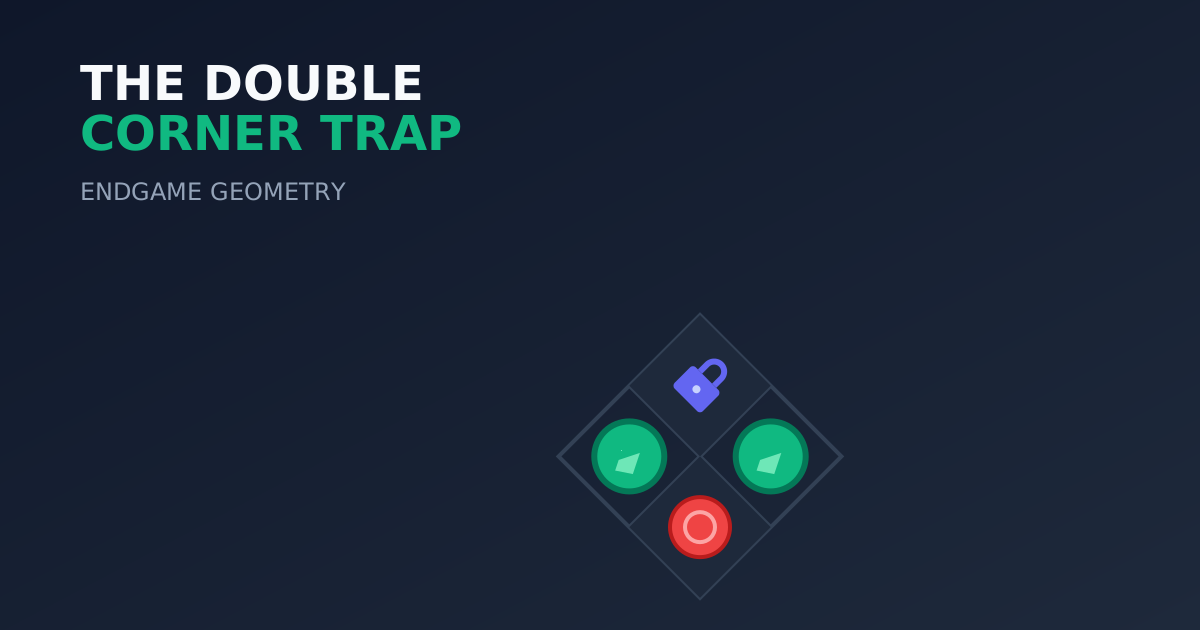
Direct Answer: In a 2-Kings-vs-1-King checkers endgame, you win by forcing the lone king into a double corner (squares 1 and 5, or 28 and 32) using coordinated movement, then blocking the only exit square. The key is tempo management and never chasing — you restrict your opponent's movement until they have only one legal, losing move left.
Mastering Checkers Endgame: How to Trap a Lone King
When the board clears down to kings, the game transforms from tactical fireworks into a precise, mathematical dance. Trapping a lone king against a superior force is one of the most satisfying skills in Checkers — and one of the most difficult to master. This guide teaches you the exact technique to corner and capture a lone king, using the proven "double corner" method that works against any opponent. The techniques here align with endgame principles used by the Chinook project, which proved Checkers is a draw with perfect play (Schaeffer et al., Science 2007).
The 40-Move Draw Rule
In standard American Checkers (English Draughts), if no capture has been made and no piece has been kinged within the last 40 moves, the game is declared a draw. This rule exists specifically to prevent indefinite king-chasing.
Once you're in a 2v1 king endgame, the clock is ticking. While 40 moves sounds generous, an inefficient chase can easily hit the limit. A correctly executed trap takes between 15 and 25 moves. If you find yourself chasing a lone king in circles, you are handed a draw by the clock even if your position is superior.
The 2-Kings-vs-1-King Trap: Step-by-Step
In checkers, trapping a king requires geometry, not aggression. You don't chase. You restrict. Here is the move-for-move logical sequence to close out the game.
Step 1: Form the Wall
Do not attack the lone king directly. Instead, position your two kings on adjacent diagonal lines to form a "wall." For example, if the opponent is in the center, place your kings on squares that prevent them from moving toward the "Single Corners" (squares 4 and 29). You want to funnel them toward the "Double Corners."
Step 2: Herd Toward the Double Corner
Slowly advance your wall. Every move should reduce the number of squares available to the lone king. If the lone king moves toward square 5 (a double corner), move your kings to squares 14 and 10 to cut off its retreat back to the center.
Step 3: Block the Exit Square
Once the lone king is inside the double corner (say, square 5), its only legal exit is usually square 9. You must occupy square 14 or 10 such that the moment the king moves to 9, you can move adjacent to it.
Step 4: Execute the Jump
Once the exit is blocked, the lone king is forced to move back into square 5 or attempt a jump that results in its own capture. By maintaining "Opposition" (staying one square apart on the same diagonal), you force the final move.
What is a Double Corner in Checkers?
The Double Corner refers to the two adjacent playable squares in the corner region: squares 1 & 5, and squares 28 & 32. It is the most dangerous position for a retreating king because diagonal movement is naturally restricted here. Unlike the "Single Corner" (4 or 29) which allows a king to hide indefinitely in a 1v1 scenario, the double corner allows an attacker to "trap" the exit and force a jump.
Other King Endgame Scenarios
3 Kings vs 1 King
This is a guaranteed win and much faster than the 2v1. Use two kings to form the primary wall and the third king to perform the final "pinch" move. The principle remains the same: herd to the double corner.
3 Kings vs 2 Kings
This is also a forced win for the side with three kings, but it requires more patience than 3v1. The two defending kings will try to form their own wall near a single corner, making it much harder to funnel them into a trap.
The key is to use your extra king as a "probe" — while your two kings maintain a wall, the third king probes for weaknesses in the opponent's formation. The defenders must stay connected (within one diagonal move of each other) to survive. The moment they lose coordination — and they will, under pressure — you exploit the gap. One common approach: force one defending king toward the double corner using the wall, then use the probe king to cut off the second king's escape route. Once the two defenders are separated, each can be trapped individually using the 2v1 technique.
Expect this endgame to take 25-35 moves. It's slower than 3v1 but still well within the 40-move draw limit if you play methodically. The biggest mistake is rushing — trying to trap both kings simultaneously usually lets one slip free.
1 King vs 1 King
In a 1v1 king scenario, the game is a forced draw. Provided the defending player knows to head for a "Single Corner" (squares 4 or 29), they can oscillate between the corner and its adjacent square forever. No single king can force a capture against another king.
How to Practice King Endgames Against the AI
Reading about the double corner trap is one thing. Executing it under the 40-move clock with a king darting around the board is another. Here's how to build real endgame skill using our Checkers game:
Easy Difficulty: Learn the Geometry
At Easy, the AI makes frequent positioning mistakes in the endgame. Use this level to practice the basic wall-and-herd technique without time pressure. Your goal: complete the 2v1 trap in under 25 moves every game. If you're regularly hitting 30+ moves, you're chasing instead of herding.
Medium Difficulty: Beat the Clock
The Medium AI will actively try to reach the single corner and oscillate there. This is where you learn to cut off the corner route early — before the lone king gets there. Practice reading the board two moves ahead: "If I move to square 14, what squares can the opponent reach in their next two moves?" Complete the trap in under 20 moves consistently before moving up.
Hard Difficulty: Master the 3v2
At Hard, the AI won't hand you easy 2v1 endgames — it fights hard in the midgame to avoid losing pieces. When you do reach a king endgame, it'll often be 3v2 or a messy position with kings and a few pawns still on the board. This is where the probe technique matters. Practice separating the two defending kings and trapping each individually.
Expert Difficulty: Endgame Under Fire
The Expert AI plays near-optimal endgame defense. It will head for the single corner immediately, oscillate efficiently, and exploit any gap in your wall. At this level, you need to execute the double corner trap flawlessly — every move must restrict the opponent. One wasted move and the 40-move clock becomes a real threat. This is where you find out if you've truly internalized the technique or just memorized the steps.
One more thing: don't forget that forced captures in endgames can be weaponized. If the lone king is forced to jump one of your kings, it may land in a position where your remaining king can immediately capture it. The mandatory jump rule isn't just a midgame tool — it's an endgame weapon too.
Common Mistakes When Trapping a King
- Chasing Instead of Herding: Running directly at the lone king allows them to pivot around you and return to the center. You must move to the squares they *want* to go to, not the square they are currently on.
- Breaking the Wall: If you move your two kings too far apart, the lone king will "slip through" the gap, resetting the 40-move clock and forcing you to start the herd from scratch.
- Losing Tempo: Every move that doesn't restrict the opponent's movement is a wasted move. In a 2v1, you have the advantage — use it to dominate the board's geometry.
Frequently Asked Questions
Can a king escape a corner in checkers?
In a 2v1 or 3v1 scenario, no. If the attacker plays correctly, the lone king has only one exit square, which can be easily blocked. Once you are in a double corner, you are mathematically trapped.
How many moves do you have to win in checkers?
You have 40 moves to make a capture or king a piece before a draw is declared. In a king-only endgame, this means you have 40 moves to complete the capture.
Is 2 kings vs 1 king always a win?
Yes, it is a forced win for the side with two kings, provided they execute the double corner trap correctly within the 40-move limit.
How do you force a draw in checkers?
If you are the lone king, your goal is to stay in the center as long as possible and then retreat to a Single Corner (4 or 29). If your opponent doesn't know the double corner trap, you can often reach the 40-move limit and secure a draw.
Summary and Key Takeaways
- Trapping a king requires geometry and herding, not direct aggression.
- The Double Corner (1/5 or 28/32) is the only place a 2v1 win can be forced.
- Always keep an eye on the 40-move draw rule; inefficiency is your biggest enemy.
- Form a "Wall" with your two kings to restrict the lone king's movement.
- Check out the World Checkers Federation (WCDF) for official ruling on draws and competitive endgame play.
Test Your Endgame Skills
Think you can beat the 40-move clock? Challenge our AI in an endgame scenario and see if you can execute the double corner trap perfectly.
Play Checkers NowReferences: World Checkers/Draughts Federation (WCDF) Rulebook, Chinook Checkers Project (University of Alberta).