Gomoku vs Tic Tac Toe: Why 'Five-in-a-Row' Changes the Math Entirely

Discuss this article with your favorite AI assistant
The Illusion of Similarity
At a quick glance, Gomoku (often called Five-in-a-Row or Gobang) looks like Tic Tac Toe's slightly more complicated cousin. Both games require players to place symbols on a grid to form an unbroken line. However, structurally and mathematically, they exist in entirely different universes of strategy.
While Tic Tac Toe is a child's game that can be mastered and solved in an afternoon, Gomoku is an ancient, deeply complex battlefield that challenges modern Artificial Intelligence systems. The gap between them isn't just "a bit harder" — it's the difference between solving a Rubik's Cube and mapping the human genome.
The Board Size: Order of Magnitude
The core difference between the games lies in the "State Space Complexity"—meaning the total number of legal board positions that can possibly exist.
- Tic Tac Toe: Played on a 3x3 grid, it has exactly 9 squares. There are precisely 255,168 unique games, but when you factor in symmetry, the number drops to just 26,830. A basic computer algorithm can map every possible outcome of Tic Tac Toe instantaneously.
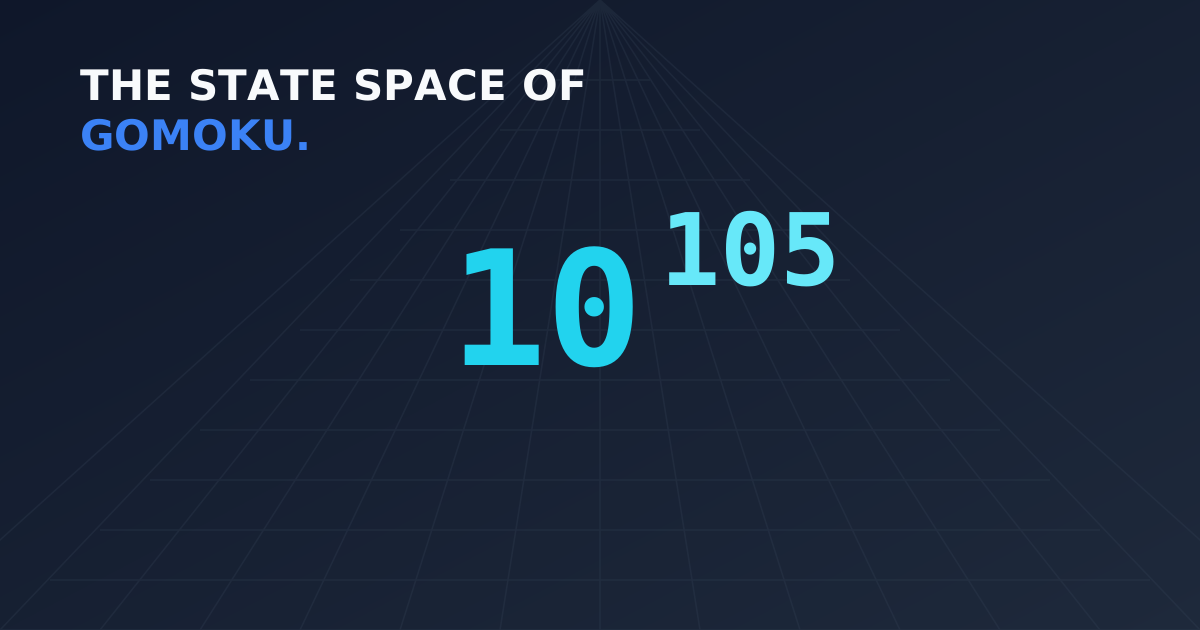
- Gomoku: Played on a traditional Go board, typically 15x15, providing 225 intersections. The State Space Complexity of Gomoku is estimated at 10105. To put that completely incomprehensible number into perspective: there are only an estimated 1080 atoms in the entire observable universe.
This isn't a gradual increase — it's a dimensional leap. Tic Tac Toe's state space is small enough that a phone can solve it in milliseconds. Gomoku's state space is so vast that even supercomputers can't brute-force it. The game was proven to be a first-player win by L. Victor Allis in 1993 using threat-space search techniques, documented in the paper "Go-Moku Solved by New Search Techniques" (AAAI, 1993).
The First Mover Advantage
In perfectly played Tic Tac Toe, the game always ends in a draw regardless of who goes first. The board is too small to build overlapping threats.
In Gomoku, the player who moves first (Black) possesses such a terrifying mathematical advantage that professional tournaments had to invent specialized rules (like "Swap2" or "Renju" restrictions) simply to prevent Black from winning automatically. Because there are no walls on a 15x15 board to constrict the opening player, Black can freely construct branching, multi-directional attacks.
Threat Scaling
Unlike Tic Tac Toe, where you only ever have to worry about a single active threat (two-in-a-row), Gomoku requires you to monitor a cascading web of threats. A single stone placed near the center of a 15x15 grid creates eight distinct directions of attack. By the fifth move, a strong player can construct geometric shapes that generate three or four simultaneous overlapping threat lines.
In Tic Tac Toe, your opponent blocks one threat and you're done — the board is too small for a second angle. In Gomoku, blocking one threat often opens two more. The defense never catches up to the offense, which is precisely why the first-player advantage had to be artificially restrained in competitive play.
Gomoku Threat Types: The Vocabulary of Attack
If Tic Tac Toe has one concept worth knowing ("block the fork"), Gomoku has an entire taxonomy. Understanding these threat types is the difference between randomly placing stones and actually playing the game. Here are the patterns that matter:
Open Four (Straight Four)
Four stones in an unbroken line with both ends open. This is an immediate, unblockable win — your opponent can only close one end, and you complete five on the other. In competitive Gomoku, creating an open four is essentially checkmate. Every strategy on the board ultimately serves the goal of producing one of these.
Broken Four (Four with a Gap)
Four stones with a single empty space in the middle — for example, three in a row, a gap, then one more. This is also a winning threat because filling the gap completes five. Beginners often miss broken fours because the eye is trained to look for consecutive stones, not patterns with holes. Train yourself to see the gaps.
Open Three
Three stones in a row with both ends open. An open three becomes an open four on the next move, which then becomes a win. Your opponent must block it immediately — but blocking an open three often requires placing a stone on one specific intersection, which may not help their own attack at all. Open threes are the engine of Gomoku offense: they force the opponent into pure reaction mode.
Broken Three
Three stones with a gap (e.g., two in a row, a gap, then one). These are subtler than open threes but just as dangerous because they can extend into a broken four or an open four depending on how the gap is filled. Strong players create broken threes deliberately because they're harder for opponents to spot.
Double Threat (The Kill Pattern)
The real goal of Gomoku strategy isn't to build five in a row directly — it's to create a position where you have two simultaneous threats that can't both be blocked. The most common kill patterns are an open three plus a broken three, or two open threes on different lines. Once you've created a double threat, the game is over regardless of what your opponent does. This is the Gomoku equivalent of a fork in Tic Tac Toe — except instead of happening once in a blue moon, it happens every game at the intermediate level and above.
Gomoku Opening Theory: Where Games Are Won
In Tic Tac Toe, the opening is essentially solved — there are only a handful of first moves, and the responses are mechanical. In Gomoku, the opening is a deep, evolving art form. Professional players have named and studied dozens of openings, and new variations are still being discovered. Here are three of the most important:
The Flower Opening (Direct Opening)
Black places the first stone at the center of the board (H8 on a 15x15 grid). White responds adjacent to it. Black then places a third stone diagonally adjacent to the first, creating a "flower petal" shape. This is the most aggressive opening — it immediately claims central territory and creates multiple diagonal threat lines. The flower opening is why the Swap2 rule was invented: it's simply too strong for unrestricted play.
The Yuanye (Indirect Opening)
Instead of placing stones directly adjacent, Black's second and third stones are placed one intersection apart from the first, creating a "knight's move" or "indirect" pattern. This looks less threatening than the flower, but it's actually more flexible — the gaps between stones can be filled later to create broken threes and broken fours that are harder to defend against. Think of it as the "positional" opening versus the flower's "tactical" one.
The D7 Opening
Named after a specific coordinate on the board, the D7 opening moves Black's first stone slightly off-center. This is a compromise between central dominance and flexibility — it avoids the most heavily analyzed center lines while still maintaining strong diagonal potential. Intermediate players often prefer D7 because it leads to less predictable games where pattern recognition matters more than memorized sequences.
The Swap2 Rule: Why Fairness Requires a Rule Change
Here's the problem with Gomoku: Black (the first player) wins with perfect play. This was proven computationally in 2001 by L. Victor Allis. So if both players play perfectly, the game is predetermined — Black always wins. That's not much of a game.
The competitive Gomoku community solved this with the Swap2 rule, and it's one of the most elegant fairness mechanisms in any board game. Here's how it works:
- First player places three stones: Black places two black stones and one white stone on the board in any positions they choose.
- Second player chooses color: White looks at the position and decides whether to play as Black or as White. If they choose Black, they take over the two black stones. If they choose White, the original player stays as Black.
- Color assignment: The player who ends up as White places one more white stone, and then the game continues normally with Black's turn.
The genius of Swap2 is that it forces the first player to create a balanced opening. If they make the position too favorable for Black, the second player will simply choose Black and steal the advantage. If they make it too favorable for White, they've handed their opponent a free advantage. The only safe strategy is to create a genuinely even position — which is exactly what fair play demands.
This rule doesn't exist in Tic Tac Toe because it doesn't need to. Tic Tac Toe is naturally balanced (it always draws). Gomoku is so unbalanced that the rules had to be reinvented to make it competitive. That alone tells you how deep the first-player advantage runs.
How to Practice Gomoku: A Step-by-Step Plan
Reading about threat types and openings is useful, but Gomoku is a pattern-recognition game — you have to see these shapes on the board under pressure to really internalize them. Here's a practical training path using our Gomoku game against the AI:
Stage 1: Learn to See Threes (Beginner)
Set the AI to Easy. Your only goal for the first 10-15 games is to spot open threes — both yours and your opponent's. Don't worry about winning. Don't worry about openings. Just practice recognizing three-in-a-row patterns with open ends. Once you can reliably see every open three on the board within a second or two of glancing at it, you're ready for the next stage.
Stage 2: Build Double Threats (Intermediate)
Move to Medium difficulty. Now your goal shifts: every move you make should either create a threat or set up a future double threat. Start with the Flower opening and practice building two open threes on different lines. The AI at this level will block obvious threats, so you'll learn to create threats that are harder to spot — broken threes and indirect patterns.
Stage 3: Play Under Pressure (Advanced)
Switch to Hard difficulty. At this level, the AI will punish any mistake immediately and will start building its own double threats by move 7-8. You'll need to balance offense and defense — every stone must serve both purposes. This is where Gomoku starts to feel like a real fight rather than a puzzle.
Stage 4: Refine Openings (Expert)
At Expert difficulty, the opening matters enormously. Practice the Flower, Yuanye, and D7 openings against the AI and see which ones lead to positions you're comfortable with. The AI plays near-optimal strategy, so you'll learn quickly which moves work and which don't — it will exploit every weak opening move ruthlessly.
Gomoku vs Tic Tac Toe: At a Glance
| Feature | Tic Tac Toe | Gomoku |
|---|---|---|
| Board Size | 3×3 (9 squares) | 15×15 (225 intersections) |
| Win Condition | 3 in a row | 5 in a row |
| State Space | ~26,830 positions | 10105 positions |
| Solved? | Yes — always draws | Yes — Black wins (without Swap2) |
| First-Player Advantage | None (draw) | Massive (requires rule fixes) |
| Typical Game Length | 5-9 moves | 20-60 moves |
| Skill Ceiling | Solved in an afternoon | Years of study, still evolving |
Step Off the 3×3 Grid
Tic Tac Toe is solved. Gomoku is a living, breathing strategy game with openings to learn, threats to spot, and double-threats to build. Play it against our AI engine and see how deep the rabbit hole goes.
Play Gomoku vs AIFrequently Asked Questions
Is Gomoku the same as Five in a Row?
Yes. Gomoku, Five-in-a-Row, and Gobang are all names for the same game. "Gomoku" is the Japanese name (meaning "five stones"), while "Five-in-a-Row" is the common English name. "Gobang" is an older term used in some European countries. They all refer to placing stones on a grid to form an unbroken line of five.
Can Gomoku be played on a smaller board?
Yes — a 9×9 board is sometimes used for faster, more tactical games. The smaller board reduces the first-player advantage somewhat because there's less room to build branching attacks. Our Gomoku game uses the standard 15×15 board, which is the tournament standard.
What is the Renju rule in Gomoku?
Renju is a Japanese variant that adds restrictions specifically for Black (the first player) to balance the game. Under Renju rules, Black cannot create a double-three (two open threes simultaneously), a double-four (two fours simultaneously), or an "overline" (six or more in a row). White has no such restrictions. These rules make the game fair but also make Black's strategy significantly more complex — you have to win while avoiding certain patterns.
How long does it take to get good at Gomoku?
You can learn the rules in two minutes and start spotting basic threats within your first 10 games. Becoming genuinely competent — where you consistently create double threats and defend against them — typically takes 30-50 games against progressively harder AI opponents. Reaching a competitive level takes months of study, especially if you're learning named openings and Swap2 strategy.
Why isn't Gomoku as popular as Chess or Go?
Gomoku sits in an awkward cultural position — it's played on a Go board, which makes people assume it's a Go variant. It's also perceived as "too simple" by Go players and "too complex" by casual gamers. In reality, it's a fast, aggressive strategy game that's easier to learn than Chess but harder to master than most people expect. It's hugely popular in Japan, China, and Eastern Europe, where it has organized competitive scenes.