Mancala Endgame: How to Predict the Winner 10 Moves Ahead

Discuss this article with your favorite AI assistant
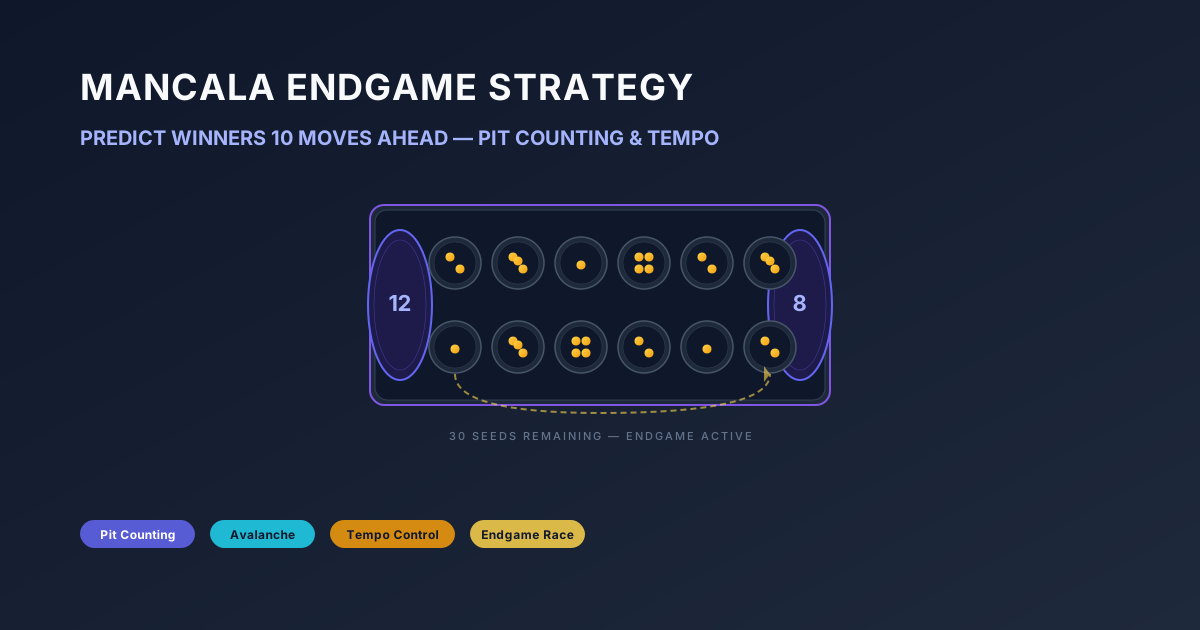
Direct Answer: You can predict the winner of a Mancala endgame 10 moves ahead by mastering three techniques: (1) Pit counting — know exactly how many seeds each pit will yield when sown, so you never waste a move. (2) Tempo control — understand whose turn it is and who will reach the empty-pit bonus first. (3) Avalanche chains — sequence your moves to create multiple consecutive turns. The endgame starts when the board has roughly 24-30 seeds remaining (down from 48 at the start). At this point, positional play matters more than raw seed count. A player who controls the tempo can win from a 4-6 seed deficit.
When Does the Endgame Begin?
The Mancala endgame starts when the board transitions from "building and blocking" to "empty and race." The key signal: the front-most pits on your side start running empty. When your rightmost pit (closest to your store) has 0-2 seeds, every move you make affects the tempo. The game is about to end.
Quantitatively: the endgame begins when total seeds on the board (excluding stores) drop below 30. At this point, a single capture or extra turn is decisive. In the opening and midgame, a 4-seed mistake is recoverable. In the endgame, it's game-ending.
Technique 1: Pit Counting
Pit counting is the ability to look at a pit's seed count and know exactly where the last seed will land. This is critical because landing in an empty pit on your side captures that seed and the opponent's seeds opposite.
- 1 seed: Lands in the next pit. If that's your empty front pit, you capture your own 1 seed + opponent's opposite pit. If the next pit is your store, you get an extra turn.
- 2 seeds: Skips the immediate next pit, lands in the second one forward. Use this to reach your store for an extra turn.
- 3 seeds: Third pit. Often used to land in your store from 3 pits away.
- 4+ seeds: Requires tracking around the board. Count: pit position + seeds = landing position. If the count wraps around to your side and lands on an empty pit, you capture.
Practice pit counting against Mancala Medium AI. Before every move, predict which pit the last seed will land in. After 20 games, you'll do it automatically.
Technique 2: Tempo Control
Tempo is the number of turns you get before your opponent can make a meaningful move. In the endgame, tempo is everything. A single extra turn can be the difference between capturing 4 seeds or losing them.
How to gain tempo:
- Land in your store: The most direct way to get an extra turn. Plan your move so the last seed lands in your store. This is Mancala's version of "getting the ball back."
- Force opponent to feed you: Make moves that force your opponent to place seeds in your front pits, which you then capture on your next turn.
- Avoid giving opponent captures: If your opponent has an empty front pit, don't place seeds opposite it — they'll capture everything on their turn.
Technique 3: Avalanche Chains
An avalanche chain is a sequence where one move leads to an extra turn, which leads to another capture, which leads to another extra turn. In a perfect chain, you can take 3-5 consecutive turns while your opponent watches.
How to create an avalanche:
Set up your rightmost pits with exactly the right number of seeds to land in your store. If pit 1 has 1 seed, pit 2 has 2 seeds, and pit 3 has 3 seeds, you can chain: play pit 3 (lands in store → extra turn), play pit 2 (lands in store → extra turn), play pit 1 (captures opponent's opposite pit). Three turns, one capture, potentially game-ending.
This is the highest-level Mancala technique. The Hard AI actively builds these chains — that's why it's hard to beat.
Endgame Race: When to Shift Gears
When the board is nearly empty (fewer than 15 seeds remaining), the game becomes a pure race. Your only goal: make sure you get the last move. At this point, pit counting reduces to a simple rule: always take the move that gives you the most extra turns. A 2-seed pit that lands in your store is better than a 5-seed pit that doesn't, because that store landing gives you another move and your opponent doesn't get one.
Common Endgame Mistakes
- Playing too fast: The endgame rewards calculation, not intuition. Slow down. Count every pit before every move.
- Ignoring the opponent's empty pits: If your opponent has an empty pit on their front row, every seed you place opposite it is a gift. Avoid those columns entirely in the endgame.
- Focusing on store seeds instead of tempo: An extra turn that lets you capture 3 seeds is better than a direct deposit of 2 seeds into your store. Tempo beats raw seed count in the endgame.
Frequently Asked Questions
What's the difference between endgame strategies for Easy vs Hard AI?
The Easy AI makes short-sighted moves — it takes captures that look good now but give you better positions later. Practice your avalanche chains against Easy. The Medium AI blocks some captures but doesn't build chains. The Hard AI plays near-perfect endgames — it's the best training partner for advanced pit counting and tempo control.
How do I practice endgame positions?
Play against the Medium AI and focus exclusively on the last 15 moves of each game. After the game, replay the endgame mentally: "If I had played pit 3 instead of pit 4, would I have won?" This post-game analysis is the fastest way to improve.
Can I win from a 6-seed deficit in the endgame?
Yes, if you control the tempo. A well-timed avalanche chain that captures 4-5 seeds in a single turn can erase a deficit. The key is not to panic — deficit in the endgame means you need perfect play, not desperate play.
Summary and Key Takeaways
- The endgame starts when total board seeds drop below 30.
- Pit counting: know exactly where every move's last seed will land.
- Tempo control: extra turns are worth more than raw seed count.
- Avalanche chains: sequence moves to get 3-5 consecutive turns.
- In the final race (under 15 seeds), maximize extra turns above all else.
- Avoid giving the opponent captures by respecting their empty pits.
- Practice pit counting against Medium AI, tempo control against Hard AI.
Practice Your Endgame Right Now
Play Mancala against three AI difficulty levels. The endgame is where champions are made — every move counts.
Play MancalaNew to Mancala? Start with How to Play Mancala and Mancala Opening Theory.