How to Play Mancala: Rules and Beginner Strategy Guide

Discuss this article with your favorite AI assistant
Direct Answer: Mancala is a two-player seed-sowing game played on a board with 12 pits (6 per player) and 2 stores (one per player). Each pit starts with 4 seeds. On your turn, pick up all seeds from one of your pits and sow them one by one counter-clockwise, skipping your opponent's store but dropping into your own. You score by landing the last seed in your store (earning an extra turn) or by landing in an empty pit on your side (capturing that seed plus all seeds in the opponent's pit directly across). The game ends when one player's pits are empty — the player with the most seeds in their store wins. Against our AI, the best beginner strategy is pit counting: always play from a pit where you can predict where the last seed will land and plan for bonus turns and captures.
The Mancala Board: A Quick Tour
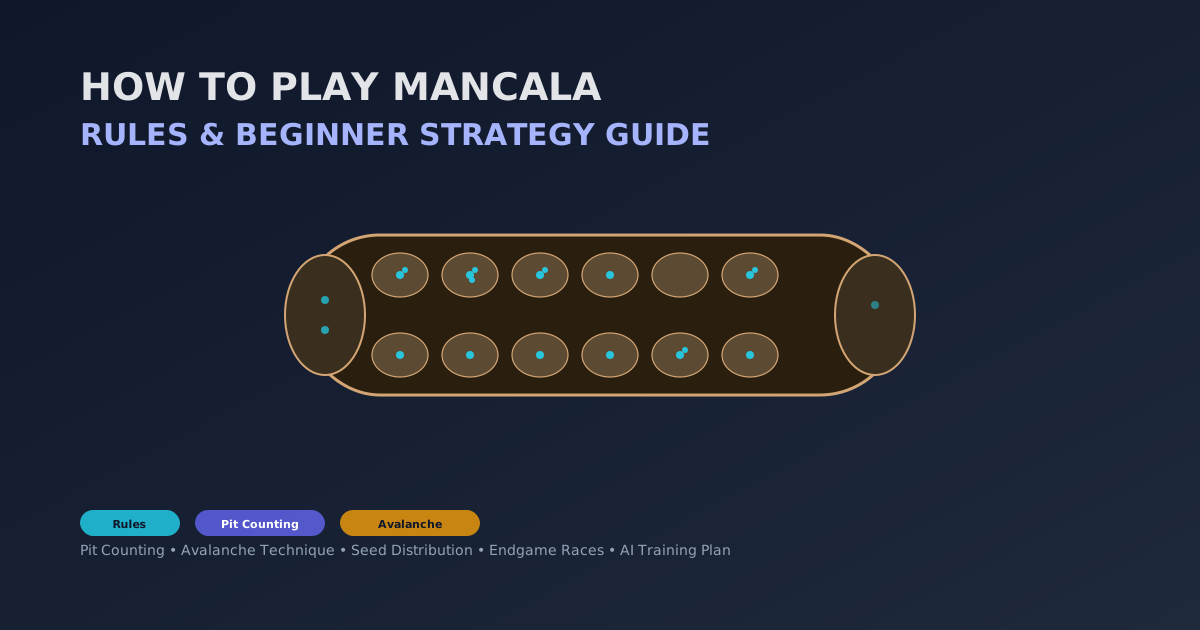
A standard Mancala board (the Kalah variant used by our Mancala game) has 14 zones: 12 small pits arranged in two rows and 2 large stores at each end. Your row is the six pits closest to you. Your opponent's row is the six pits across from you. Your store is on your right. The number of seeds in a pit tells you how many moves are possible from it — and that number is the whole game.
Starting position: 4 seeds in every pit, empty stores. Total: 48 seeds in play. The player who ends with 25 or more seeds in their store wins. 24-24 is a draw.
How a Turn Works
- Sow: Pick up all seeds from one of your pits. Drop one seed into each subsequent pit going counter-clockwise, including your own store. Skip your opponent's store entirely.
- Bonus turn: If your last seed lands in your own store, you get another turn immediately. This is the most powerful mechanic in the game — chain 2-3 bonus turns together and you've effectively played 2-3 moves while your opponent played zero.
- Capture: If your last seed lands in an empty pit on your own side, you capture that seed plus all seeds in the opponent's pit directly across from it. Both go into your store. This is how big leads are built — a well-timed capture can swing the game by 6-10 seeds.
- End of game: If you empty all pits on your side, the game ends immediately. Your opponent collects all remaining seeds from their pits into their store. Whoever has the most seeds in their store wins.
Pit Counting: The Foundation of All Strategy
Pit counting is the single most important skill in Mancala. Every strategic decision flows from it. The skill is simple: before you move, count how many seeds are in the pit you're about to pick up. That number tells you exactly where your last seed will land because you drop one seed per pit as you go.
The formula: If your pit has N seeds, your last seed lands N pits away from it (counter-clockwise). Your own store counts as 1 pit in the path. Your opponent's store does not count — it's skipped entirely, which effectively adds 1 to the distance when your seeds cross the opponent's side of the board.
Example: You have a pit with 4 seeds, and it's the third pit from your store. Your path: pit → pit → store (4 moves total). The 4th seed lands in your store. You get a bonus turn. This is why counting to 4 is the first skill to develop — any pit with exactly the right number to reach your store is a free extra move.
Practice drill: Play against the Easy Mancala AI and before every move, verbally say: "If I play from pit X with N seeds, my last seed lands in [position]." If you can predict the landing position correctly 9 out of 10 times, you've mastered pit counting and can move on to strategy.
Three Beginner Strategies That Work
Strategy 1: The Store Chase
In the opening, prioritize playing from pits that give you bonus turns (last seed lands in your store). Every bonus turn is free — you gain seeds while your opponent does nothing. A single bonus turn chain of 3 moves can swing the game by 5-6 seeds.
How to find store-chase opportunities: Your store is on the right. A seed from your leftmost pit travels 6 pits to reach your store. A seed from your rightmost pit travels 1 pit. A pit with 1 seed that is 1 pit from your store lands right in the store (1-step path). A pit with 2 seeds that is 2 pits from your store also reaches it (2-step path). In general, a pit with N seeds reaches your store if the distance from the pit to the store (going counter-clockwise) equals N. Memorize the distances for your 6 pits — this pays off every single game.
Strategy 2: The Across Capture
The highest-scoring single move in Mancala is the capture. When your last seed lands in an empty pit on your side, you capture that seed plus all seeds across from it. Captures of 8+ seeds (1 + 7 across) are game-swinging.
Setup: Watch for opponent's pits that have accumulated seeds (5+). If you can land your last seed in an empty pit on your side that is directly across from this large opponent pit, you capture the whole pile. This often requires multiple moves of setup — you must first empty your target pit (by playing from it earlier) and then time the capture by playing from another pit.
The trap: Don't chase captures at the expense of bonus turns. A capture of 6 seeds is worth roughly the same as two bonus turns that add 3 seeds each. If setting up the capture costs you a bonus turn opportunity, the capture might not be worth it. Always compare: "Can I get more seeds from bonus turns in the same number of moves, or is the capture a better deal?"
Strategy 3: Empty Your Pits, Starve Your Opponent
The endgame in Mancala (when one player has 1-3 pits left) is all about tempo. If you can empty your pits faster than your opponent empties theirs, you force the "remaining seeds" bonus in your favor. In the endgame, prioritize playing from your most-seeded pit to maximize the number of seeds you collect in your store before the game ends.
The endgame rule: When you're down to 2 pits, always play from the one with more seeds. This maximizes the seeds that pass through your store on the way to other pits. Also: never leave a pit with 1 seed in the endgame unless you're certain the opponent can't reach your side of the board — a single seed in an endgame pit is a liability because it blocks a potential capture opportunity.
How to Play Against Each AI Difficulty
Easy AI (Beginner Practice)
The Easy AI plays without looking ahead — it evaluates each move independently using simple heuristics. It sometimes makes obviously bad moves (playing from a pit that gives you a capture). Focus on pit counting accuracy and bonus turn chains. A beginner using pit counting and store chasing should win 80%+ of games. Expected final score: 28-20 or better.
Medium AI (Strategy Development)
The Medium AI looks 2 moves ahead and blocks obvious captures. You can't rely on the AI handing you captures anymore. You need to set them up over 2-3 moves by emptying target pits and then timing the capture. The Medium AI also punishes predictable patterns (always playing from the same pit). Vary your openings. A player with solid pit counting and capture setup should win 50-60% of games. Expected final score: 26-22 range.
Hard AI (Advanced Play)
The Hard AI looks 4+ moves ahead and plays near-optimal Mancala within the limits of its search depth. It chain-bonus-turns reliably, sets up captures across multiple moves, and endgames efficiently. Against the Hard AI, you must play perfect pit counting and anticipate multi-move sequences. A 40% win rate is strong. The Hard AI is excellent for learning advanced positional concepts because every mistake gets punished — you learn fast. Read the opening theory guide to maximize your odds.
Common Beginner Mistakes
- Playing without counting: The most common mistake. If you don't know where your last seed will land, you're guessing. Guessing in Mancala is roughly equivalent to a 10% win rate against any AI. Always count before you move.
- Giving away captures: Leaving a pit with 1 seed on your side when the opponent can reach it with a seed that lands there. If you see an empty pit on your side with a large opponent pit across from it, assume the opponent can capture it on their next turn — fill the empty pit or empty the opponent's pit first.
- Over-chasing bonus turns: Getting a bonus turn is good. Getting so fixated on bonus turns that you ignore a massive capture opportunity is bad. Weigh every move: "Is this bonus turn worth more seeds than the alternative?" Sometimes the answer is no.
- Ignoring the opponent's store path: When you're deciding which pit to play from, check whether the seeds you're sowing will give your opponent a capture opportunity on their next turn. If your move creates an empty pit on your side that the opponent can exploit, don't make that move.
Frequently Asked Questions
How many seeds are in a Mancala game?
48 total — 4 seeds in each of the 12 pits at the start. Over the course of the game, seeds shift from pits to stores. The total number of seeds in pits decreases as seeds accumulate in stores. A player wins when they have 25+ seeds in their store.
What is the best first move in Mancala?
Playing from your fourth pit (counting from left to right, or the third pit from your store) is statistically the strongest opening. It sows seeds across your side and lands in your store, giving you a bonus turn immediately. Other openings from pit 3 or pit 5 are playable but give the opponent counter-play opportunities. See Mancala Opening Theory for a full breakdown of all 6 opening moves.
How do I win at Mancala every time?
You can't — Mancala is a solved game at the highest level, but there's no guaranteed win from the starting position. What you can do is maximize your odds: perfect pit counting, aggressive bonus turn chaining, well-timed captures, and efficient endgame play. Against the AI, mastering these four skills should give you a 60-80% win rate on Medium difficulty.
Is Mancala a game of luck or skill?
Mancala is almost entirely skill. There is no randomness — no dice, no cards, no hidden information. Every move is deterministic and both players see the full board state. The complexity comes from combinatorial depth, not randomness. A skilled player will beat a beginner 95%+ of the time.
How long does a Mancala game take?
Against the AI, a typical game takes 5-10 minutes at Easy difficulty, 8-15 minutes at Medium, and 10-20 minutes at Hard. The game length increases with AI strength because stronger AI plays more defensively, requiring more moves to find winning opportunities.
Summary and Key Takeaways
- Mancala is a seed-sowing game — 48 seeds, 12 pits, 2 stores. Collect 25+ seeds in your store to win.
- Pit counting is the foundation: before every move, know where the last seed lands.
- Bonus turns (last seed in your store) are the most efficient way to gain seeds — chain them when possible.
- Captures swing games — set them up by emptying a target pit, then timing the play from another pit.
- Endgame is about tempo — empty your pits faster than your opponent to force the remaining-seeds bonus.
- The best first move is from your fourth pit (pit 4 from the left, or the third pit from your store).
- Easy AI (80%+ win target), Medium AI (50-60%), Hard AI (30-40% is strong).
Play Mancala Online — No Login Required
Practice pit counting and bonus turn chains against AI at three difficulty levels. Start with Easy to build the counting habit.
Play Mancala NowMaster the opening — read Mancala Opening Theory: First Move Wins 60% of Games.