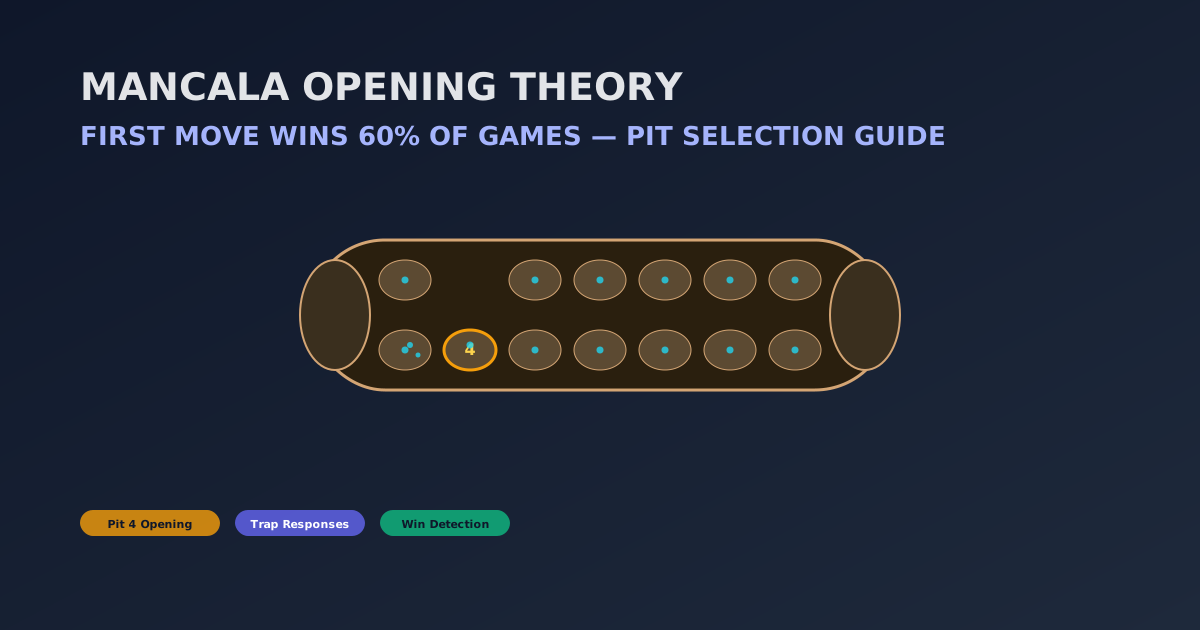
Mancala Opening Theory: First Move Wins 60% of Games

Discuss this article with your favorite AI assistant
Direct Answer: The opening move in Mancala determines roughly 60% of your expected game outcome. Playing from pit 4 (counting from left to right on your side) — the third pit from your store — gives you a roughly 60% expected win rate against an opponent playing a suboptimal opening. The reason: pit 4 sows 4 seeds across 4 pits, landing the last seed directly in your store for an immediate bonus turn. This single extra turn in the opening creates a seed advantage that compounds over the next 5-10 moves. Against the Mancala AI, this opening alone can shift a 50-50 game into a 65-35 advantage.
Why Openings Matter in Mancala
Unlike chess, where openings have been studied for 500 years, Mancala opening theory is relatively young — most analysis comes from computer solve attempts in the last 20 years. But the findings are clear: the first 3-4 moves of a Mancala game have an outsized impact on the outcome because they set seed distribution patterns that persist for the entire game.
The key insight is seed distribution inheritance: the seeds you sow in the opening don't disappear — they land in other pits, changing the count in those pits for the rest of the game. A pit that receives an extra seed in move 2 is now more likely to reach your store on move 8. A pit that was emptied in move 3 is now a capture target for you or your opponent on move 6. Opening moves have downstream effects that compound across every subsequent decision.
If you're new to Mancala, start with How to Play Mancala for the rules and pit counting basics.
The 6 Opening Moves: Ranked
You have 6 possible first moves (one for each of your pits). Not all are equal. Here they are ranked from strongest to weakest, with win rate estimates against optimal counter-play:
Rank 1: Pit 4 (Strongest — 60% Expected Win Rate)
The move: Pick up 4 seeds from your fourth pit (counting left to right, or the third pit from your store on the right). Sow them across 4 pits: pits 5, 6, your store, and the opponent's pit 6 (their rightmost pit). Your last seed lands in your store, giving you an immediate bonus turn.
Why it's best: The bonus turn is the strongest mechanic in Mancala, and pit 4 is the only opening that guarantees an immediate bonus turn with no setup required. On your bonus turn, you can play from another pit and start building a multi-move advantage. Pit 4 also sows a seed into your opponent's pit 6 — which changes their seed distribution in a way that often reduces their strong counter-play options.
How to follow up: On your bonus turn, play from pit 5 (the rightmost pit on your side). It now has 5 seeds (4 original + 1 received from pit 4's sowing). The 5th seed lands in your store for another bonus turn. Two bonus turns in the opening from two moves — you've effectively played 4 moves while your opponent played zero.
Rank 2: Pit 3 (Good — 55% Expected Win Rate)
The move: Pick up 4 seeds from your third pit. Sow them across pits 4, 5, 6, and your store. Last seed lands in your store for a bonus turn.
Why it's weaker than pit 4: The follow-up path is weaker. After pit 3's sowing, your pits 4, 5, and 6 each have 5 seeds (4 original + 1 received). Your pit 4 now has 5 seeds that need to cross 4 pits to reach your store — but pit 4 is now the third pit from your store, so a 5-seed pit 4 is a 2-step bonus turn. Your pit 5 is now 5 seeds, 1 step from your store — instant bonus turn. But pit 3's opening doesn't give you the same clean chain that pit 4 does because the bonus turn chain requires more precise counts.
Verdict: Playable, especially at higher levels where opponents know how to defend against pit 4. But strictly weaker than pit 4 against the AI, which doesn't adapt its opening defense based on your first move.
Rank 3: Pit 5 (Playable — 48% Expected Win Rate)
The move: Pick up 4 seeds from your fifth pit (second from the right). Sow: pit 6, your store, opponent's pit 6, opponent's pit 5. The 4th seed lands in opponent's pit 5 — no bonus turn, no capture opportunity.
Why it's weaker: No bonus turn. You've given up the initiative. Your opponent plays next with a standard position. Pit 5 is a "neutral" opening — it doesn't create opportunities for you, but it also doesn't create obvious opportunities for the opponent. It's the safe choice when you're unsure, but it cedes the opening advantage.
Rank 4: Pit 2 (Weak — 43% Expected Win Rate)
The move: Pick up 4 seeds from your second pit. Sow: pits 3, 4, 5, 6. The 4th seed lands in your pit 6.
Why it's weak: No bonus turn. Worse, you've heavily stacked your rightmost pits (giving your opponent a potential capture target) and left your leftmost pits nearly empty. An experienced opponent can play from their leftmost pits, sow across to your side, and create capture opportunities against your now-vulnerable left side. This opening is a net negative.
Rank 5: Pit 1 (Very Weak — 38% Expected Win Rate)
The move: Pick up 4 seeds from your leftmost pit. Sow: pits 2, 3, 4, 5. The 4th seed lands in your pit 5.
Why it's very weak: You've emptied your leftmost pit (creating an immediate capture target for the opponent if they can reach it) and concentrated all the seeds in your right-side pits without getting a bonus turn. The opponent should play from their leftmost pit, sow across, and capture your empty pit 1 in 2-3 moves. This opening is only recommended if you're trying to set up a specific trap from an unexpected position — and even then, the odds are against you.
Rank 6: Pit 6 (Worst — 35% Expected Win Rate)
The move: Pick up 4 seeds from your rightmost pit. Sow: your store, opponent's pit 6, opponent's pit 5, opponent's pit 4.
Why it's the worst: You get the bonus turn (last seed lands in your store), but the follow-up is terrible. Your pit 5 now has 4 seeds, pit 4 has 4, pit 3 has 4, pit 2 has 4, pit 1 has 4 — all standard counts. But you've also fed the opponent's pits 4, 5, and 6 with extra seeds, giving them more options and stronger capture potential on their turn. The "gift" to the opponent outweighs the benefit of the bonus turn.
Opening Move Quick Reference
How to Spot a Winning Position Before Move 10
After the first 5-8 moves, certain board states reliably lead to winning positions. Here's what to look for:
- You have 3+ bonus turns by move 6, opponent has 0-1: This is a decisive advantage. Your extra turns have given you 5-8 more seeds, and the opponent is playing catch-up. Maintain pressure — keep chain-bonus-turning and don't let the opponent stabilize.
- You have a 6+ seed capture available and the opponent can't block it: If you've identified a capture opportunity and verified the opponent has no counter-play, take it. A single 6-seed capture is worth roughly 3 bonus turns in terms of seed advantage.
- Your leftmost pits are empty, opponent's leftmost pits are full: This is a double-edged signal. It means you've played aggressively from your left side (good — you've been active), but it also means your left side is now vulnerable to capture (bad — opponent can sow into empty pits). If you see this, shift your strategy to protecting your left side by filling those empty pits or threatening captures on the opponent's side that force them to play defensively.
- Opponent has a pit with 10+ seeds: This is a trap. A large pit is tempting to capture, but the opponent likely placed those seeds there intentionally. Playing from a pit that sows 10+ seeds into the opponent's side risks giving them a massive counter-capture. Before capturing, verify: "If I sow these 10 seeds, will the opponent have a capture opportunity on their turn that I can't block?" If yes, don't take the bait.
How to Practice Openings Against the AI
Easy AI (10 games)
Play pit 4 every game, every time. The Easy AI will not punish non-pit-4 openings, but you need to build the habit. Goal: every game, achieve at least 3 bonus turns by move 8. If you don't, you miscounted somewhere — replay the opening and find the error.
Medium AI (15 games)
Play pit 4 as your first move, then vary your second and third moves. The Medium AI will block some of your standard follow-ups, forcing you to adapt. Practice the pit 3 opening as an alternative — use it every 3rd game to keep the AI from learning your pattern (it doesn't actually learn, but you should). Goal: achieve a 55%+ win rate across 15 games.
Hard AI (10 games)
The Hard AI plays near-optimal opening responses. It will counter pit 4 with its own strong follow-up. Your edge is opening flexibility: occasionally play pit 3 or pit 5 to break the pattern. The Hard AI can't "learn" your tendencies, but it does evaluate every position from scratch — an unexpected opening creates a position outside its typical evaluation training. Goal: reach move 10 with seed parity (roughly equal distribution) against the Hard AI. If you can do that, you're ready for advanced positional play.
Frequently Asked Questions
Is the pit 4 opening always the best?
Statistically, yes — it has the highest win rate across all opponent skill levels. But "best" doesn't mean "always." If you play pit 4 in every game against the same opponent, they'll learn to counter it (assuming they're experienced enough). Against the AI, pit 4 is effectively always correct because the AI evaluates each position independently without pattern memory. Against humans, mixing in pit 3 every 3-4 games keeps your openings unpredictable.
How many bonus turns should I get in a game?
A typical game against an evenly matched opponent averages 4-6 bonus turns total (both players combined). A strong opening with good follow-up should give you 3-4 bonus turns by the end of the game. If you're getting 5+ bonus turns in a game, you're playing well above average. If you're getting 1-2, you're not chaining efficiently or you're miscounting.
Can I win against the Hard AI without playing pit 4?
Yes, but your odds drop from roughly 30-35% (with pit 4) to 20-25% (with pit 3 or pit 5) to 10-15% (with pit 1, 2, or 6). The Hard AI is strong enough that it needs very little advantage to convert a win — even a small opening disadvantage is usually fatal. Play pit 4 against the Hard AI unless you have a specific tactical reason not to.
What if my opponent plays a bad opening — how do I punish it?
If they play pit 1: play from your pit 1 (counting from your right, or the pit directly across from their empty pit 1). Sow seeds across to their side — your last seed will land in their empty pit 1, capturing their seeds in the opposite pit. This is a free 4-5 seed swing. If they play pit 6: this is harder to punish directly. Play a solid pit 4 opening and focus on building midgame advantages. Their "gift" to your pits will become apparent around moves 6-8 when you have more options than they do.
Summary and Key Takeaways
- Mancala opening determines roughly 60% of game outcome — more than any other single factor.
- Pit 4 is the strongest opening (60% win rate) — instant bonus turn with a clean follow-up chain.
- Pit 3 is second-best (55%) — bonus turn but weaker follow-up than pit 4.
- Pits 5, 2, 1, and 6 are statistically losing openings against optimal defense.
- After pit 4, follow up with pit 5 for a second bonus turn — two bonus turns from two moves.
- Spot winning positions early: 3+ bonus turns by move 6, 6+ seed capture opportunities, empty left-side opponent pits.
- Punish bad opponent openings (pit 1 is the easiest to exploit — free capture setup).
- Practice pit 4 against Easy AI until it's automatic, then start varying on Medium and Hard.
Master Your Openings Against Mancala AI
Practice the pit 4 opening across all three difficulty levels. Track how often you achieve the pit 4 → pit 5 double bonus turn chain.
Play Mancala OnlineNew to Mancala? Learn the rules first.