No Login Multiplayer Games to Play with Friends Online

Discuss this article with your favorite AI assistant
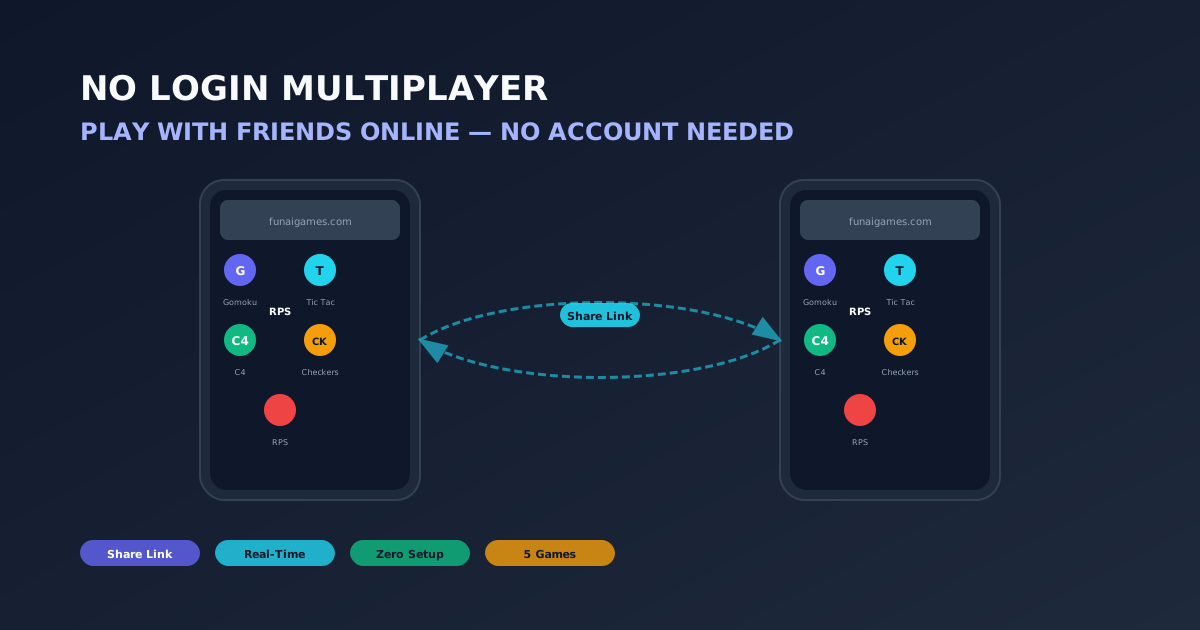
Direct Answer: You can play no-login multiplayer games with friends instantly by creating a private room on Fun AI Games. Choose from Gomoku, Tic Tac Toe, Connect Four, Checkers, or Rock Paper Scissors — each game generates a unique room link you can share with anyone. No accounts, no downloads, no sign-ups. Your friend clicks the link and plays. All five games support real-time online play through WebSocket connections, so moves appear instantly on both screens. The invite system works like a video call link: you create the room, send the URL, and the game starts the moment both players join. No friend lists, no lobby searches, no waiting in queues.
How No-Login Multiplayer Works
Traditional online gaming platforms require you to create an account, build a friend list, send requests, wait for acceptance, and finally invite someone to a game. The process takes several minutes and creates friction every time you want to play. No-login multiplayer removes every step: you click "Create Room," a URL appears instantly, you paste it into WhatsApp, Discord, or iMessage, and both of you are playing within seconds. The room exists only as long as both players are connected. When you leave, the room disappears. No data is stored.
The underlying technology is straightforward: when you create a room, the server assigns a random room ID and waits for a second player to connect via that ID. The URL encodes this room ID. Both browsers establish a WebSocket connection to the server, which relays moves between the two players in real time. No authentication tokens, no cookies, no persistent storage. The entire system is designed to be ephemeral — you play, you leave, and no trace remains.
Game-by-Game Breakdown
Gomoku Online — Five in a Row
Gomoku online is the deepest strategic option in the no-login multiplayer lineup. Played on a 15x15 board, the goal is to place five stones in a row — horizontally, vertically, or diagonally. The online version supports standard Gomoku rules with the opening swap rule to balance first-move advantage.
What changes with a human opponent: Against AI, Gomoku is a pattern-matching exercise. Against a human, it becomes a psychological game. Humans build "traps" — patterns that create two threats simultaneously so that blocking one leaves the other open. Human opponents also use "feint" patterns: building a threat in one area to draw your attention while quietly setting up the real attack elsewhere. AI opponents do not bluff. Human opponents bluff constantly. Create a room at Gomoku online room and share the link.
Tic Tac Toe Online — Quick and Universal
Tic Tac Toe online is the fastest multiplayer option — games finish in under a minute. The simplicity makes it perfect for quick breaks, warm-ups, or playing with younger players. Despite its solved status (perfect play always leads to a draw), playing against a human adds unpredictability that the computer cannot replicate.
The human element: Some players deliberately play suboptimally to create traps — placing an O in a corner instead of the center to bait the opponent into a mistake. A perfect-information AI would never do this, but human opponents exploit the fact that you might not notice a threat. This makes Tic Tac Toe online less about the game itself and more about reading your opponent's psychology. Join a game at Tic Tac Toe online room.
Connect Four Online — Vertical Strategy
Connect Four online adds a spatial reasoning dimension that screen-based play enhances. The vertical board and gravity mechanic make it easy to visualize on a browser — dropped pieces stack naturally, and the winning patterns (horizontal, vertical, diagonal) are instantly readable. Online play introduces the pressure of the countdown: opponents must respond within a time limit, which creates tension that single-player AI games lack.
Human-specific patterns: Human Connect Four players tend to favor the center columns (3 and 4) because they offer the most winning combinations. Experienced human opponents exploit this tendency by building threats on the edges where you are less likely to look. The AI ignores this psychology — it calculates pure game theory. Against a human, you need to defend against both the board state and your opponent's predictable biases. Start a room at Connect Four online room.
Checkers Online — Classic Depth
Checkers online offers the deepest traditional experience in the lineup. The forced capture rule creates cascading chains that can turn a losing position into a winning one with a single sequence. Online play against a human is the only way to experience the psychological dimension of Checkers — the frustration of being forced into an unfavorable exchange, the satisfaction of baiting an opponent into a trap that clears three of their pieces, and the endgame precision required to convert a king advantage into a win.
Human blind spots: In Checkers, humans consistently undervalue the importance of the back rank. A human opponent will often trade center pieces aggressively while leaving their back rank vulnerable, allowing the opponent to king a piece and dominate the endgame. AI opponents do not make this mistake. Playing Checkers online against a human means exploiting real cognitive biases that no AI difficulty setting can simulate. Challenge a friend at Checkers online room.
Rock Paper Scissors Online — Best of 5
Rock Paper Scissors online is the fastest game in the lineup — each round takes about one second. The online version uses a best-of-5 or best-of-7 format to reduce luck. What makes online RPS interesting is the pattern-reading element: across multiple rounds, players develop unconscious tells and rhythms that observant opponents can detect and exploit.
The psychology of RPS: Most humans follow predictable patterns under pressure — they repeat a winning throw (the "win-stay" bias) or switch after a loss (the "lose-shift" bias). Against a friend who knows your tendencies, RPS becomes a game of meta-prediction: you predict what they think you will throw. This recursive mind-reading is unique to human-vs-human play. The AI uses Markov chains to detect your patterns — but a human opponent can actively manipulate your expectations, which is a far richer game. Play at RPS online room.
Human vs AI: Why Playing a Person Changes Everything
Playing against AI opponents is excellent for skill development. The AI is consistent, never gets tired, and plays at the same level every game. But playing against a human introduces dimensions that AI cannot replicate:
- Psychological pressure: Humans feel the weight of their decisions. A human opponent on a winning streak plays differently than one who just lost three games. Emotional state affects move quality — and savvy players exploit this.
- Adaptation: AI plays the same way every game. Humans learn your style within 5-10 moves and adjust. A friend who knows you will deliberately play moves you find uncomfortable, targeting your known weaknesses.
- Bluffing and deception: AI never bluffs. Humans bluff constantly — building threats they have no intention of completing, just to force you to waste a move blocking.
- Unpredictable errors: The most instructive moments in multiplayer games come when your opponent makes a "bad" move that you did not anticipate. These errors teach you to think about board positions you would never encounter against perfect AI play.
Why No-Login Multiplayer Matters for Quick Sessions
The biggest barrier to casual online gaming is not the game itself — it is the setup process. UX research shows that each additional step in a sign-up flow causes a 20% drop in conversion. For gaming, this means four out of five casual play sessions never happen because the setup takes longer than the game. No-login multiplayer removes this bottleneck entirely. You can go from "want to play a game?" to both players staring at the board in under 10 seconds. This makes no-login multiplayer ideal for:
- Work breaks: Five-minute games of Tic Tac Toe or RPS fit perfectly into a coffee break. See our work break gaming guide for session planning.
- Remote socializing: Play a game while on a voice call without requiring your friends to create accounts. The link arrives in the chat, they click it, and the game is on.
- Cross-device play: One person on a phone, one on a laptop, both play the same game with no compatibility issues. No app store, no platform restrictions.
- Impromptu tournaments: Share a room link in a group chat and run a mini-tournament without anyone registering. Winner stays, loser passes the link to the next challenger.
The Invite Link System Explained
The invite system is designed to be as frictionless as possible. Here is how it works:
- You navigate to any online game page (e.g., /online/gomoku)
- You click "Create Room" — the system generates a unique room ID and a URL like
funaigames.com/online/gomoku/abc123 - You copy the URL and send it to your friend via any messaging app
- Your friend clicks the link — the game loads immediately with no sign-up prompt
- Once both players are connected, the game starts automatically
- The room persists as long as at least one player remains connected. If you both disconnect, the room expires within minutes
There is no maximum session length. You can take as long as you want on each move (within a reasonable timeout to prevent stalled games). You can play as many rounds as you want in the same room. The only limitation is that the room cannot be saved and resumed later — it is designed for continuous sessions. This is a deliberate tradeoff to maintain the no-login, no-storage promise.
Multiplayer Room Protocol
Playing online with friends works best when everyone understands the unspoken rules. Here is the standard etiquette:
- Confirm receipt: When someone sends a room link, reply to confirm you joined. The game creator sees a "waiting for opponent" state until you do. A quick "got it" in the chat avoids awkward waiting.
- Announce delays: If you need more than 30 seconds to make a move, send a quick message. The default move timeout is generous (5-10 minutes), but your opponent does not know if you are thinking or if you walked away.
- Best-of formats reduce luck: Connect Four and Gomoku have meaningful skill components, but a single game can be decided by a single oversight. A best-of-3 format ensures the better player wins more reliably and gives both players more game time per session.
- Rematch etiquette: The room stays open after a game ends. The player who lost should get first choice to start a rematch. If they are done, say so — no need to play another if you are not enjoying it.
Session Ideas: How to Structure a Game Night
A well-structured multiplayer session keeps everyone engaged. Here are three formats that work well:
- The Gauntlet (20 minutes): Start with Rock Paper Scissors (best of 7) as a warm-up. Move to Tic Tac Toe (best of 5). Progress to Connect Four (best of 3). Finish with Gomoku or Checkers (one game). Each game increases in depth, building momentum through the session.
- The Tournament (30-45 minutes): Pick one game (Gomoku or Checkers) and run a round-robin with 3-4 people. Each person plays every other person once. Winner is the player with the most individual game wins. The room link stays the same for all matches — just start a new game in the same room.
- The Side-Quest (15 minutes): Play two games simultaneously. Send a Connect Four link and a Gomoku link. Play a Connect Four move, then while your opponent thinks, play a Gomoku move. This format eliminates dead time and keeps both players constantly engaged.
Vs Other Platforms: The Comparison
Most online gaming platforms require accounts for multiplayer. Here is how the no-login approach compares:
- Chess.com / Lichess: Require accounts for online play. Excellent matchmaking and analysis tools, but you cannot play with a specific friend without both having accounts and being logged in. Setup time: 2-5 minutes.
- Board Game Arena: Requires account for multiplayer. Premium subscription for fast access. Setup time: 3-5 minutes.
- Tabletopia / Tabletop Simulator: Require accounts and software downloads. Heavy for casual play.
- Fun AI Games (this site): No account needed. Create room, share link, play. Setup time: under 10 seconds.
The tradeoff is depth versus accessibility. Platforms with accounts offer rankings, history, analysis, and persistent communities. No-login platforms offer instant access and zero commitment. Both have their place. For casual play with friends — especially spontaneous sessions — no-login multiplayer is the better choice.
Tips for Playing with Friends
- Use a voice or video call alongside the game — talking to your opponent adds a social dimension that makes the game more engaging. The trash talk in Connect Four is half the fun.
- Play best-of series — a single game of Gomoku or Checkers might end in one-sided victory. Playing a best-of-3 or best-of-5 series gives both players time to adapt to each other's style.
- Try simultaneous games — share both a Gomoku room link and a Tic Tac Toe room link. Play one quick game of TTT between Gomoku moves to maintain momentum during longer thinking periods.
- Use the room link as a recurring bookmark — the room IDs are disposable, but you can keep the game page URLs bookmarked for instant access. Just create a new room each session.
- Mix game types — start with RPS (30 seconds) to warm up, move to Tic Tac Toe (2 minutes), then Connect Four (5 minutes), and finish with Gomoku or Checkers for the main event.
Frequently Asked Questions
Do both players need to be on the same device?
No. Each player uses their own device and browser. The game works across any combination: phone vs phone, phone vs laptop, laptop vs laptop. All that matters is both have an internet connection.
Is there a time limit per move?
Yes, there is a reasonable timeout (typically 5-10 minutes per move) to prevent stalled games from staying open indefinitely. If you need more time, you can create a new room and continue from where you left off — though there is no built-in save/restore for board state.
Can someone else join my room?
Only if they have the exact room URL. The room ID is a random string that is practically impossible to guess. Only the people you share the link with can join your game.
Is there matchmaking against strangers?
Currently, the online rooms are designed for private play with friends. There is no public matchmaking queue. If you want to play against strangers, each game also offers AI opponents at multiple difficulty levels. Browse all no-login games for the full collection.
What happens if someone disconnects?
If a player disconnects, they have a brief window (about 30 seconds) to reconnect and resume the game. If they do not return, the room closes. Because there are no accounts, there is no way to resume a disconnected game later — you would need to start a new room.
Can I play with more than two players?
The current online rooms support two players only. For group play, use a round-robin format: one person creates the room, plays their match, then passes the room link to the next pair. The room link stays valid as long as at least one player remains connected between matches.
What WebSocket ports or network settings do I need?
The games use standard WebSocket connections over port 443 (the same port as HTTPS). No special firewall rules, port forwarding, or VPN configuration is needed. If you can browse the web, you can play multiplayer. Corporate or school networks that block WebSocket connections (rare in 2026) would need to allow secure WebSocket (WSS) traffic on port 443.
Try No-Login Multiplayer Now
Create a room, share the link, and play against a friend in seconds. No accounts, no downloads, no waiting.
Start a Multiplayer GameWant the full collection? Browse all no-login games — 11+ games, zero sign-ups required.