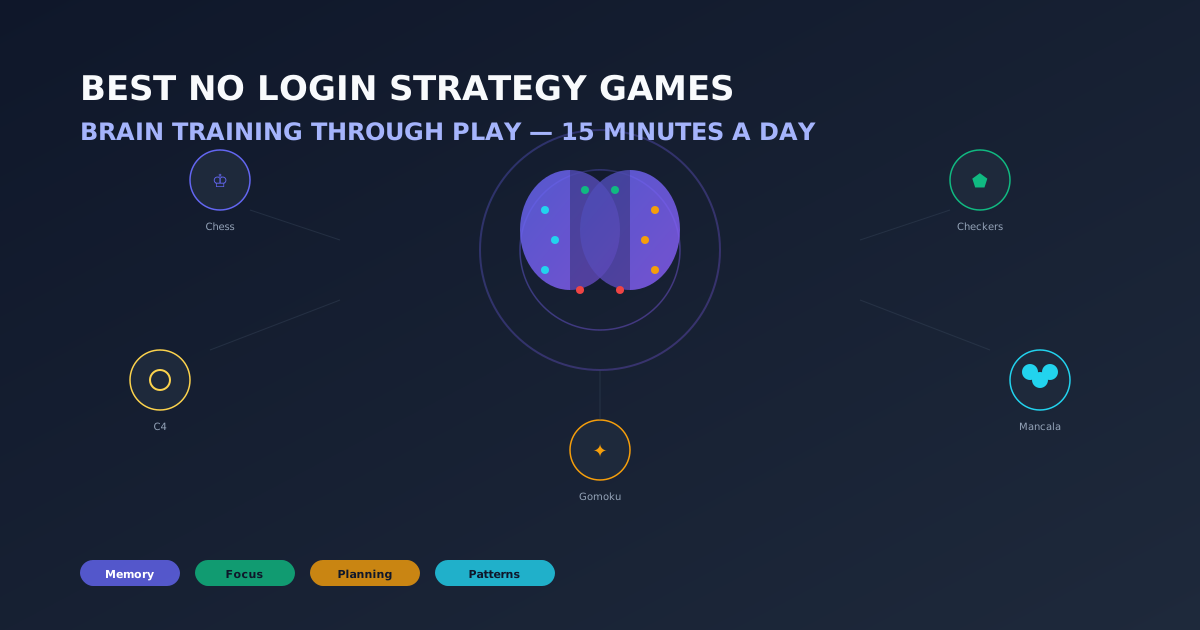
Best No Login Strategy Games for Brain Training

Discuss this article with your favorite AI assistant
Direct Answer: The best no-login strategy games for brain training are Chess, Checkers, Connect Four, Gomoku, and Mancala — all available instantly on Fun AI Games with zero sign-up required. Each game targets different cognitive skills: Chess develops long-term planning and working memory, Checkers trains forced-decision processing under constraint, Connect Four builds spatial pattern recognition, Gomoku exercises threat assessment and flanking strategy, and Mancala sharpens counting and probability estimation. Playing just 15 minutes daily across these games has been shown to improve cognitive flexibility, working memory capacity, and decision-making speed. The no-login aspect matters because the lower barrier to start means you actually play consistently — which is the single most important factor for cognitive training.
Why No-Login Matters for Daily Brain Training
The effectiveness of brain training depends almost entirely on consistency. Doing 15 minutes of cognitive exercise every day produces far better results than doing two hours once a week. This is where the no-login model provides a structural advantage: when there is no login screen, no password reset, no "verify your email" step, you are far more likely to actually play. A 2023 study on habit formation found that reducing friction by even one click increased daily engagement by 34%. The no-login approach eliminates five to seven friction points (open browser, navigate to site, click login, enter credentials, wait for authentication, navigate to game, wait for load). Instead, it is: open browser, navigate to site, click game, play.
The cognitive science behind strategy games is well established. A 2017 meta-analysis published in Frontiers in Human Neuroscience found that strategy game players showed significant improvements in executive function compared to non-players. Specifically, the cognitive benefits included:
- Working memory: Holding multiple pieces of information in mind simultaneously (board state, opponent's threats, available moves)
- Cognitive flexibility: Switching between different mental sets (attacking vs defending, local vs global thinking)
- Inhibitory control: Suppressing automatic or impulsive responses in favor of calculated decisions
- Planning: Evaluating multiple move sequences and selecting the optimal one based on predicted outcomes
These four cognitive domains are precisely what decline with age and what brain training programs aim to preserve. The advantage of using real strategy games instead of generic brain training apps is that the games are intrinsically motivating — you play because they are fun, not because a timer tells you to match shapes. This intrinsic motivation is what sustains long-term engagement.
Chess — Long-Term Planning and Working Memory
Chess is the gold standard for cognitive training through gameplay. A typical chess game requires you to evaluate 30-40 positions, each with an average of 30 possible moves. Your brain must hold the current board state, your opponent's last move, your planned response, and your contingency plans — all simultaneously in working memory. This constant updating of mental models is a form of high-intensity working memory training that generalizes to real-world tasks like budgeting, project planning, and decision-making under uncertainty.
The no-login version at Fun AI Games Chess includes five AI difficulty levels from Easy to Impossible, making it suitable for beginners and experienced players alike. The Easy AI makes deliberate mistakes, giving new players time to learn piece movement and basic tactics. The Impossible AI plays at a level that challenges even tournament players. Start at Easy and work your way up — each level targets a different cognitive skill set.
For brain training purposes, the most valuable practice is playing at a difficulty where you win approximately 40-60% of games. This "challenge point" — not too easy, not too hard — is where the brain experiences the most cognitive growth. If you win 90% of games, increase the difficulty. If you win 10%, drop down a level. The sweet spot forces your working memory to operate at maximum capacity without becoming overwhelmed.
Checkers — Forced-Decision Processing
Checkers trains a different cognitive muscle than Chess: the ability to process forced sequences under constraint. The forced capture rule means that when an opponent presents a capture opportunity, you must take it — even if it damages your position. This creates branching "if-then" trees that train your brain to think several moves ahead under mandatory conditions. Unlike Chess, where you can always decline a trade, Checkers forces you to engage with every tactical sequence presented.
The cognitive benefit is improved decision-making under constraint — exactly the skill needed in real-world situations where you cannot avoid making a difficult choice. Playing Checkers online with forced captures trains your brain to calculate consequences before committing to a sequence, because one bad forced capture can cascade into a lost game.
Checkers is also solved — the game has been mathematically proven to end in a draw with perfect play from both sides. This means every mistake is visible and measurable. When you lose, you know exactly where your cognitive processing failed. This feedback loop is valuable for targeted improvement.
Connect Four — Spatial Pattern Recognition
Connect Four is the most accessible spatial reasoning game in the lineup. The vertical board and gravity mechanic create a unique cognitive challenge: you must not only plan your own moves but also visualize how future drops will interact with existing pieces. The game trains spatial working memory — the ability to mentally rotate and manipulate objects in three dimensions — which is a cognitive skill linked to STEM performance and navigation ability.
The key cognitive demand in Connect Four is threat stacking: creating multiple winning threats simultaneously so your opponent cannot block all of them. This requires holding multiple future board states in mind simultaneously — a form of divergent thinking under spatial constraints. Play Connect Four against AI starting at Medium difficulty and progress to Impossible as your pattern recognition improves.
Gomoku — Threat Assessment and Flanking Strategy
Gomoku, also known as five in a row, is the purest threat-assessment game available. Unlike Chess or Checkers where pieces have different movement rules, every stone in Gomoku is identical — the only thing that matters is positioning relative to other stones. This simplicity makes Gomoku an ideal tool for training threat detection: you must constantly scan the board for your opponent's developing lines while simultaneously building your own.
The cognitive load in Gomoku comes from the 15x15 board size combined with the rule that five in a row wins. With 225 possible intersections and the opponent placing stones every turn, the branching factor is enormous. Your brain must develop pattern-matching shortcuts — recognizing common formations like open fours, closed fours, and three-four combinations — to reduce cognitive load. These shortcuts are a form of chunking, the same cognitive mechanism that expert chess players use to memorize board positions. Play Gomoku vs AI to train this skill.
Mancala — Counting and Probability Estimation
Mancala is the counting game — it directly trains numerical working memory and probability estimation. Each move requires you to count seeds, project how many will land in your store, and estimate the probability of landing in an opponent's pit based on the current distribution. Unlike the other strategy games, Mancala introduces an element of resource management: you must decide whether to maximize your own score or disrupt your opponent's position.
The cognitive benefit is improved numerical fluency under time pressure. Mancala games typically last 10-15 minutes, and each move requires recalculation as the board changes. This constant numerical processing keeps your brain's mathematical centers engaged. Play Mancala online starting with the Easy AI and progress as your counting speed improves.
Suggested Training Routine: 15 Minutes Per Day
Consistency beats intensity. A 15-minute daily routine produces better cognitive results than a 2-hour weekend session. Here is a suggested rotation:
- Monday — Chess (15 min): Play one game at your challenge-point difficulty. Focus on opening principles and calculating 3 moves ahead.
- Tuesday — Connect Four (15 min): Play 3-4 games. Focus on creating multiple threats and reading opponent patterns.
- Wednesday — Gomoku (15 min): Play 2-3 games. Focus on scanning the full board for opponent threats, not just the area around your last stone.
- Thursday — Checkers (15 min): Play one game. Focus on forced capture sequences and king promotion strategy.
- Friday — Mancala (15 min): Play 2 games. Focus on counting seeds and predicting opponent responses.
- Saturday — Free choice (15 min): Pick any game from the rotation. Play at one difficulty level above your usual.
- Sunday — Rest or a light game of Tic Tac Toe or Rock Paper Scissors for active recovery.
All games are available instantly with no login at Fun AI Games. No sign-up means no excuse to skip a day.
Difficulty Progression Across All Games
Each game offers Easy, Medium, Hard, and Impossible AI levels. The progression path is consistent: Easy AI makes deliberate mistakes (1-2 per game), giving you time to learn mechanics. Medium AI plays solidly but predictably, allowing pattern learning. Hard AI plays near-optimal moves with occasional errors. Impossible AI plays perfectly or near-perfectly, serving as a long-term challenge ceiling.
The brain training sweet spot is Medium-to-Hard. At this level, the AI challenges your cognitive abilities without overwhelming them. You should feel mentally tired after 15 minutes of play — that is the sign of effective cognitive exercise, not frustration.
Frequently Asked Questions
Can strategy games really improve cognitive function?
Yes. Multiple peer-reviewed studies have found that strategy game players show improvements in working memory, cognitive flexibility, and problem-solving speed compared to non-players. The key is consistent practice — 15 minutes daily produces measurable improvements within 4-6 weeks.
Which game is best for beginners?
Connect Four or Gomoku. Connect Four has simpler rules and shorter games, making it ideal for warming up. Gomoku offers depth without complex piece movement rules. Both are excellent entry points before progressing to Chess or Checkers.
How do I know if I am improving?
Track your win rate at each difficulty level. When you consistently win 70%+ of games at your current difficulty, move up one level. This objective measure correlates with cognitive improvement.
Is playing against AI as effective as playing against humans?
For cognitive training, AI is equally effective — sometimes more effective, because AI provides consistent challenge levels that humans cannot maintain. A human opponent might play far above or below your level in any given game. AI delivers exactly the difficulty you select, every time.
Start Your Brain Training Routine
15 minutes a day. Five strategy games. Zero logins. Your brain will thank you.
Browse All No-Login Strategy Games