Defensive Gomoku Play: How to Stop an Aggressive Attacker

Discuss this article with your favorite AI assistant
One of the most intimidating experiences in Gomoku is playing against a hyper-aggressive opponent (or an attacking AI) who wields the Black stones. Because Black moves first, they dictate the opening flow of the grid. If you are playing White, your first dozen moves will feel like desperate firefighting. If you only play reactively — simply blocking their stones after they build a threat — you will eventually be overwhelmed by a Double-Three fork. True defense in Gomoku is about pre-emptive spatial control rather than reactive blocking.
Why Reactive Defense Fails
The natural instinct when you see a threat is to block it. In Gomoku, this instinct is correct about 40% of the time. The other 60%, blocking the immediate threat is exactly what your opponent wants you to do, because it lets them build a second threat elsewhere while you waste moves responding to the first one. A strong attacker will create a series of single threats, each forcing you to block, until you run out of space and they run out of patience.
The fundamental flaw of reactive defense is that it cedes initiative entirely. Every move you spend blocking is a move you are not spending building your own position. Against a patient attacker, this means you will eventually face a fork that you cannot block with a single stone. Pre-emptive defense avoids this by denying the attacker the structural foundation they need to build forks in the first place.
The Rules of Engagement for White
1. Block the "Twos", Not Just the "Threes"
Amateur players wait until the opponent establishes an "Open Three" (three stones in a row with both ends empty) before they panic and block it. Against a strong attacker, this is way too late. By the time an Open Three exists, the attacker has already invested three stones in that line. Blocking one end still leaves the other end open, and the attacker can extend from the block to create a second line simultaneously.
Your primary defensive objective is to cap their "Twos". When the opponent places two stones diagonally or horizontally with vast empty space around them, immediately drop your stone on one end. This may feel like paranoia — blocking a "Two" when there is no immediate threat — but it is the single most effective defensive technique in Gomoku. By capping their threat lines at two stones, you completely deny them the structural material needed to build the complex forks (like the Double-Three) required to win.
The one exception: if the opponent's Two is on an edge of the board with only one direction to grow, you can let it develop and block later. Edge-limited twos are inherently weaker and do not justify the tempo investment to cap them early.
2. The "Mirror" Defense
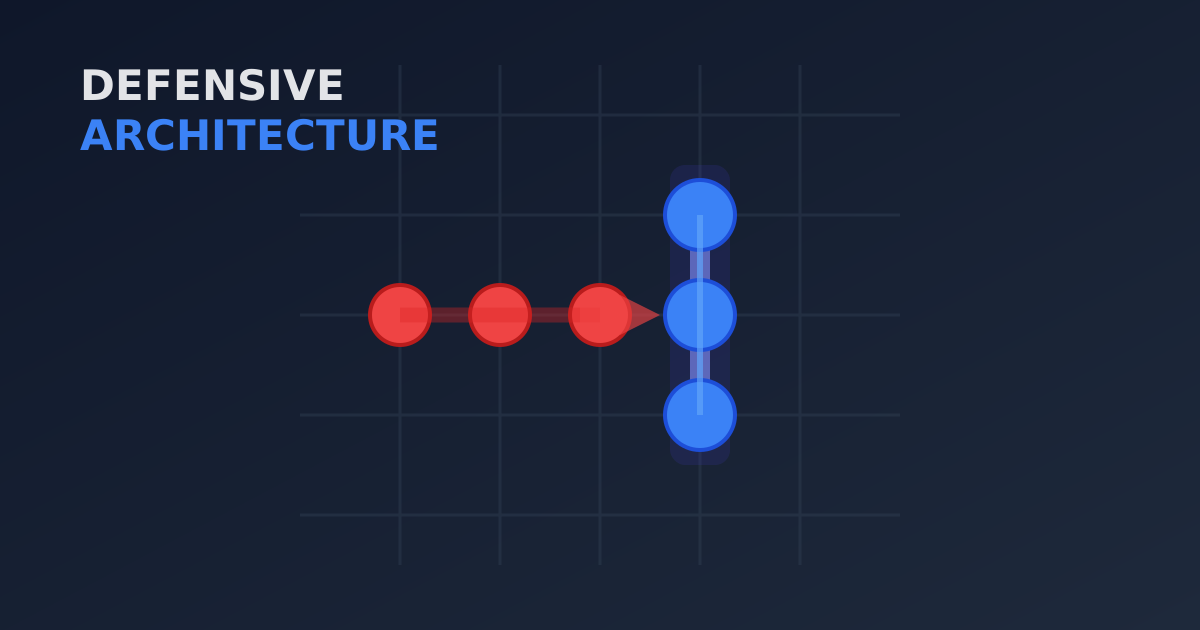
When you are heavily pressured, mimicking the opponent's geometric shape can often safely neutralize their territory. If they build outward from the center, you place your defensive stones parallel to theirs, effectively building a physical "wall" that cuts the 15x15 board in half. Once an attacker hits your wall, their threat lines are officially closed.
The mirror defense works because Gomoku is a game of open space. The 15x15 board has 225 intersections, and the winner is the player who controls the most connected space, not just the most stones. When you mirror the opponent's structure, you are claiming the space on your side of the wall while denying them the space on their side. This is particularly effective against the "V" attack, where Black tries to build two diagonal lines radiating from a center point. Mirroring the angles forces Black to choose between defending their own structure and continuing the attack.
3. The "Staggered Block"
When your opponent has an Open Three, most players block at one end. The stronger response is to block one cell away from the end — leaving a gap between your blocking stone and the threat line. This staggered block serves two purposes. First, it retains the option to extend your own line from the block. Second, it forces the opponent to waste an extra move converting the Open Three into a direct threat, giving you time to build your counter-attack. The staggered block is risky — if the opponent can ignore your extension threat and continue building elsewhere, you have wasted a move. Use it only when your blocking stone connects to existing stones of your own.
Common Defensive Mistakes
Mistake 1: Blocking the Wrong Side of an Open Three
When you must block an Open Three, which side do you choose? The correct answer is the side that gives you the most extension options. If one side of the three points toward a cluster of your own stones, block that side — your counter-attack will be stronger. If one side points toward the board edge, block that side — the attacker has less space to work with on the edge. If both sides are equal, block the side that is farther from the center. Center-adjacent threats are more dangerous than edge threats because they have more directions to grow.
Mistake 2: Playing Too Close to the Attacker
When under pressure, players instinctively place their stones right next to the attacker's line. This creates a dense, tangled cluster where the attacker has more opportunities to fork. Instead, place your defensive stones at a distance when possible. A stone placed three cells away from an attacker's nearest stone creates a much broader defensive perimeter and gives you more room to build your own structure.
Mistake 3: Ignoring Your Own Stone Placement Quality
Every defensive stone you place should be evaluated for its offensive potential. If a blocking stone connects to zero of your existing stones, ask yourself: could I block the same threat with a stone that does connect to my structure? If yes, place that stone instead. Over the course of 20-30 defensive moves, this habit can transform a game you were losing into a game you dominate. A passive defender ends the opening with all stones clustered around the attacker's formation. A smart defender ends the opening with two or three disconnected but promising formations of their own.
Turning Defense into an Unstoppable Counter-Attack
The greatest flaw of a hyper-aggressive Gomoku player is over-extension. When an attacker is laser-focused on building their own five-in-a-row, they frequently neglect their own defensive liabilities.
Every time you place a stone to block an opponent's attack, make sure your blocking stone is simultaneously building your own line. This is called aggressive defense. If the opponent attacks with a three-in-a-row in the center, do not just drop a random blocking stone. Look at the board. Can you block their line using a square that also connects to two of your own dormant stones nearby?
The trigger for a counter-attack is when your blocker creates an Open Three of your own. Once you have an Open Three, the opponent must abandon their assault and block you. The psychological shift is dramatic: in one move, you go from losing to winning. The key is recognizing this moment. Watch for the specific pattern: your blocker completes a line of three where both endpoints are free. The moment this happens, stop building defense and start pushing your attack.
The "Two-Stone Buffer" for Late-Game Defense
If the game reaches the mid-to-late stage and the attacker has already built a sprawling formation, your single-stone blocks will no longer suffice. You need to think in pairs. A Two-Stone Buffer means placing two stones that bracket a critical sector of the board, creating a defensive zone that the attacker cannot penetrate with a single line. This is expensive — two stones for one defensive purpose — but against a well-developed attack, it is the only reliable way to prevent a fork. Focus on the cells where the attacker has the most open extensions, not where their stones currently sit.
Practice Routine: The 20-Game Defensive Drill
To internalize these techniques, run this drill against the Gomoku AI on Medium difficulty:
- Games 1-5: Play as White. Your only goal is to keep the AI from winning for 30 moves. Do not try to win. Focus entirely on capping Twos early and maintaining the mirror defense.
- Games 6-10: Play as White. Same restriction, but now look for staggered block opportunities. Try to leave a gap at least once every game, even if it feels risky.
- Games 11-15: Play as White. Now you are allowed to counter-attack. Use aggressive defense: every blocker must connect to an existing stone or create a new line of your own.
- Games 16-20: Play as White with the goal of winning. By now, your defensive habits should be automatic. The AI should find it very difficult to fork you, and your counter-attacks should convert at least 40% of the time.
After 20 games, switch to Black and try the same sequences. Playing defense as the first player is a different experience — you have more space but also more responsibility. The same principles apply: cap Twos early, mirror their structure, and never block without building.
Test Your Defensive Formations
Play against our Gomoku AI. Let the engine take the Black stones and launch a relentless attack. See if you can build the perfect defensive wall and launch a game-winning counter-strike.
Play Gomoku vs AI FreeDefense in Gomoku is not about cowering; it is about architectural patience. Absorb the early attacks, cap their Twos, build your hidden structures during the blocks, and strike when they run out of space. The transition from defender to attacker happens in a single move — and when it does, your opponent will realize they spent the entire game building a position that you were quietly dismantling from the inside.