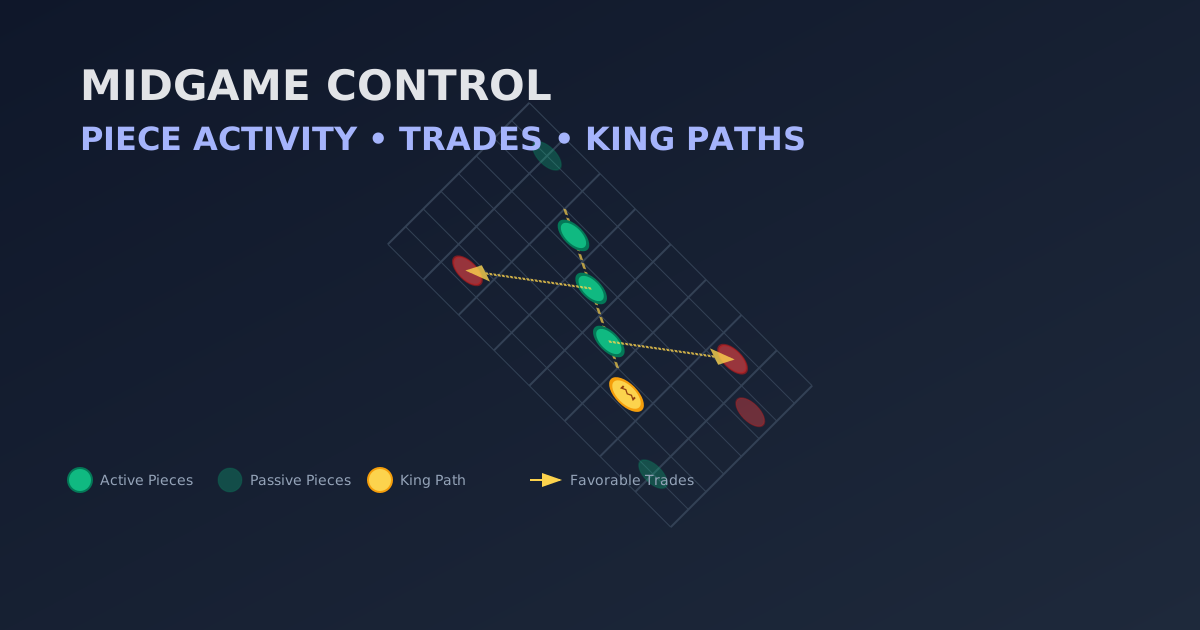
Checkers Midgame Strategy: How to Control the Board After the Opening

Discuss this article with your favorite AI assistant
Direct Answer: The checkers midgame begins the moment your opening structure is set (around move 8-12) and ends when kings enter the board. The single most important midgame principle is piece activity over piece count. A player with 8 active, centrally-placed pieces will dominate a player with 10 passive, edge-hugging pieces. Your goals in the midgame are: maintain your center wedge, identify and execute favorable trades, and create a path to king while denying your opponent the same.
What Is the Midgame in Checkers?
The midgame is the longest and most complex phase of a checkers match. It sits between the opening — where you establish your structure — and the endgame — where kings hunt each other in the corners. During the midgame, both players still have most of their pieces, the board is crowded, and every move has cascading consequences.
Unlike the opening (where the goal is structure) and the endgame (where the goal is trapping), the midgame is about transition. You are transitioning from a structured starting position to a simplified board state where your advantages become decisive. The player who navigates this transition better wins.
The Three Phases of Every Checkers Game
- Opening (Moves 1-10): Establish structure. Control the center. Build your wedge. See: Opening Strategies
- Midgame (Moves 10-25): Improve activity. Execute trades. Create king paths. You are here.
- Endgame (Moves 25+): Trap kings. Manage the 40-move clock. See: Endgame Techniques
The Five Pillars of Midgame Strategy
1. Maintain the Center Wedge
If you built a center wedge during the opening (pieces on squares 14, 15, 18, 19), your first midgame priority is keeping it intact. The wedge does three things simultaneously: it splits your opponent's forces, it gives you maximum mobility, and it creates a physical barrier that funnels enemy pieces toward the edges where they become weak.
How to maintain it: Avoid trading center pieces for edge pieces. If your opponent offers a trade that would remove your piece from square 15 but their piece from square 24, decline by moving a different piece. Center pieces are worth roughly 1.5x an edge piece in terms of strategic value. Only trade center for center.
When the wedge breaks: If your opponent forces a trade that breaks your wedge (often via forced captures), you must rebuild immediately. Push your next available piece into the gap. A broken wedge that isn't repaired within 2-3 moves usually leads to a lost game because the opponent will flood through the center.
2. Piece Activity Over Piece Count
This is the most counterintuitive principle in checkers midgame strategy. Beginners count pieces. Experts count active pieces. A piece is "active" if it has two forward diagonal options and is positioned to influence the center or the opponent's back row. A piece is "passive" if it has only one forward option, is stuck on an edge, or is serving as a back-row defender that never moves.
The Activity Test: Look at each of your pieces and ask: "Can this piece participate in an attack within the next three moves?" If the answer is no, that piece is passive — it exists, but it doesn't contribute. A position with 8 active pieces beats a position with 10 passive pieces almost every time.
Practical application: When deciding whether to accept a trade, don't just count total pieces. Count active pieces. If a trade removes one of your active pieces but also removes one of your opponent's active pieces while leaving their passive pieces untouched, it's usually a good trade for you — the ratio of active pieces improves in your favor.
3. The Art of the Favorable Trade
Trades are the engine of the midgame. Every exchange changes the board's geometry, and the player who controls which trades happen controls the game. There are four types of trades, ranked from best to worst:
- Upgrade Trade: You lose a passive piece, they lose an active piece. This is the holy grail. Sacrifice a back-row defender to remove their center wedge piece. Forced captures make this possible — bait their active piece into jumping your passive one.
- Even Trade: Both pieces are equally active. This simplifies the board, which favors the player with the positional advantage (usually the one with the center wedge).
- Downgrade Trade: You lose an active piece, they lose a passive piece. Avoid these unless the positional compensation is clear (e.g., the trade opens a path to king).
- Disaster Trade: You lose an active center piece, they lose a piece that was already trapped and going nowhere. Never accept this voluntarily.
The key insight: in the midgame, you choose which trades happen. Your opponent can only force a trade by offering a capture. If you don't like the trade on offer, simply don't place your piece in a position where it can be jumped. Move a different piece. Improve a different part of your position. Patience in the midgame is a weapon.
4. Create a King Path
The midgame's ultimate objective is creating a clear path for one of your pieces to reach the king row. A single king in the midgame is devastating — it can move both forward and backward, it can jump in any direction, and it can single-handedly dismantle an opponent's structure.
The Lane Clearing Technique: Identify your most advanced piece (the one closest to the opponent's back row). Now identify every piece — yours and theirs — that sits between it and the king row. You need to clear a "lane" — a diagonal path with no obstacles. Use trades to remove blocking pieces, and use forced captures to pull defending pieces out of position.
The Race: In many midgames, both players are simultaneously trying to create king paths. This creates a "race" situation. The player who kings first usually wins because a midgame king operates against pieces that can only move forward. If you notice your opponent is one step from kinging, you may need to abandon your own king path temporarily to block theirs — even if it means sacrificing a piece.
Back Row Discipline: While you're pushing for a king, don't strip your own back row. The pieces on squares 1-4 (for Black) or 29-32 (for White) are your last line of defense. Moving them forward to join the attack is tempting, but it creates a gap that an alert opponent can exploit for an easy king. Only move a back-row piece when you are certain the opponent cannot reach your king row within the next three moves.
5. Restrict Opponent Mobility
Every move your opponent makes should be slightly worse than the last. This is the "squeeze" principle. By maintaining your wedge and refusing unfavorable trades, you gradually reduce the number of good moves available to your opponent. Eventually, they are forced to make a move that weakens their position — moving an edge piece further into the edge, breaking their own wedge, or abandoning their back row.
The Squeeze in Action: Imagine your opponent has pieces on the left side of the board but your wedge controls the center. Their left-side pieces can only move along the left edge — they have no way to cross to the right side because your wedge blocks them. Each move they make on the left edge pushes them further into a dead end. Meanwhile, your pieces on the right side are freely maneuvering, improving their position with every move. The squeeze doesn't win immediately — it wins by making every opponent move slightly worse than the one before it.
The Midgame Decision Framework
When you're unsure what to do in the midgame, run through this checklist in order:
- Is my wedge intact? If not, repair it immediately.
- Can I execute an upgrade trade? If yes, do it. Removing an active opponent piece for a passive one of yours is almost always correct.
- Am I closer to king than my opponent? If yes, push for the king path. If no, block theirs first.
- Can I improve my worst piece's position? Move your most passive piece toward a more active square.
- Can I restrict my opponent's mobility? Make the move that leaves them with the fewest good options.
If none of these apply, you're likely in a balanced position. Play patiently — maintain your structure and wait for your opponent to make the first mistake.
Common Midgame Mistakes (And How to Fix Them)
Mistake 1: Trading Without a Plan
The most common midgame error is making trades just because they're available. Every trade changes the board. If you don't know why you're trading, don't trade. Ask yourself: "Does this trade improve my piece activity? Does it clear my king path? Does it weaken my opponent's structure?" If the answer to all three is "no," the trade is a waste of a move.
Mistake 2: Abandoning the Center
Some players get excited about an attack on the wing and pull their center pieces out to support it. This is almost always wrong. The center wedge is your foundation. If you dismantle it to chase an attack on the edge, your opponent will simply march through the center while you're busy on the perimeter. Attack from the center — don't abandon it to attack.
Mistake 3: King-Chasing Without Preparation
Pushing a single piece aggressively toward the king row without clearing the path first is a recipe for disaster. Your piece gets blocked, captured, or forced into a corner. Worse, the moves you spent pushing that piece were moves you didn't spend maintaining your wedge or restricting your opponent. King paths are built through methodical lane clearing, not through reckless charges.
Mistake 4: Ignoring the Opponent's King Path
While you're executing your brilliant midgame plan, your opponent is executing theirs. If you don't periodically scan the board for their king path, you'll often find that they king a piece while you weren't paying attention. A midgame king against non-kings is game-breaking. Always check: "Can my opponent reach my back row in the next 2-3 moves?" If the answer is yes, block immediately.
Mistake 5: Moving the Back Row Too Early
Your back-row pieces (squares 1-4 for Black) are the gatekeepers. Moving them forward before the midgame is resolved creates a gap that an opponent can exploit for a cheap king. The back row should stay intact until you have a clear numerical or positional advantage that makes the risk acceptable. There's a reason the opening article warns about this — it's a mistake that spans both phases.
Midgame Patterns From Specific Openings
Your opening choice determines the type of midgame you'll face. Here's how each of the seven major openings shapes the midgame:
From Old Faithful (11-15)
The midgame is balanced and strategic. Both players have solid structures, and the game often comes down to who executes the first successful upgrade trade. Patience is key — don't force trades. Wait for your opponent to make a positional concession, then exploit it. The player who maintains the wedge longer usually wins.
From the Bristol (11-16)
The midgame is asymmetric and tactical. You've ceded some center control for left-flank pressure, so your midgame strategy is to create complications. Look for double-jump opportunities and sacrifice sequences that exploit the unbalanced position. If the game simplifies to an even endgame, the Bristol player is often slightly worse — so you need to make your tactical chances count before the board clears.
From the Glasgow (9-13)
The midgame is defensive and methodical. Your structure is solid but not aggressive. The goal is to gradually improve piece activity, make even trades that simplify the board, and reach an endgame where your small positional advantages become decisive. Don't take unnecessary risks — the Glasgow rewards patient, accurate play.
From the Double Corner (9-14)
The midgame is sharp and fast. You've created early pressure on the opponent's double corner, and the midgame is about converting that pressure into a king. The race is on — if you can force a king before your opponent stabilizes, you win. But if the opponent defends accurately, the early aggression can leave you with a compromised structure. This is a high-variance midgame that rewards calculation.
How to Practice the Midgame Against AI
The midgame is the hardest phase to practice because it requires recognizing patterns, not just executing techniques. Here's a structured approach using our Checkers game:
Easy Difficulty: Learn to Identify Trades
At Easy, the AI will offer many trades. Your practice goal: before every move, classify the available trade (upgrade, even, downgrade, disaster). Only accept upgrade and even trades. If you finish a game with more active pieces than the AI, you've passed this level.
Medium Difficulty: Build King Paths
The Medium AI will defend its back row more carefully. Your practice goal: in every game, identify your most advanced piece and deliberately clear a lane for it to reach the king row. Count how many moves it takes from the moment you identify the lane to the moment you king the piece. Under 8 moves is good; under 5 is excellent.
Hard Difficulty: Execute the Squeeze
The Hard AI won't hand you easy trades or obvious king paths. Your practice goal: play an entire midgame without making a single downgrade trade. Only accept trades that improve your position. If the game reaches an endgame and you have more active pieces (or a king while the opponent doesn't), you've successfully executed the squeeze.
Expert Difficulty: Full Midgame Mastery
At Expert, the AI plays near-optimal midgame strategy. It will maintain its wedge, only offer downgrade trades to you, and create king paths efficiently. Your goal: survive the midgame without falling behind. If you reach the endgame on equal terms against Expert, you've mastered the midgame. From there, endgame technique will close out the win.
Frequently Asked Questions
When does the midgame start in checkers?
The midgame begins when your opening structure is established — typically around moves 8-12. It ends when the first king appears on the board or when the position simplifies enough that endgame techniques (king trapping, the 40-move rule) become the primary concern.
Is it better to have more pieces or better positioned pieces?
Better positioned pieces, almost always. A center piece with two forward options is worth significantly more than an edge piece with one. Count active pieces (those that can participate in an attack within three moves), not total pieces. A player with 8 active pieces will beat a player with 10 passive pieces in the vast majority of games.
Should I trade pieces in the midgame?
Only trade with a purpose. Classify every trade: upgrade (you lose passive, they lose active), even (equal activity), downgrade (you lose active, they lose passive), or disaster (you lose active, they lose trapped). Accept upgrade and even trades. Decline downgrade and disaster trades unless there's clear positional compensation like an open king path.
How do I create a king path in the midgame?
Identify your most advanced piece. Map every piece between it and the king row. Use trades to remove blocking pieces and forced captures to pull defending pieces out of position. Clear one diagonal lane completely. Don't rush the piece forward until the lane is clear — a blocked advanced piece is a liability.
What happens if my center wedge breaks?
Rebuild it immediately. Push your next available piece into the gap within 2-3 moves. A broken wedge that isn't repaired quickly allows the opponent to flood through the center, splitting your forces and creating king-path opportunities on both sides of the board simultaneously.
How does the midgame differ based on opening choice?
Solid openings (Old Faithful, Glasgow) lead to strategic midgames where patience and small advantages matter. Aggressive openings (Bristol, Double Corner) lead to tactical midgames with early trades and king races. Your midgame plan should match your opening — don't play an aggressive opening and then play passively in the midgame, or vice versa.
Summary and Key Takeaways
- The midgame is about transition — converting opening structure into endgame advantage.
- Piece activity beats piece count. Count active pieces, not total pieces.
- Maintain your center wedge at all costs. If it breaks, rebuild immediately.
- Only trade with a purpose. Classify trades as upgrade, even, downgrade, or disaster.
- Create a king path through methodical lane clearing, not reckless charges.
- Restrict opponent mobility — the squeeze wins by making every opponent move slightly worse.
- Never abandon the center to chase a wing attack. Attack from the center.
- Keep your back row intact until you have a clear advantage that makes the risk acceptable.
- Your midgame strategy should match your opening: solid openings → patient midgame; aggressive openings → tactical midgame.
- Connect all three phases: Openings → Midgame → Endgame mastery is the complete Checkers skill chain.
Test Your Midgame Strategy
Put these midgame principles to work against our AI. Start with Medium difficulty and practice identifying favorable trades and building king paths.
Play Checkers OnlineReferences: World Checkers Federation competitive play guidelines | Chinook Project (University of Alberta) | Schaeffer et al., Science 2007.