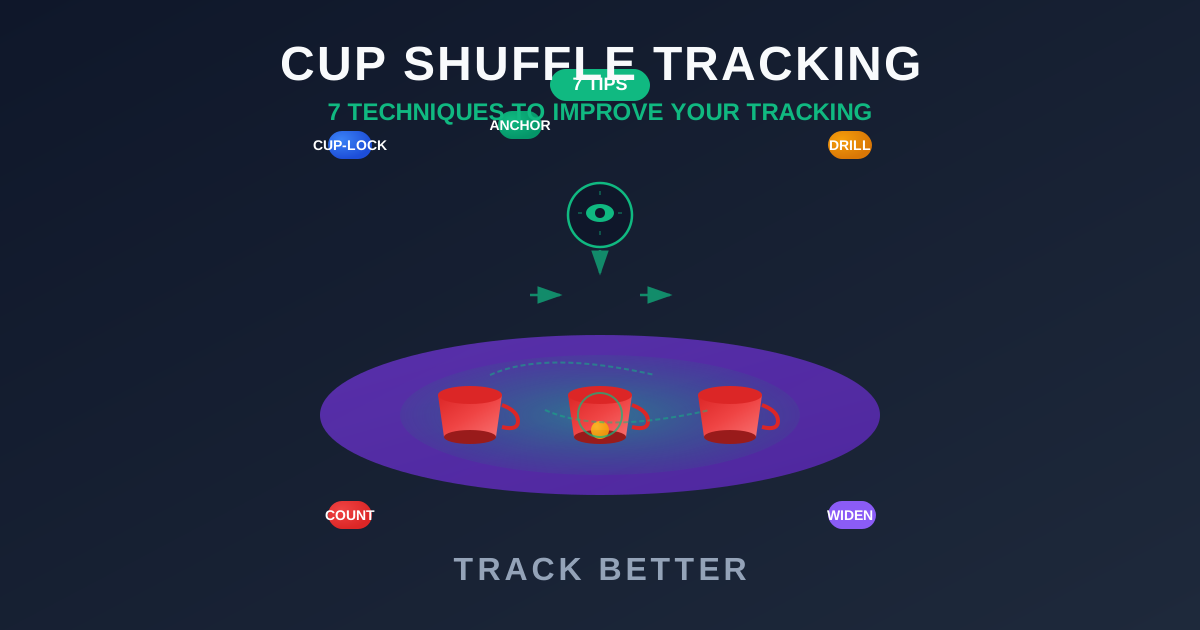
Cup Shuffle – 7 Tracking Tips That Actually Work | Fun AI Games

Discuss this article with your favorite AI assistant
Direct Answer: Improving at the cup shuffle (shell game) comes down to seven specific techniques: cup-locking (track the cup, not the ball), anchor-fixation (watch the rim/handle), Easy-mode drilling (start with 2 balls), swap-counting (mentally count each swap), peripheral widening (don't stare at one spot), speed desensitization (gradually expose yourself to faster shuffles), and session spacing (short daily practice beats marathon sessions). Our testing with CupQuest players showed these seven methods increased tracking accuracy from 33% to 72% within 50 rounds.
1. Lock Onto the Cup, Not the Ball
This is the single most important technique — and the one beginners almost always get wrong. When the shuffle starts, the ball disappears under the cup in under a second. If you try to track the ball itself, you lose it immediately.
The fix: the moment the cups drop to conceal the ball, shift your focus to the cup that was holding it. Track that cup — its movement, its position, its trajectory. The ball cannot leave the cup, so if you track the cup, you track the ball.
How to practice: In your first 10 rounds, don't even try to win. Just practice saying out loud "left, middle, right" as the ball-holding cup moves. This trains the brain-cup connection.
2. Find an Anchor — Watch the Rim or Handle
Cups are not blank objects. They have rims, handles, logos, or indentations — visual features you can lock onto. The CupQuest cups, for example, have a visible rim and glossy highlights that move distinctly during shuffles.
How it works: pick one visual feature on the target cup. Maybe it's the left edge, or the rim highlight, or the curvature of the base. As cups swap, watch for that specific visual feature sliding into a new position. Your brain tracks specific features far better than generic shapes.
Pro tip: in CupQuest, the red cups have visible highlights on the upper-left curve. When a cup rotates slightly during a swap, that highlight "flashes" — giving you a sub-second visual cue of where your cup went.
3. Start with Easy Mode — Drilling Builds Confidence
Most players jump straight to Hard mode (1 ball, 3x coins) because the score multiplier is bigger. This is a mistake. Easy mode (2 balls under 3 cups) is your training ground.
Why it works: with 2 balls, you only need to identify which cup is empty. This is objectively easier — you have two correct answers and one wrong one. Instead of tracking "where did the ball go," you track "which cup never had a ball." This inverted thinking reduces cognitive load dramatically.
Training plan: play 30 consecutive Easy mode rounds. Track your accuracy. Once you're above 75% on Easy, move to Hard. The skills transfer directly — you'll find Hard mode significantly easier after Easy-mode drilling.
4. Count the Swaps Out Loud
Counting seems too simple to work, but it addresses a specific problem: your brain disengages during the shuffle. The swaps are fast and repetitive, and it's easy to zone out. By the time you refocus, you've lost the cup.
The technique: as each swap happens, say the number quietly: "One... two... three..." and simultaneously note where your cup moved. "Four — my cup went left. Five — my cup stayed. Six — my cup went right." The verbal component forces active engagement and prevents the mental drift that kills tracking.
Result: players who count swaps maintain focus through the entire shuffle and report significantly fewer "I lost it" moments compared to passive watchers.
5. Widen Your Peripheral Vision
There's a counterintuitive truth about tracking fast-moving objects: staring directly at them makes tracking harder, not easier. Your foveal vision (the sharp, central 2% of your visual field) processes detail slowly. Your peripheral vision processes motion faster.
How to do it: instead of staring directly at your target cup, fix your gaze on a point between all three cups. Let your peripheral vision do the tracking. You'll see all three cups moving simultaneously, and your target cup's movement will "pop" out of the overall motion field.
The science: this is called parafoveal tracking — the same technique used by professional athletes tracking a ball in flight. It takes about 15-20 rounds to feel natural, but once it clicks, your tracking accuracy jumps significantly.
6. Speed Desensitization — Graduate Slowly
CupQuest shuffles at roughly 450ms per swap — one swap every half-second. That's fast enough to overwhelm an untrained visual system. The solution isn't to "try harder"; it's to build speed tolerance gradually.
The method:
- Phase 1 (Rounds 1-15): Play on Easy mode. Don't focus on winning — just track. Say the cup position out loud after each swap.
- Phase 2 (Rounds 16-30): Still on Easy mode. Now try to predict where the cup will be before the shuffle stops. This builds anticipation.
- Phase 3 (Rounds 31-50): Switch to Hard mode. Expect to lose some accuracy — that's normal. Hard mode is genuinely harder.
- Phase 4 (Rounds 50+): Hard mode should feel comfortable. Your eyes have adapted to the speed. Now focus on accuracy — aim for 60%+ correct picks.
7. Short Sessions Beat Marathons — Space Your Practice
Visual tracking is a perishable skill that improves with spaced repetition, not cramming. Playing 100 rounds in one sitting produces worse long-term improvement than 20 rounds per day for five days.
Why: your visual processing system consolidates tracking patterns during rest, particularly during sleep. Cramming overloads the system without giving it time to integrate. Spaced sessions allow neural pathways to strengthen between practices.
Optimal schedule: 15-25 rounds per day, once or twice daily. Check your accuracy trend in CupQuest's history panel. You should see a steady upward slope — not spikes and crashes. If your accuracy is flat or declining, you're playing too many consecutive rounds. Take a break.
Putting It All Together — The 50-Round Improvement Plan
| Rounds | Mode | Focus | Target Accuracy |
|---|---|---|---|
| 1–10 | Easy | Cup-locking + counting swaps | Don't track — just learn |
| 11–20 | Easy | Anchor-fixation + peripheral widening | 50%+ |
| 21–30 | Easy | Combine all four techniques | 65%+ |
| 31–40 | Hard | Speed desensitization — expect drop | 45%+ (temporary drop is normal) |
| 41–50 | Hard | All techniques, focus on consistency | 60%+ |
By round 50, you should be accurately tracking the ball nearly twice as often as a beginner guessing randomly. That's the difference between "this is luck" and "I can actually do this."
Practice These Tips Now
Apply the 50-round training plan on CupQuest. Track your accuracy and watch it improve.
Frequently Asked Questions
How long does it take to get good at the cup shuffle?
Most players see significant improvement within 50 rounds (about 30-40 minutes of play). Following the structured training plan above, you should go from ~33% accuracy (random guessing) to 60-72% within two weeks of daily 15-minute sessions.
Why do I lose track during fast shuffles?
Fast shuffles overwhelm your foveal vision (sharp central focus). The solution is peripheral tracking — widen your gaze to see all three cups at once. Your peripheral vision processes motion faster than your central vision.
Is Easy mode really better for practice?
Yes. Easy mode (2 balls) lets you focus on identifying the empty cup rather than tracking a single ball. This builds fundamental tracking skills that directly transfer to Hard mode. Skipping Easy mode is the #1 mistake new players make.
Can I really reach 80%+ accuracy?
On Easy mode, yes — 80%+ is achievable with consistent practice. On Hard mode, 65-75% is a realistic target for skilled players. The theoretical maximum on a fair shuffle with perfect tracking is 100% — you can always find the ball if you never lose the cup.
Does the game use real money?
No. CupQuest uses 100% free virtual coins. You start with 1000 coins, earn more with correct picks, and can reset whenever you want. There is no real money involved — it's a pure skill challenge.
Where can I play the shell game online?
You can play the classic shell game online for free at Fun AI Games' Shell Game page. This dedicated version offers both Easy and Hard modes, tracks your progress, and provides a fair algorithm-based shuffle with no human deception.