Is Rock Paper Scissors Just Luck? The Math and Strategy Explained

Discuss this article with your favorite AI assistant
The Math Behind the Hand Game:
This article explores the game theory, probability, and statistics of Rock Paper Scissors. For the psychological side — reading opponents, spotting patterns, and behavioral tells — see our companion piece The Psychology of Rock Paper Scissors. Ready to beat AI? Read How to Beat a Rock Paper Scissors AI.
The Mathematical Truth of a Children's Game
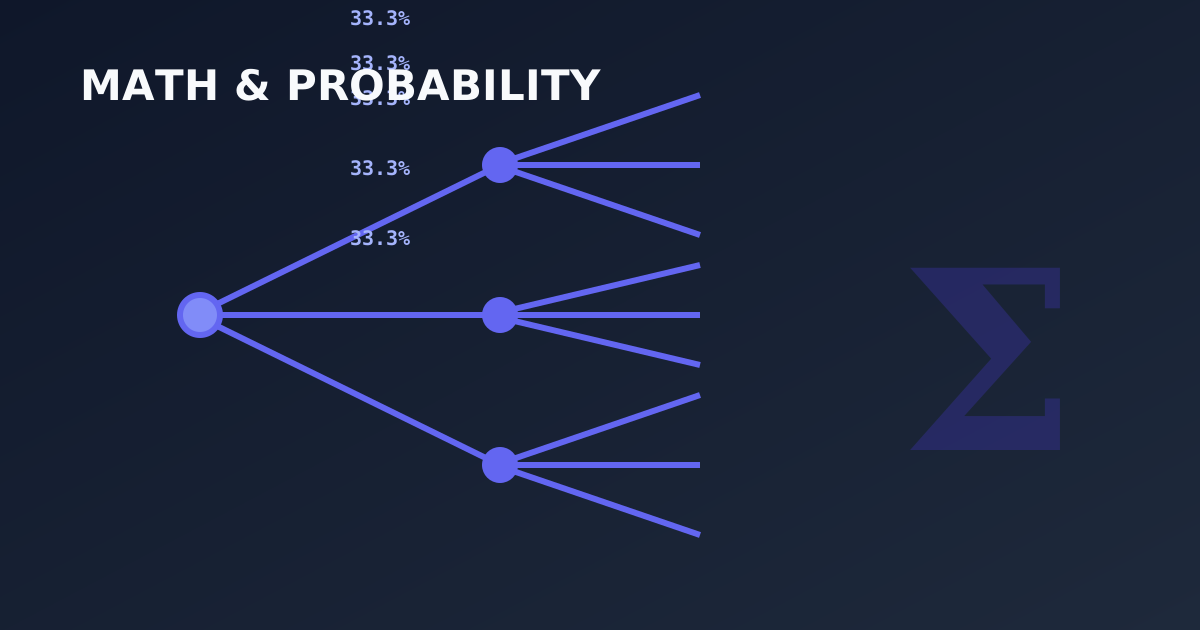
When you boil Rock Paper Scissors (RPS) down to its purest, most academic form, it represents a perfect zero-sum game. The rules state that there are exactly three choices, each with a 33.33% chance of being thrown randomly, and each choice has an identical 1/3 probability of winning, losing, or tying.
Because of this, mathematicians and game theorists utilize Rock Paper Scissors as the foundational model to explain complex concepts like the Nash Equilibrium and statistical probability. But does this math mean the game is purely luck? Not quite.
Understanding the Nash Equilibrium
Named after the Nobel Prize-winning mathematician John Forbes Nash Jr., a Nash Equilibrium occurs in game theory when no player can gain an advantage by unilaterally changing their strategy, assuming the other players keep their strategies unchanged.
In the context of Rock Paper Scissors, the optimal Nash Equilibrium strategy is terrifyingly simple on paper but impossible for a human to execute flawlessly: Throw Rock, Paper, and Scissors completely at random, exactly 33.33% of the time each.
If you play with absolute, true randomness, you cannot be exploited. No pattern-recognition software, psychologist, or professional opponent can gain an edge over you, forcing the game into a statistical 50/50 toss-up over infinite rounds.
Why Humans Fail the Nash Equilibrium
You cannot randomly generate numbers in your head. It is biologically impossible. When humans try to "act random," they actually follow subconscious patterns. For example, if you ask a human to throw randomly 100 times in a row, they will almost never throw the same shape three times consecutively, because their brain believes "three times isn't random." A true random number generator, however, will naturally string together streaks of three or four quite often.
The Mathematical Proof
The Nash Equilibrium for Rock Paper Scissors can be expressed mathematically. If Player A chooses Rock with probability p, Paper with probability q, and Scissors with probability r (where p + q + r = 1), and Player B chooses similarly, the expected value of the game for Player A is:
E(A) = p(q_B - r_B) + q(r_B - p_B) + r(p_B - q_B)
When both players use the optimal mixed strategy (p = q = r = 1/3), the expected value equals zero. Neither player can improve their outcome by changing strategy unilaterally — this is the equilibrium.
The Mathematics of Large-Scale Tournaments
Chinese researchers at Zhejiang University conducted a massive mathematical study involving 360 students playing 300 rounds of RPS. If the game was pure luck, the data would reflect the Nash Equilibrium (a chaotic 33% spread across all choices). Instead, the data revealed fascinating strategic patterns. This research was published in Nature Scientific Reports as "Social cycling and conditional responses in the Rock-Paper-Scissors game" (Wang et al., 2014).
Key Findings from the Zhejiang Study:
- Sample Size: 360 participants × 300 rounds = 108,000 total throws for robust statistical analysis
- Deviation from Random: Human throws deviated significantly from the expected 33.33% distribution
- Temporal Patterns: Choice distributions changed based on game history (wins/losses in previous rounds)
What This Means Statistically
The Zhejiang study demonstrated that with a large enough sample size, human behavior in Rock Paper Scissors becomes predictable in aggregate, even if individual players vary. The chi-squared test of their data showed statistically significant deviation from uniform random distribution (p < 0.001), proving conclusively that humans do not play randomly.
The Winner-Loser Effect
Perhaps the most significant mathematical discovery was the "winner-loser effect" — a measurable statistical bias in how humans respond to wins and losses:
- After Losing: Players showed statistically significant tendency to shift to the option that would have beaten their opponent's last throw
- After Winning: Players demonstrated overwhelming probability (>60%) of repeating their winning choice
This mathematical bias creates exploitable patterns. For the psychology behind why humans do this — and how to spot it in real-time — see our companion article on RPS Psychology.
Probability Trees and Expected Value
In tournament play, understanding probability trees helps you make mathematically optimal decisions. If you know your opponent favors Rock 40% of the time (as many beginners do), your optimal counter-strategy is:
- Play Paper 50% of the time (beats their Rock, neutral vs other)
- Play Scissors 30% of the time
- Play Rock 20% of the time
This exploits their bias while maintaining defensive coverage against their other options.
Expected Value Calculation
Against an opponent playing Rock 40%, Paper 30%, Scissors 30%:
- EV of playing Paper: (0.40 × +1) + (0.30 × 0) + (0.30 × -1) = +0.10
- EV of playing Rock: (0.40 × 0) + (0.30 × -1) + (0.30 × +1) = 0.00
- EV of playing Scissors: (0.40 × -1) + (0.30 × +1) + (0.30 × 0) = -0.10
Paper has positive expected value against this opponent profile, making it the mathematically optimal choice.
Frequently Asked Questions
Is Rock Paper Scissors mathematically fair?
With perfect random play from both sides, yes — each player has exactly 50% expected win rate over infinite rounds. However, humans cannot achieve perfect randomness, creating exploitable imbalances.
What's the best strategy if I don't know my opponent's tendencies?
Play as close to the Nash Equilibrium (33.33% each) as possible. Use a randomization aid (dice, coin flips) if available. This prevents exploitation even if it doesn't actively exploit your opponent.
How many rounds until skill beats luck?
Statistically, skill advantages become visible over 20-30 rounds. In single-round elimination, luck dominates. In best-of-10 or longer series, strategic adaptation becomes decisive.
Does the first move matter in RPS?
No — unlike games such as Connect Four or Tic Tac Toe, RPS has no first-mover advantage. The game is symmetric.
Can I use math to beat AI opponents?
Traditional RPS AI uses pattern recognition and Markov chains to exploit human predictability. To beat AI, you need true randomness (which humans can't generate) or counter-strategies. See our guide on How to Beat RPS AI for specific techniques.
Test Your Mathematical Understanding
Knowing the math is entirely different from executing it under pressure. Our AI opponents use probability analysis and pattern recognition to exploit predictable play.
Challenge the Mathematics
Put your understanding of probability and Nash Equilibrium to the test. Can you maintain perfect randomness against an algorithm designed to find patterns?
Play Rock Paper Scissors vs MachineRelated Reading
- The Psychology of Rock Paper Scissors — Reading opponents, behavioral tells, and pattern exploitation
- How to Beat a Rock Paper Scissors AI — Counter-strategies against adaptive algorithms
- Is Connect Four Solved? — Another solved game with mathematical first-player advantage
Ultimately, Rock Paper Scissors is only "just luck" if you play it once. Across a series of ten, twenty, or fifty games, it becomes a beautiful mathematical battleground of probability, risk analysis, and game theory. Master the Nash Equilibrium, understand tournament mathematics, and you'll have the theoretical foundation to dominate the hand game.