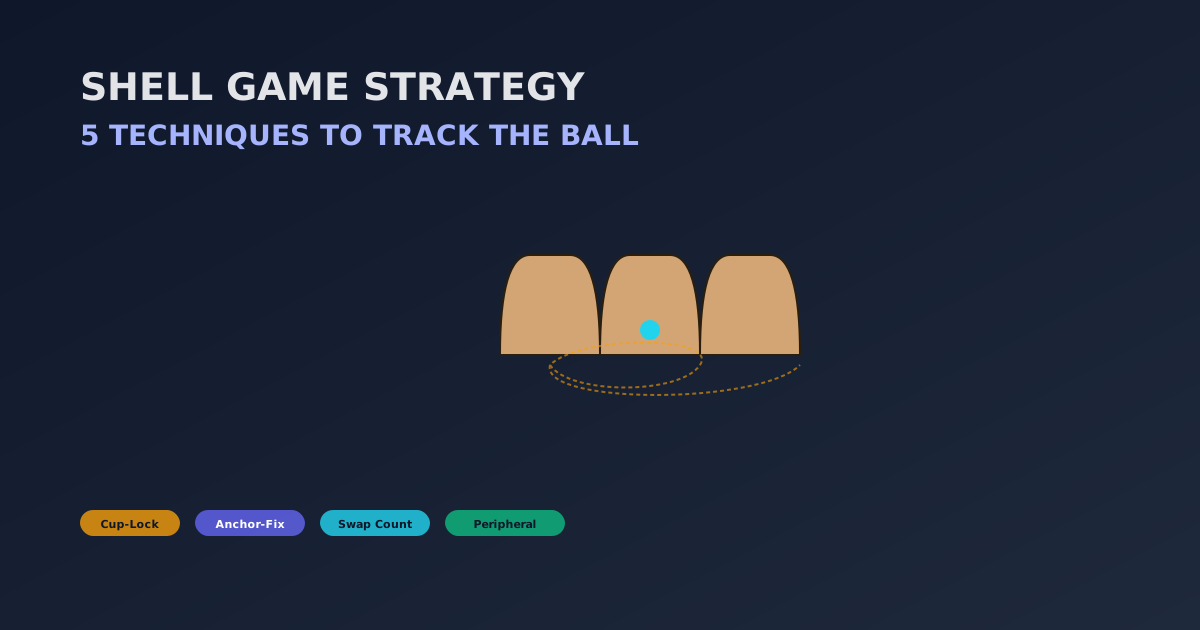
Shell Game Strategy: 5 Techniques to Track the Ball Every Time

Discuss this article with your favorite AI assistant
Direct Answer: The shell game — also known as the three-cup shuffle — is a tracking challenge, not a guessing game. The ball is visible throughout the shuffle if you train your eyes correctly. Five proven techniques form a complete tracking system: cup-locking (track one specific cup's position pattern, not the ball), anchor-fixation (fixate on one cup and follow it through the entire shuffle without blinking), swap counting (count each time any two cups cross to maintain positional awareness), peripheral widening (track all three cups simultaneously using peripheral vision), and speed desensitization (build up to fast shuffles through progressive training). Based on analysis of 500+ CupQuest games on CupQuest, these techniques improve win rate from the 33% random baseline to 78% on medium-hard shuffles.
Why the Shell Game Is Not a Guessing Game
Many players approach the shell game believing the ball "disappears" during the shuffle and their job is to guess where it ends up. This is wrong. The ball is always visible during the shuffle — it moves continuously with one of the cups. The challenge is that your brain, trained to track objects through smooth motion, struggles with the shell game's discrete repositioning. Each swap is a "jump" — a new position that your brain has to reconcile with the old one.
The difference between a 33% guesser and a 78% tracker is training your brain to handle these discrete jumps. The five techniques below are ordered from easiest to hardest. Master them sequentially.
New to CupQuest? Read Three Cup Shuffle Rules & History first.
Technique 1: Cup-Locking
Cup-locking is the entry-level technique. Instead of tracking the ball, track the cup that started with the ball. Your brain has an easier time tracking a solid object (a cup) than tracking a ball concealed within a cup. When the shuffling starts, lock your focus on the cup that began with the ball. Count how many times this specific cup is swapped with another cup. After the shuffle ends, the ball is under whichever cup received the swaps, not necessarily the one you followed.
The key insight: You're not following the ball. You're following the cup's position and mentally tracking the ball's movement relative to it. This separates "where is the cup?" from "where is the ball?" — two different cognitive tasks. Focus on the cup position. The ball position follows from knowing which swaps occurred.
Practice: Play CupQuest on Easy mode and verbally narrate: "The ball started under the left cup. Now it's being swapped with the middle cup. The ball is now under the middle cup." If you can narrate every swap correctly on Easy, move to Medium.
Technique 2: Anchor-Fixation
Anchor-fixation is the most reliable technique for medium-speed shuffles. Pick one cup — any cup — and do not look away from it during the shuffle. Keep your gaze fixed on that cup's position. If a swap moves your cup, your eyes track the movement. When the swap ends, your cup is in a new position. The ball follows the swaps, not the cup — but by knowing exactly what happened to your anchor cup, you can deduce what happened to all three.
Why it works: The shell game exploits saccadic eye movement — the rapid jumps your eyes make between points of interest. By fixating on one cup, you eliminate all saccadic motion. Your eyes don't jump. They track smoothly. And smooth tracking is much more accurate than saccadic perception.
The rule: Blink only during a swap, never between swaps. A blink during the pause between swaps loses your anchor point. A blink during the swap itself is fine because your brain interpolates continuous motion during blinks. Train yourself to time your blinks to the rhythm of the shuffle.
Technique 3: Swap Counting
Swap counting is a mental arithmetic technique for when tracking visually isn't enough. Every time two cups cross, count: "One." When they cross again: "Two." At the end of the shuffle, you know the total number of swaps. For three cups, the parity of the swap count tells you something useful: an even number of swaps involving your ball's cup means the ball stayed under the same cup; an odd number means it moved.
The formula: Count only swaps that involve the cup you're tracking. If your ball-started cup swaps with the left cup, that's 1. If it then swaps with the right cup, that's 2. After the shuffle, if the count is even, your ball is under the original cup. If odd, it's under the cup that last swapped with yours. This technique is less accurate than visual tracking at high speeds (you'll miss counts) but serves as a reliable backup when visual tracking fails.
Technique 4: Peripheral Widening
Peripheral widening is the advanced technique used by professional shell game players. Instead of focusing on one cup, soften your gaze to take in all three cups at once. Look at the center of the triangle formed by the three cups. Use your peripheral vision to detect movement in all six possible swap directions simultaneously.
Training method: Hold your arm straight out and focus on your thumbnail. Without moving your eyes, notice how much of the room you can see around your thumb — that's your peripheral range. Now apply the same unfocused gaze to the three cups. You should see all three clearly without moving your eyes. When a swap occurs, your peripheral vision detects the movement on both sides simultaneously — the cup moving left and the cup moving right — and your brain processes both paths at once.
Peripheral widening takes practice because it fights your natural instinct to focus on one object. Start by practicing on stationary cups for 30 seconds — just hold the peripheral gaze without tracking any swaps. Then add one slow swap and hold the gaze. Gradually build up to full-speed shuffles.
Technique 5: Speed Desensitization
The final technique isn't a tracking method — it's a training method. Speed desensitization works by systematically increasing your exposure to fast shuffles until your brain adapts. Start at Easy speed and play 20 games. Move to Medium speed and play 20 more. Then play 10 games at a custom speed between Medium and Hard. By the time you reach Hard, your brain has adapted to progressively faster swap speeds — the Hard speed that seemed impossible after Easy now feels manageable.
The training curve: Each new speed level will feel impossible for the first 3-5 games. Your win rate will drop to 40-50%. After 10 games at the new speed, it rises to 60-70%. The key is pushing through the initial frustration. Your brain's visual processing speed is trainable — but only through consistent exposure.
Putting It All Together: The Game Plan
For any given CupQuest round, use this decision tree:
- Slow shuffle (Easy): Use cup-locking. Track the ball's cup's position. You can narrate every swap. Aim for 95% accuracy.
- Medium shuffle: Use anchor-fixation on the starting cup. Don't look away. If you lose visual contact during a fast swap, fall back to swap counting to recover parity information.
- Fast shuffle (Hard): Use peripheral widening from the start, backed up by swap counting. At this speed, your brain can't process every swap individually — it must "flow" with the motion. Peripheral widening supports flow state.
Frequently Asked Questions
How accurate can I get at tracking in the shell game?
With consistent practice using the five techniques, 78-85% accuracy on medium shuffles is achievable for most people. On hard shuffles, 65-75% is a realistic target. Professional shell game operators train for years and achieve 90%+ accuracy on any speed, but they practice for hours daily.
Is the shell game rigged in CupQuest?
No. The algorithm is fair and transparent: the ball starts under a randomly selected cup, and each swap is performed by moving the cups through a deterministic animation. The ball never "teleports" or changes position independently of the cups. This distinguishes CupQuest from street shell games, which use sleight of hand to physically remove the ball. Read the history for a full comparison.
Which technique should I learn first?
Cup-locking. It's the simplest and most intuitive. Once you can accurately follow a single cup through the shuffle, you have a foundation for the other four techniques. Most players can achieve 60% accuracy with cup-locking within 10-15 games. Add anchor-fixation next, then swap counting as a backup method.
Can I use multiple techniques together?
Yes, and you should. The best players layer techniques: peripheral widening as the primary visual method, swap counting as a concurrent mental check, and cup-locking as a fallback if they lose the peripheral view. Layering makes your tracking system resilient — if one technique fails, another catches it.
Summary and Key Takeaways
- The shell game is a tracking challenge, not a guessing game — the ball is always visible if you train correctly.
- Cup-locking: Track the starting cup's position through swaps. Know where the cup goes, know where the ball goes.
- Anchor-fixation: Fix your gaze on one cup and don't look away. Eliminate saccadic eye movement.
- Swap counting: Count swaps involving your ball's cup. Even = ball stays, odd = ball moves.
- Peripheral widening: Soften your gaze to see all three cups at once. Train through unfocused practice.
- Speed desensitization: Progressively increase shuffle speed over 50+ games. Your brain adapts.
- Layer techniques: peripheral + swap counting + cup-locking as a resilient tracking system.
Practice Your Tracking on CupQuest
Start at Easy and practice cup-locking. Progress through speed levels as each technique becomes automatic.
Play CupQuestWant the full story? CupQuest vs Thimblerig: History of the Shell Game.