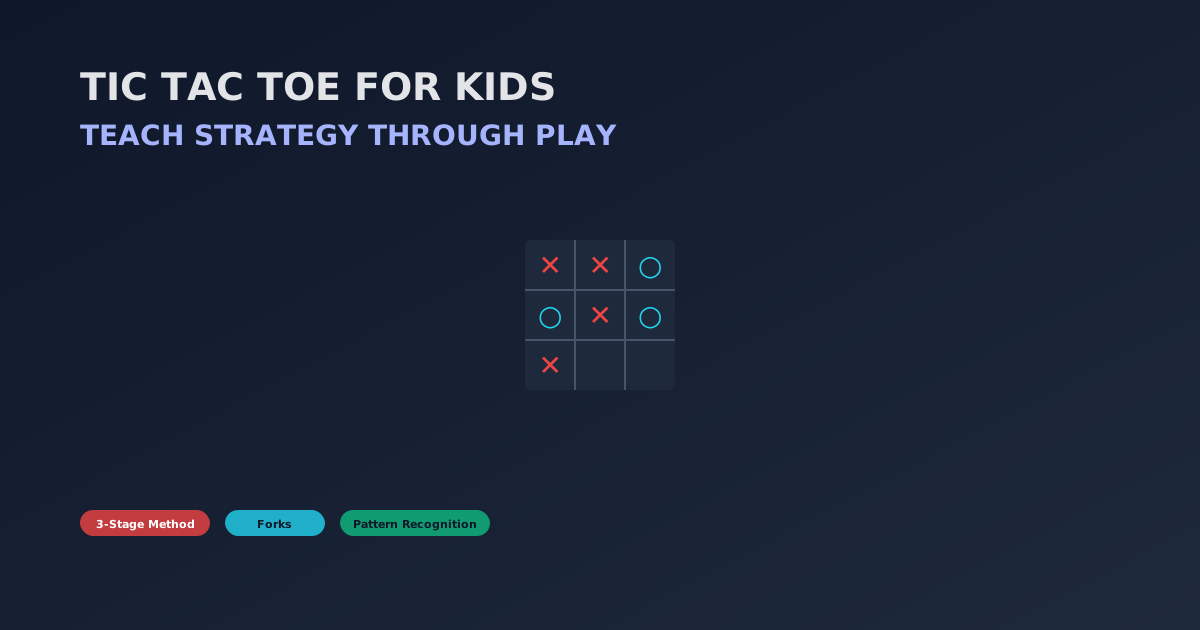
Tic Tac Toe for Beginners: How to Teach Strategy Through Play

Discuss this article with your favorite AI assistant
Direct Answer: Tic Tac Toe is the cleanest gateway game for teaching strategic thinking on a shared screen. The 3-stage method works like this: Stage 1 (first sessions) — learn the rules and play for completion; the goal is legal moves and recognizing a win. Stage 2 (after the first dozen games) — learn blocking and basic strategy; the goal is understanding that every move has a consequence. Stage 3 (when draws become common) — learn forks, traps, and optimal play; the goal is mastering the game and transitioning to checkers or chess. Each stage builds on the previous one without pressure — Tic Tac Toe has only 255,168 possible games, which makes it a safe place to experiment.
Why Tic Tac Toe Is the Perfect Teaching Tool
Tic Tac Toe sits at a useful intersection: the rules fit in a minute, but genuine strategic depth takes practice. The game tree is small enough (255,168 positions) that a beginner can experiment without feeling lost, and large enough that each game still feels different. More importantly, it teaches the three core components of strategic thinking that transfer to chess, checkers, and everyday decisions.
Play a few games against our Tic Tac Toe AI to see the range of difficulty. Easy AI leaves openings on purpose so a new player can finish a line. There is no separate Kids Mode — Easy vs Impossible is the whole ladder.
Fun AI Games is for adults, families, and beginners playing together. It is not directed at children under 13 and does not claim a children's product.
Stage 1: Rules and Recognition (First Sessions)
At this stage, the goal is not winning — it is understanding. Teach three things: (1) pieces go in empty squares, (2) three in a row wins, (3) the game ends when the board is full or someone wins. That's it. Play 10–15 games at this level. Don't offer advice during the game. Let patterns show up through repetition.
Teaching strategy: Play on the Easy AI setting. Easy AI makes deliberate mistakes — leaving two-in-a-row threats unblocked, playing in corners instead of the center. That gives a new player chances to win naturally. Every win reinforces the rules. Every loss teaches a lesson without a lecture.
Key milestone: By the end of Stage 1, the player should be able to: place pieces only in empty squares, identify when they have three in a row, identify when you have three in a row, and tell when the board is full. If they can do all four, they're ready for Stage 2.
Stage 2: Blocking and Consequences (After the First Dozen Games)
Now introduce opponent awareness. Before every move, ask: "What is the other player trying to do?" Once they can name the threat, teach the block: "If they have two in a row, we take the third square."
Teaching strategy: Switch to Medium AI. Medium AI blocks threats but doesn't create forks. That is the right training partner for Stage 2 — the player must learn to block, but they won't be punished for missing a fork they haven't learned yet. Play 15–20 games at this level.
The 2-move lookahead game: Around game 10 of Stage 2, introduce "thinking ahead by one move." Say: "I'm going to put my piece here. Where should you put yours? Good. Now where should I put mine?" That back-and-forth is the foundation of look-ahead in every two-player game.
Key milestone: They can consistently block two-in-a-row threats and can predict your next move most of the time. They should be winning roughly half their games against Medium AI. If they're losing consistently, stay in Stage 2.
Stage 3: Forks, Traps, and Optimal Play (When Draws Become Common)
Now introduce the idea that makes Tic Tac Toe a real strategy game: the fork. A fork is a move that creates two separate two-in-a-row threats at once. The opponent can only block one — you win with the other. Forks are the bridge between Tic Tac Toe and chess (where forks matter just as much).
The fork setup: Teach the "center + opposite corner" pattern. If the player takes the center and the opponent takes a corner, they take the opposite corner. That creates a fork: two ways to complete three in a row, and only one can be blocked. Our Complete Fork Strategy Guide has the full breakdown.
Advanced concept — the trap: A trap is a move that looks like a mistake but sets up a fork. If they play in the center and you respond in a corner, they can play on an edge (not the opposite corner). Their next move creates a fork you cannot fully stop. Traps are the most advanced Tic Tac Toe idea and a good signal that checkers or chess will not feel like a wall.
Transitioning to Chess and Checkers
Once someone has mastered Tic Tac Toe (forks, traps, and optimal play), they have the strategic foundation for chess and checkers. The concepts transfer:
- From Tic Tac Toe forks to chess forks: One piece attacks two targets. A knight fork is the same structure on a different board.
- From blocking to defense: Stopping a three-in-a-row is the same reflex as stopping a mate threat — see the danger, occupy the square.
- From pattern recognition to board vision: Scanning a 3×3 grid for lines is the habit you need on 8×8 with more piece types.
Start with Checkers (simpler rules, smaller decision space) before Chess. The staircase is Tic Tac Toe → Checkers → Chess.
Frequently Asked Questions
Who is this method for?
Anyone new to strategy games on a shared screen — a partner, a friend, or a family member who has never thought two moves ahead. Easy AI is the right first opponent because it does not punish every mistake. Fun AI Games is not a children's product and is not directed at children under 13.
Should I let a beginner win at Tic Tac Toe?
Yes, in Stage 1 — let them win often. The goal is confidence and rule fluency. By Stage 2, win some games (30–40%) so they learn to lose a round and try again. By Stage 3, play at full strength. Easy AI is useful in Stage 1 because it "lets" wins happen while still looking like a real game.
How do I know when someone is ready for chess?
Three signals: (1) they can consistently draw or win against Impossible AI, (2) they can explain why a move is good in terms of strategy (not just "that's my favorite square"), and (3) they can play a full game without being reminded whose turn it is. When all three are true, start with Checkers.
What if Tic Tac Toe feels boring?
That usually means the core ideas have landed and the board is too small. Jump to Checkers — the same principles (pattern recognition, blocking, forks) apply, with more variety per game.
Summary and Key Takeaways
- Three-stage method: Stage 1 (rules and recognition), Stage 2 (blocking and consequences), Stage 3 (forks and optimal play).
- Tic Tac Toe's small game tree (255,168 positions) makes it a safe environment for experimentation.
- Stage 1: Easy AI. Stage 2: Medium AI. Stage 3: Impossible AI for fork mastery. There is no Kids Mode — difficulty is the only switch.
- Fork concepts transfer directly from Tic Tac Toe to chess — same principle, different board size.
- Progression: Tic Tac Toe → Checkers → Chess.
Teach Through Play — Start With Easy AI
Easy AI is built for new players. It leaves openings, keeps rounds short, and never requires an account. Perfect for Stage 1 on a shared screen.
Play Tic Tac ToeMaster forks with The Fork Strategy Guide.