Chess vs Checkers: Which Game Is Harder to Master?

Discuss this article with your favorite AI assistant
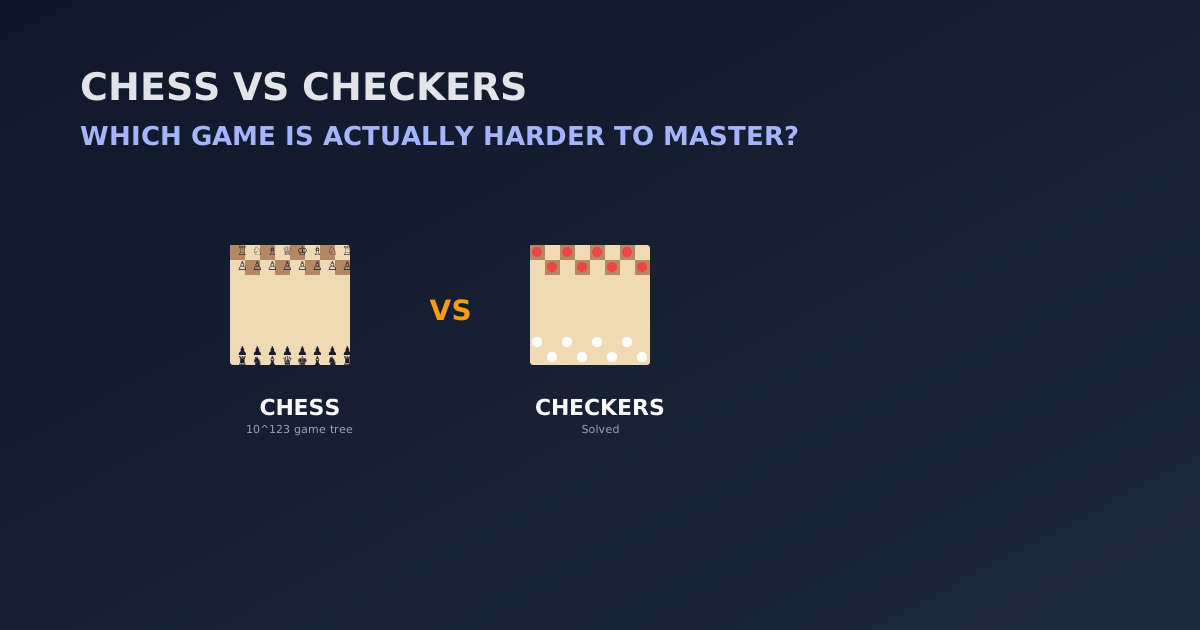
Direct Answer: Chess is significantly harder to master than checkers. The numbers tell the story: chess has approximately 10^123 possible games (the Shannon number) — more than the number of atoms in the universe. Checkers has roughly 5 x 10^20 possible positions and was mathematically solved in 2007 — perfect play from both sides always leads to a draw. Chess has never been solved and likely never will be. But "harder to master" doesn't mean "better." Checkers offers a different kind of depth: tactical precision within constrained rules, where a single forced capture can transform the entire board. Chess rewards breadth of knowledge. Checkers rewards depth of calculation. Both are worth playing, and both are available to play instantly at Chess AI and Checkers AI.
Stop reading, start playing — play Chess free (no login) or play Checkers free (no login), right in your browser.
The Game Tree Comparison
The most objective way to compare game complexity is through the game tree — the number of possible positions and games. Here's how chess and checkers measure up:
- Board size: Chess is 8x8 (64 squares). Checkers is 8x8 (32 playable squares — only the dark ones). This alone gives chess 2x the surface area.
- Piece types: Chess has 6 piece types (king, queen, rook, bishop, knight, pawn). Checkers has 2 (regular piece and king). Each piece type in chess has different movement rules, which multiplies the branching factor dramatically.
- Average branching factor: Chess has roughly 35 legal moves per position. Checkers has roughly 7. This means a chess game explores 5x more options per move — and the complexity compounds exponentially.
- Game length: Chess averages 40 moves. Checkers averages 30 moves. The longer game with the higher branching factor means chess explores roughly (35^40) / (7^30) ≈ 10^45 more total paths than checkers.
- Solved status: Checkers was solved in 2007 by the Chinook project — perfect play from both sides leads to a draw. Chess is unsolved and will likely remain unsolved for the foreseeable future. The chess game tree is simply too large for any known computational approach.
What the Numbers Mean for Players
Game tree complexity translates directly into the learning curve. In checkers, you can memorize the solved opening lines and play near-optimal chess within a few months. The optimal first move is known, the key midgame structures are documented, and the endgame positions have been solved.
In chess, no one can memorize their way to mastery. The game tree is too large. Even world champions make mistakes — not because they're bad players, but because the game is too complex for any human to calculate perfectly. This gives chess a depth that checkers can't match: there is always something new to learn, always a position you've never seen before.
But checkers has its own depth. The forced capture rule creates tactical complications that chess doesn't have. A single capture chain can remove 3-4 pieces in one sequence. The 40-move rule adds endgame pressure that chess players never face. Checkers mastery is about calculation precision within a bounded space — which is a different and equally valid skill.
The Learning Curve Comparison
Checkers: Fast Start, Hard Ceiling
A beginner can learn checkers rules in 2 minutes and play a reasonable game within 10 minutes. The constrained board and limited moves mean the first 10 games teach most of the tactical patterns you'll ever need. Improvement is fast for the first 50 games, then plateaus. After 100 games, you're playing at roughly 70% of your potential. The remaining 30% requires deep study of solved positions and endgame tablebases.
Milestones: Beat Easy AI (5 games) → Beat Medium AI (20 games) → Understand forced capture chains (50 games) → Beat Hard AI (100 games) → Study endgame tablebases (200+ games).
Chess: Slow Start, No Ceiling
A beginner can learn chess rules in 15 minutes but will play poorly for the first 20-30 games. The high branching factor means that every game presents entirely new positions. Improvement is slow and frustrating for the first 100 games. Then principles start to click: opening theory, tactical patterns, endgame techniques. After 500 games, you're still improving. After 1,000 games, you're still learning. There is no plateau because the game tree is too large to exhaust.
Milestones: Learn piece movement (5 games) → Learn opening principles (20 games) → Beat Easy AI (50 games) → Beat Medium AI (200 games) → Beat Hard AI (500 games) → Study master games (1,000+ games).
The Opening Phase: Theory and Memorization
Chess opening theory is vast. After 1.e4, there are dozens of responses (e5, c5, e6, c6, d6, Nf6, g6, b6 — each a recognized opening). Each response branches into hundreds of variations. Grandmasters memorize 20+ moves of theory in their chosen lines. Even intermediate players benefit from knowing 5-10 moves of theory in 2-3 openings.
Checkers opening theory is smaller but sharper. The solved status means optimal opening lines are known and documented. The Old Faithful (11-15), the Bristol (11-16), and the Glasgow (9-13) are the major openings. Each has 3-5 variations. The key difference: in checkers, deviating from the optimal opening line is usually immediately losing because the game tree is solved. In chess, deviating from known theory creates imbalances that both players must navigate — it's riskier, but also more creative.
The Endgame: Solved vs Infinite
Checkers endgames have been fully solved through retrograde analysis. Every position with 10 or fewer pieces is in a tablebase — the outcome is known. This means checkers endgame study is about memorization and pattern recognition of known winning positions. The Lucana position in checkers is a known win; the corresponding position in checkers endgame tablebases has a single optimal move.
Chess endgames are also tablebase-solved for 7 pieces or fewer, but the complexity is vastly higher. A king-and-pawn endgame with 5 pieces might have 500,000 possible positions in the tablebase. The Lucena position (rook and pawn vs rook) is a known win but requires precise technique across 20+ moves. Chess endgames reward understanding of principles (opposition, key squares, zugzwang) more than memorization, because the position space is too large to memorize exhaustively.
The Right Game for the Right Player
Based on these differences, here's how to choose:
- Play checkers if: You want fast improvement, tactical precision, and games that finish in 20-30 moves. Checkers rewards deep calculation within a constrained environment. It's the game for players who want to master everything within the system.
- Play chess if: You enjoy lifelong learning, opening theory, and games that feel different every time. Chess rewards broad knowledge and pattern recognition across an enormous game space. It's the game for players who want to always have something new to discover.
- Play both if: You want to cross-train. Chess teaches you pattern recognition across multiple piece types. Checkers teaches you forced-capture calculation. Together, they form a complete strategic thinking workout.
If you're new to both, start with Checkers — the faster learning curve builds confidence. Then graduate to Chess when the checkers board starts feeling too small.
Frequently Asked Questions
Is checkers easier than chess?
Yes, by almost every measure: fewer pieces, fewer move types, smaller branching factor, smaller game tree, and a solved game. A beginner can reach a competent level in checkers in 20-30 games. Chess requires 100+ games to reach the equivalent level. But "easier" doesn't mean "easy" — checkers at the expert level requires immense calculation precision, especially in forced capture sequences and the 40-move endgame rule.
Is checkers harder than chess in any way?
Checkers is harder in one specific area: forced captures. In checkers, if a capture is available, you must take it. This creates multi-move capture chains that require deep calculation. Chess has no equivalent — in chess, you can always choose to decline a capture. The forced capture rule makes checkers tactically sharper in certain positions, even though the overall game is simpler.
Which game has more AI training value?
Both are excellent for training against AI, but for different reasons. Checkers AI is better for teaching you to calculate forced sequences. Chess AI is better for teaching you positional strategy and pattern recognition. The funaigames.com Chess AI offers three difficulty levels spanning 600-1700 Elo, while the Checkers AI offers four levels including a near-solved Expert mode.
Can knowing checkers help me learn chess?
Yes. Checkers teaches core strategic concepts that transfer directly: pattern recognition, opponent threat awareness, the value of central control, and endgame calculation. Many chess grandmasters played checkers as children and credit it with developing their tactical vision. The concepts don't overlap 100% (chess has far more piece types), but the foundational thinking habits transfer.
Summary and Key Takeaways
- Chess is harder to master: 10^123 possible games vs 5 x 10^20 for checkers. Chess is unsolved. Checkers was solved in 2007.
- Checkers has a faster learning curve: competent in 20-30 games vs 100+ for chess.
- Checkers is harder in one dimension: forced captures require calculation precision that chess doesn't demand.
- Chess rewards breadth: opening theory, multi-piece strategy, lifelong learning.
- Checkers rewards depth: tactical precision within a constrained system.
- Cross-training both games develops complementary strategic skills.
Play Both Games — See Which You Prefer
Chess for breadth, checkers for depth. Both are available instantly with no login and no download. Ads may appear around the page, not during a move.
New to chess? Learn the rules. New to checkers? Master the openings.