History of Strategy Games: 5,000 Years of Evolution

Discuss this article with your favorite AI assistant
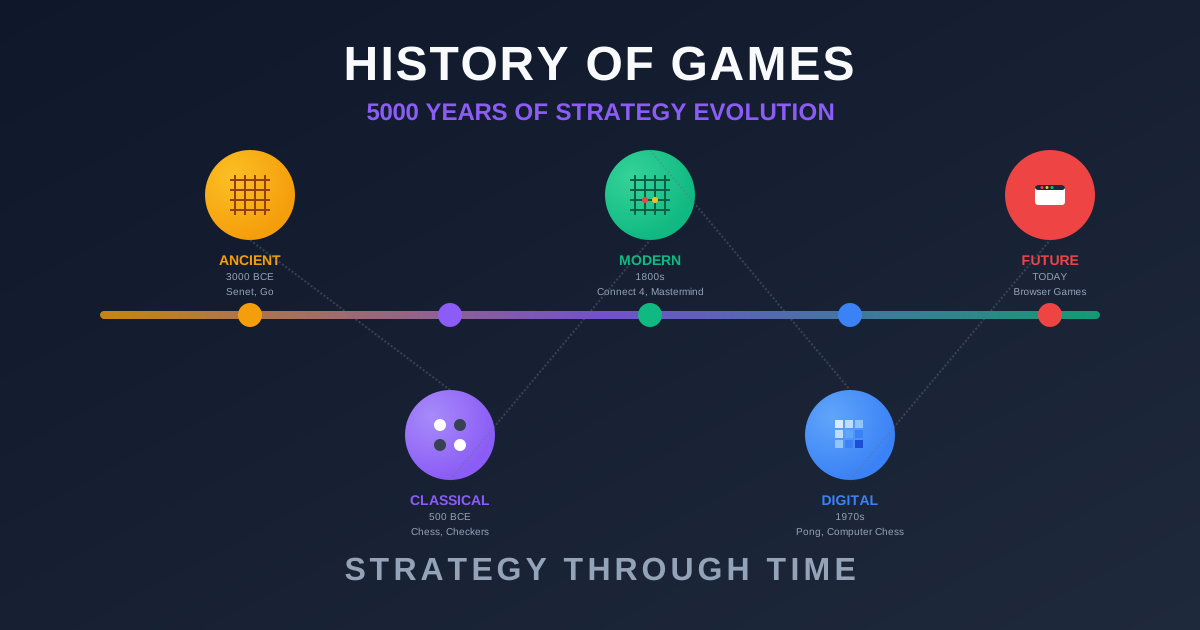
Direct Answer: Strategy games have evolved over 5,000 years from ancient board games like Senet (3000 BCE) through classical chess (500 BCE), modern abstract games (1800s), digital revolution (1970s), to today's browser games. This evolution reflects human development in mathematics, psychology, and technology. Each era introduced new strategic concepts while preserving fundamental principles of tactical thinking that remain relevant across all time periods.
The Dawn of Strategy - Ancient Games (3000 BCE - 500 BCE)
The earliest strategy games emerged alongside the first human civilizations, reflecting our ancestors' growing understanding of tactics, planning, and competition. What archaeologists have discovered: game boards found in Egyptian tombs, Mesopotamian palaces, and Indus Valley settlements reveal that strategic thinking was as fundamental to ancient life as agriculture and trade.
Senet - The Game of Passage (3100 BCE)
Considered the oldest known board game, Senet was discovered in predynastic Egyptian burials and featured on wall paintings in ancient tombs. Strategic significance: Senet wasn't just entertainment - it represented the journey of the soul through the afterlife, with each move symbolizing spiritual progression. The game combined luck (throwing sticks) with strategy (piece placement), teaching ancient Egyptians about balancing fate with free will.
The Royal Game of Ur (2600 BCE)
Excavated from the Royal Cemetery of Ur in modern-day Iraq, this game featured a complex board with 20 squares and beautiful inlaid shell decorations. Strategic innovation: The Royal Game introduced the concept of "safe zones" and "danger zones," where pieces could be captured or protected. This risk-reward mechanic became fundamental to countless future strategy games.
Go - The Eastern Strategic Masterpiece (2300 BCE)
Originating in China, Go represents perhaps the most sophisticated strategic game of the ancient world. Why Go endures: its simple rules (place stones, surround territory) create infinite strategic complexity. Unlike many ancient games that relied heavily on luck, Go is pure strategy - no dice, no chance, only skill. This purity made Go the perfect tool for teaching military strategy, diplomacy, and philosophical thinking throughout East Asian history.
The Classical Era - Birth of Modern Strategy (500 BCE - 500 CE)
The classical period witnessed the birth of games that would dominate strategic thinking for the next two millennia. Cultural significance: these games weren't pastimes - they were essential tools for education, military training, and intellectual development across civilizations.
Chess - The Game of Kings (600 CE)
While its exact origins are debated, chess as we know it emerged in Persia and India around the 6th century CE. Revolutionary concept: chess introduced differentiated pieces with unique movement patterns, creating unprecedented strategic depth. Each piece type represented different social classes - kings, queens, bishops, knights, rooks, and pawns - making chess a metaphor for society itself.
Strategic Impact of Chess:
- Tactical Hierarchy: Different piece values created complex decision-making
- Positional Warfare: Control of key board areas became crucial
- Endgame Theory: The concept that games progress through distinct phases
- Sacrificial Tactics: Sometimes losing material gains strategic advantage
Checkers (Draughts) - Democratic Strategy (1100 CE)
While chess was the game of nobility, checkers emerged as the strategy game of common people. Accessibility innovation: checkers used identical pieces with simple rules, making strategic thinking available to everyone regardless of social class or education. This democratic approach to strategy games would influence game design for centuries.
The Medieval Renaissance - Strategy Spreads Globally (500 - 1500 CE)
During the medieval period, strategy games spread along trade routes, adapting to different cultures while preserving core strategic principles. Global exchange: the Silk Road carried games from China to Europe, while Islamic traders brought African and Middle Eastern games throughout the known world.
Backgammon - The Perfect Balance (3000 BCE but popularized 1000 CE)
While ancient in origin, backgammon reached its modern form during the medieval period. Strategic breakthrough: backgammon perfectly balances luck (dice rolls) with strategy (piece movement). This balance made it universally appealing - enough randomness for beginners to win, enough strategy for experts to master.
Mancala - African Strategic Tradition
Played across Africa and the Middle East, Mancala games taught resource management and long-term planning. Economic strategy: Mancala's "sowing" mechanic mirrored agricultural cycles, teaching players about investment, growth, and sustainable harvesting. These games directly influenced the development of economic strategy concepts that would appear in modern games.
The Enlightenment - Strategy Becomes Science (1500 - 1800 CE)
The Enlightenment brought mathematical rigor to strategy games. Scientific approach: thinkers began analyzing games mathematically, calculating probabilities, and developing optimal strategies. This scientific approach transformed games from entertainment into intellectual pursuits.
The First Game Theory (1650)
Mathematicians like Blaise Pascal and Pierre de Fermat developed probability theory while analyzing games of chance. Foundation insight: they realized that even games with luck elements could be approached mathematically. This breakthrough laid the groundwork for modern game theory, economics, and computer science.
Mastermind - Logic and Deduction (1970, but conceptually Enlightenment)
While created in the modern era, Mastermind embodies Enlightenment thinking: pure logic, deduction, and systematic problem-solving. Intellectual legacy: the game teaches the scientific method - form hypotheses, test them, analyze results, and refine your approach. This educational value made Mastermind popular in schools and intelligence testing.
The Industrial Revolution - Mass Production and Innovation (1800 - 1950 CE)
Industrial manufacturing made strategy games accessible to the masses for the first time. Democratization of strategy: inexpensive printed boards, machine-cut pieces, and mass distribution meant that strategic thinking was no longer limited to the wealthy or educated.
Connect Four - Modern Abstract Strategy (1974)
While technically from the digital era, Connect Four represents the culmination of industrial-era game design principles. Design innovation: Connect Four took the complex concept of connection games (like Go) and made it accessible through vertical gravity and clear win conditions. This simplification without strategic loss became a hallmark of modern game design.
Strategic Principles from Connect Four:
- Forced Moves: Gravity creates mandatory moves, adding tactical constraint
- Center Control: Middle positions offer more winning possibilities
- Offensive-Defense Balance: Building threats while blocking opponents
- Solved Game Theory: Computer analysis proved perfect play leads to draws
The Digital Revolution - Strategy Meets Technology (1950 - 2000 CE)
Computers transformed strategy games forever, enabling artificial intelligence, online multiplayer, and unprecedented complexity. Technological leap: suddenly, games could have perfect opponents, infinite variations, and global connectivity.
Computer Chess - The AI Challenge (1950s)
The first major challenge for artificial intelligence was mastering chess. Historic achievement: when IBM's Deep Blue defeated World Champion Garry Kasparov in 1997, it marked the first time a computer had beaten the best human player at a complex strategy game. This victory demonstrated that machines could achieve strategic mastery once thought uniquely human.
Video Game Strategy - New Frontiers (1970s-1990s)
Video games introduced real-time strategy, resource management, and complex simulations. Genre expansion: games like Civilization, StarCraft, and Age of Empires combined traditional strategic thinking with technological possibilities, creating entirely new strategic challenges that had no analog in board games.
The Internet Age - Global Strategy Communities (2000 - Present)
The internet connected strategy players worldwide, creating global communities and unprecedented access to opponents. Community impact: players could now find opponents of any skill level 24/7, study games from masters worldwide, and participate in global tournaments without leaving home.
Online Chess - Global Accessibility
Platforms like Chess.com and Lichess made chess accessible to millions. Revolutionary change: a player in rural India could now play against a grandmaster in New York, study games from centuries ago, and get instant analysis - all for free. This democratization of high-level strategy education transformed how people learn and play.
Esports - Professional Strategy Gaming
Strategy games became spectator sports with professional players, million-dollar tournaments, and global audiences. Cultural shift: strategy gaming transformed from private intellectual pursuit to public entertainment, with professional players becoming celebrities and strategy games becoming mainstream entertainment.
The Browser Revolution - Strategy Without Barriers (2010 - Present)
Modern browser games represent the latest evolution in strategy gaming's 5,000-year history. Accessibility breakthrough: anyone with an internet connection can play sophisticated strategy games instantly, without downloads, registration, or payment barriers.
Instant Access Strategy
Browser games like those on FunAI Games continue the tradition of making strategy accessible to everyone. Historical parallel: just as checkers democratized strategy in medieval times, browser games democratize it in the digital age. No downloads, no accounts, no barriers - just pure strategic thinking available instantly.
AI Integration
Modern browser games incorporate AI opponents of varying difficulty, allowing players to practice against perfectly calibrated challenges. Evolutionary achievement: the AI that once took supercomputers to play chess now fits in your browser, offering personalized strategic challenges that adapt to your skill level.
Fundamental Strategic Principles That Endure
Despite 5,000 years of technological and cultural change, certain strategic principles remain constant across all games and eras. Timeless wisdom: these principles apply whether you're playing Senet in ancient Egypt or Connect Four in your browser today.
Control of Key Positions
From Go's territory control to chess's center squares to Connect Four's middle column, controlling key positions has always been fundamental to strategy. Universal truth: not all positions are created equal - some offer more strategic advantages than others.
Balance of Offense and Defense
Every successful strategy requires balancing aggressive play with defensive awareness. Historical consistency: whether you're protecting your king in chess or blocking your opponent in Connect Four, pure offense or pure defense rarely leads to victory.
Resource Management
Games have always taught resource management - whether it's pieces on a board, stones in Go, or time in a timed match. Strategic foundation: understanding how to efficiently use limited resources remains crucial across all strategy games.
Pattern Recognition
The ability to recognize patterns and anticipate opponent moves has been essential since Senet. Cognitive skill: pattern recognition connects ancient games to modern ones, representing the fundamental cognitive ability that strategy games develop.
The Future of Strategy Games
As we look to the future, strategy games continue evolving with new technologies and insights. Emerging trends: artificial intelligence, virtual reality, and brain-computer interfaces promise to create strategic experiences that would seem magical to our ancestors, while preserving the fundamental human joy of outthinking an opponent.
AI as Teacher and Opponent
Future AI won't just be opponents - they'll be personalized teachers that understand your learning style and help you improve. Educational revolution: imagine a chess tutor that knows exactly which concepts you're struggling with and creates custom exercises to help you master them.
Virtual Reality Strategy
VR will create immersive strategic experiences where you can walk through 3D battlefields or manipulate abstract concepts in virtual space. Sensory expansion: strategy games will engage more of our senses and cognitive abilities, creating deeper and more intuitive strategic understanding.
Global Strategy Communities
The internet will continue connecting strategy players worldwide, creating truly global strategic culture. Cultural exchange: players from different cultures will share strategic insights, creating new hybrid approaches that combine the best of Eastern and Western strategic traditions.
Conclusion - Strategy Games as Human Heritage
The 5,000-year history of strategy games is more than entertainment - it's the story of human intellectual development. From ancient Egyptians playing Senet in tombs to modern players clicking Connect Four in browsers, we've always used games to explore strategic thinking, competition, and intellectual growth. Each era has contributed something valuable while preserving the fundamental joy of outthinking an opponent.
Your Place in History
When you play strategy games today, you're participating in a tradition that spans millennia and includes some of history's greatest minds. The same strategic principles that guided ancient generals, medieval scholars, and modern computer scientists are at work in your games. You're not just playing - you're continuing humanity's oldest intellectual tradition.
Your Next Step
Experience this rich heritage by playing our collection of strategy games. Each game represents thousands of years of strategic evolution, refined for modern players. Start with Checkers to understand classical strategy, try Connect Four for modern abstract thinking, or explore Gomoku for Eastern strategic wisdom - all continuing the 5,000-year journey of human strategic development.
Experience Strategic History
Play games that represent 5,000 years of strategic evolution - from classical to modern.
Frequently Asked Questions
What is the oldest known strategy game?
Senet, dating back to 3100 BCE in ancient Egypt, is considered the oldest known board game. Game boards were found in predynastic Egyptian burials, and the game was so important it was depicted in tomb paintings and mentioned in Egyptian religious texts.
How did strategy games spread across cultures?
Strategy games spread primarily through trade routes like the Silk Road, military conquests, and cultural exchange. For example, chess spread from India to Persia, then to the Arab world, and finally to Europe, adapting to each culture along the way.
Why were ancient strategy games often associated with religion?
Ancient cultures saw strategy games as metaphors for cosmic order, divine will, and spiritual journeys. Senet represented the soul's journey through the afterlife, while other games symbolized the battle between order and chaos. This religious significance elevated games beyond mere entertainment.
How did computers change strategy games?
Computers revolutionized strategy games by enabling AI opponents, online multiplayer, instant analysis, and global connectivity. They also allowed games to become more complex, with computer tracking handling rules that would be too cumbersome for human players.
What strategic principles have remained constant throughout history?
Key principles include controlling key positions, balancing offense and defense, managing limited resources, and recognizing patterns. These fundamentals apply whether you're playing ancient Go, medieval chess, or modern Connect Four.
How did the industrial revolution affect strategy games?
Mass production made strategy games affordable and accessible to ordinary people for the first time. Previously, games were handmade luxury items available only to the wealthy. Industrial manufacturing democratized strategic thinking, making it accessible across social classes.