Shell Game vs Skill Game: Why CupQuest Is Not a Street Con

Discuss this article with your favorite AI assistant
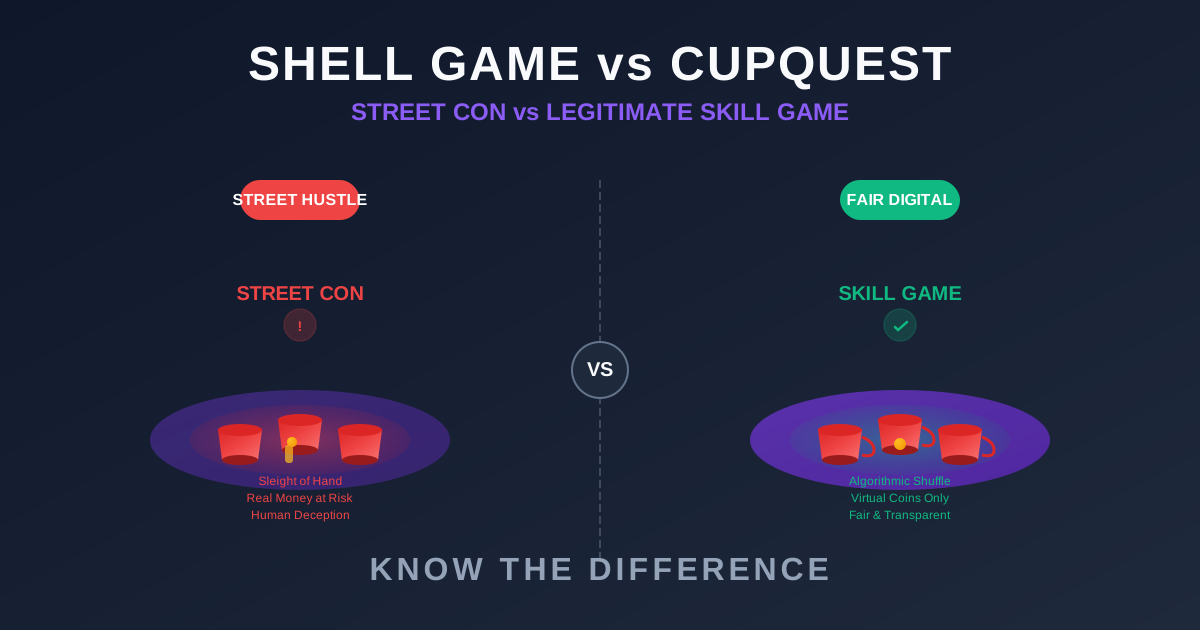
Direct Answer: The street shell game is a con where a human operator uses sleight of hand to make it impossible to win real money. Online skill games like CupQuest are the opposite — algorithmic shuffles with no human deception, no real money, and no tricks. The street version preys on your trust. The online version rewards your focus. Understanding the difference isn't just about knowing which one to play — it's about recognizing how the same game can be a scam or a legitimate skill challenge depending entirely on who's running it.
The Street Shell Game: A 200-Year-Old Confidence Trick
Walk through any major city's tourist district and you might still see it: a small crowd gathered around a folding table, three cups, and a man with fast hands. The shell game — also called thimblerig, the cup shuffle, or "find the lady" when played with cards — has been separating people from their money since the early 1800s.
Here's how the street con works: the operator (called the "tosser") places a ball under one of three cups. He shuffles them slowly at first, letting you track it easily. You feel confident. Then speed increases. Your eyes struggle. Meanwhile, the operator uses sleight of hand — palming the ball out from under the cup mid-shuffle, or using a second hidden ball to confuse your tracking, or having an accomplice in the crowd distract you at the critical moment.
The result: you cannot win. The game is rigged from the start. The operator controls the ball's actual position and can change it at will. The shuffle is theater. The outcome is fixed.
The Psychology of the Street Con
Why do people keep playing when they keep losing? The tosser uses specific psychological techniques that are well-documented:
- The "easy win" setup: the first few shuffles are deliberately slow and obvious. You win. Confidence spikes. You increase your play amount.
- The "near miss" manipulation: when the ball is palmed away, the operator lets you see it "almost" under your cup — close enough to feel like you almost won. This triggers the brain's near-miss reward circuit, identical to what keeps people playing slot machines.
- The accomplice decoy: a shill in the crowd "wins" a big round, proving it's possible. It isn't — the shill is part of the crew.
- The sunk cost trap: after losing money, leaving feels worse than trying one more time to win it back.
The fundamental difference: in the street game, a human being is actively deceiving you with practiced manipulation. In the digital game, an algorithm shuffles cups according to fixed rules — no deception, no sleight of hand, no accomplice.
Online Shell Games: Algorithmic Fairness
When you play an online shell game like CupQuest, the experience is fundamentally different — not just in medium, but in philosophy.
How Online Cups Actually Move
- The ball's starting cup is randomly chosen by a pseudo-random number generator — truly random, not manipulated by a human
- Cups swap via structured shuffle patterns — the algorithm picks two cups and swaps their positions, repeating 12-17 times. No cup teleports. No ball jumps.
- The ball stays with its cup — through every swap, the ball moves exactly where the cup moves. There is no palming, no hidden ball, no mid-shuffle switch.
- Animations match reality — what you see on screen is exactly what happened. The cups aren't lying to you.
The critical distinction: in the street game, the ball can be anywhere because the human operator controls it. In the online game, the ball is exactly where the tracking says it is — and if you tracked correctly, you win. Full stop.
No Real Money — No Gambling
Another distinction that fundamentally changes the nature of the game: online shell games like CupQuest use virtual coins — not real money. You start with 1000 free coins. You earn more with correct picks. You can reset anytime. There is no deposit, no withdrawal, no cash-out, no "buy more coins" feature.
This means the game is a skill challenge with a progression layer — not gambling. The coins exist to give you a tangible sense of improvement (your coin balance rising over time reflects your growing skill) rather than a financial incentive.
Side-by-Side: Street Shell Game vs Online Skill Game
| Feature | Street Shell Game | CupQuest / Online Shell Game |
|---|---|---|
| Who controls the ball? | Human operator with sleight of hand | Algorithm with fixed rules |
| Can the ball be moved mid-game? | Yes — operator palms or switches it | No — ball stays under its cup |
| Can you win through skill? | No — game is designed to be unwinnable | Yes — tracking skill determines outcome |
| Money involved? | Yes — real cash, often large amounts | No — virtual coins only, free to play |
| Psychological manipulation? | Yes — near-misses, shills, sunk cost | No — transparent mechanics |
| Legal status | Illegal in most jurisdictions | Legal — skill game, no gambling |
| Can you practice? | No — you're being actively deceived | Yes — play anytime, track progress |
| Privacy / safety | Public street, peer pressure, physical risk | Private browser, no account needed |
Why the Shell Game Has a Bad Reputation — and Why That's Changing
The shell game's negative reputation is entirely earned. For two centuries, it has been exclusively a tool for theft. When people hear "shell game," they think "scam." That's a completely reasonable association — and it's one the online gaming community is gradually undoing.
Here's what's changing: as browser games evolve, developers are rescuing the core mechanic — visual tracking under controlled conditions — and stripping away everything toxic. No human operator. No sleight of hand. No real money. What remains is a genuinely satisfying perceptual challenge: can your eyes beat the shuffle?
This rehabilitation mirrors what happened with poker. For decades, poker was associated with smoky backroom gambling. Then online platforms introduced free-play poker with no real money, and suddenly millions of people were enjoying Texas Hold'em as a pure strategy game. The game didn't change — the context did.
Is It Still the "Shell Game" If There's No Con?
Language shapes perception. We could call it the "cup tracking challenge" or the "ball shuffle focus game," but those names don't capture the cultural recognition of "shell game." The term has 200 years of meaning — and reclaiming it for a legitimate context is more powerful than inventing a new name.
Our approach: use the recognizable term ("shell game," "three cup shuffle," "thimblerig") to help people find the game, then immediately differentiate the online version from the street version. The FAQ on every page explicitly addresses the gambling question. The copy emphasizes skill, tracking, and focus — never luck, betting, or "beating the dealer."
This honest framing works: it acknowledges the game's history without being defined by it. When someone searches "shell game online" and finds CupQuest, they get exactly what they're looking for — the game they know about — but in a safe, transparent, purely skill-based format.
How to Identify a Legitimate Online Shell Game
Not every game calling itself a "shell game" is legitimate. Here's a quick checklist for evaluating any cup-shuffle game you find online.
- Is there real money involved? Legitimate skill games use virtual currency only. If the site asks for a credit card or offers cash-out, it's gambling — not what we're talking about.
- Is the shuffle transparent? Can you see the cups moving, or do they disappear and reappear? Visible movement = trackable. Teleporting cups = un-trackable (and unfair).
- Is there a skill progression? Does the game track your accuracy over time? Legitimate skill games help you improve. Scam games want you to keep losing without learning why.
- Are the mechanics explained? Does the site tell you how the shuffle works, how many swaps there are, and whether the ball stays with its cup? Transparency is the hallmark of a fair game.
CupQuest checks every box: virtual coins only, visible cup animations, accuracy tracking in the history panel, and fully explained mechanics. It's built on the principle that a shell game can be both authentic and fair.
Try a Legitimate Shell Game
Play CupQuest — the online shell game with no sleight of hand, no real money, and fair algorithmic shuffles. Your eyes vs the cups.
Frequently Asked Questions
Is the online shell game the same as the street version?
Only the visual concept is the same. The online version uses fair algorithms with no sleight of hand, no real money, and no human deception. It's a skill challenge, not a con.
Can you actually win at online shell games?
Yes. Skilled players who track the cup correctly can achieve 65-80% accuracy depending on difficulty mode. Unlike the street version where winning is deliberately impossible, the online version rewards genuine tracking skill.
Why would anyone play a game associated with scams?
For the same reason people play poker online without gambling — the core mechanic is fun and skill-testing. The scam is the context (real money, human deception), not the game itself (cup tracking, visual focus).
Is CupQuest legal to play?
Yes. CupQuest uses only virtual coins with no real-money purchase or cash-out option. It operates as a free skill-based game — the same legal category as puzzle games with virtual currency, memory training apps, and brain games where skill determines outcome with no financial stake.
How do I know the shuffle isn't rigged?
CupQuest's shuffles are generated algorithmically with no favor toward the player or the "house." The animations are exactly what happened — you can verify by watching for the ball when cups lift after a wrong pick. It's always exactly where the tracking logic says it should be.
Where can I experience the fair version of the shell game?
Experience the legitimate, skill-based shell game at Fun AI Games' Shell Game page. This dedicated version offers transparent algorithmic shuffles, no human deception, and pure focus-based gameplay where your tracking skill determines the outcome.