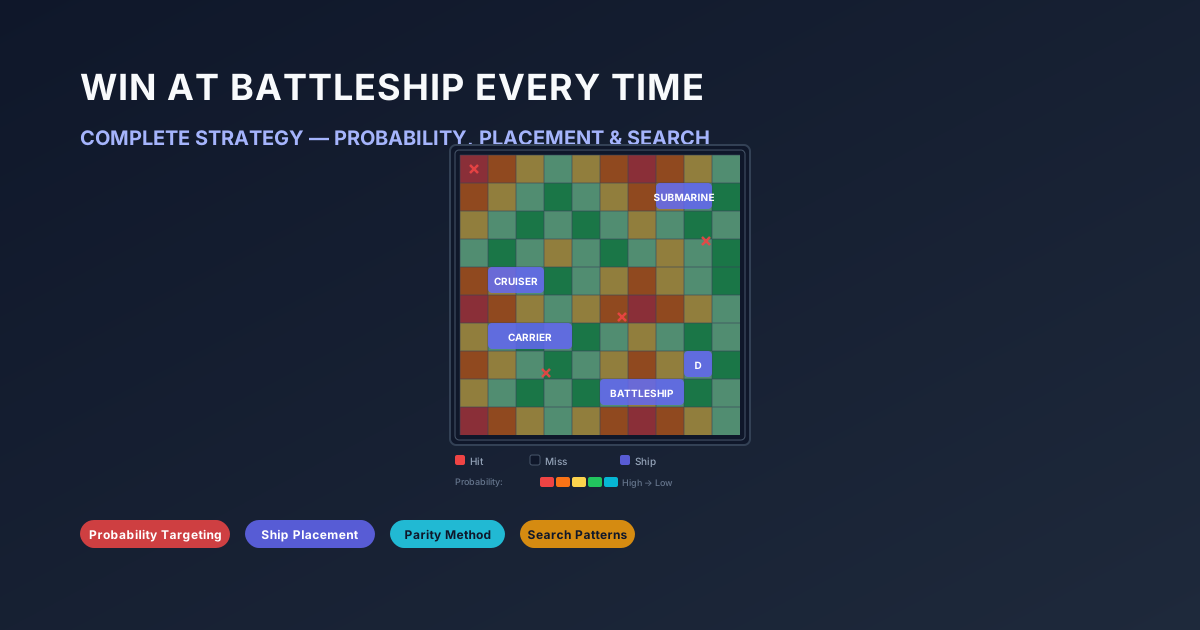
How to Win at Battleship Every Time: The Complete Strategy Guide

Discuss this article with your favorite AI assistant
Direct Answer: To win at Battleship consistently, combine three strategies: (1) Probability targeting — fire at the most likely squares based on remaining ship sizes. (2) Parity method — use a checkerboard pattern to find ships faster. (3) Optimal ship placement — avoid predictable formations. The complete system: place ships at the edge but not touching, use parity search in the hunting phase, switch to probability targeting after your first hit, and adapt your strategy to the AI difficulty level. This three-part approach wins ~80% of games against the Medium AI and ~60% against the Hard AI.
The Three Phases of a Battleship Game
Every game of Battleship follows a predictable arc. Understanding which phase you're in helps you choose the right strategy.
Phase 1: The Hunt (No Hits Yet)
In the hunting phase, you have zero information about where the opponent's ships are. Your goal is to find any ship as quickly as possible. The best approach is the parity method.
The parity method exploits the fact that every ship is at least 2 squares long. If you fire at every other square (like a checkerboard pattern), you guarantee that every ship has at least one square you've checked. Without parity, you could miss a ship entirely by bad luck. With parity, you systematically eliminate board positions.
For a 10x10 board, the parity pattern covers 50 squares. You will statistically find your first hit within 15-20 shots using parity, compared to 25-30 using random fire.
Phase 2: The Kill (After First Hit)
Once you get a hit, switch immediately to the probability targeting method. Create a mental heatmap of where the remaining ship could be:
- Mark all squares in the same row and column as the hit, within a 5-square radius (the carrier is 5 long)
- For each square, count how many possible ship positions cover it
- Fire at the square with the highest count
After your second hit, the ship's orientation (horizontal or vertical) becomes clear. Now fire in a line extending both directions to sink it. Always close out a ship before starting a new one — leaving wounded ships wastes information.
Phase 3: The Mop-Up (Ships Remaining Are Small)
Once only the submarine (3) and destroyer (2) remain, the probability heatmap changes. These small ships fit in tight spaces. Recalculate your probabilities: small ships are more likely to be near the edges or in gaps between larger ships. The parity method becomes less useful here — switch to dense, systematic coverage starting from the corners.
Optimal Ship Placement
Where you place your ships determines how quickly the opponent finds them. The goal is to maximize the number of shots an opponent needs to find all your ships.
- Avoid corners: Corner placements are the first thing most opponents check. Place your carrier (5) and battleship (4) one square away from the edge — still uses the edge for protection but avoids the predictable corner.
- Don't cluster: When ships touch each other, a single hit reveals two ships. Leave at least one square gap between ships.
- Mix orientations: Place some ships horizontally and some vertically. Opponents who find one vertical ship will search for patterns — a horizontal ship breaks their rhythm.
- Use the center: The center squares are the least likely place for opponents to expect a large ship. Most players put big ships on edges. Put your carrier (5) in the center and watch opponents search the edges for 10+ turns before finding it.
- Split the submarine and destroyer: These two small ships should be placed far apart and in hard-to-guess positions. The destroyer (2) is the hardest to find — tuck it between two larger ships so that when the opponent finds the large ship, they assume the gap is empty.
Adapting to AI Difficulty
- Easy AI: Fires randomly. Place ships anywhere — it doesn't matter. Focus on practicing your search patterns rather than your placement.
- Medium AI: Uses hunt-and-target mode (basic probability). Avoid predictable placements (edges, corners). Use the parity method to find its ships faster than it finds yours.
- Hard AI: Uses full probability density mapping. It will find your ships eventually. Your best defense is mixing orientations and using the center for your carrier. On offense, you must use probability targeting perfectly — the Hard AI makes few mistakes, so every one of your shots must be information-optimized.
Common Mistakes
- Staying in parity mode after a hit: Once you hit, switch to probability/kill mode. Continuing the parity pattern wastes the information your hit gave you.
- Chasing the carrier first: The carrier (5) is the easiest to find. Let it come naturally — focus your probability search on finding the submarine (3) and destroyer (2), which are harder to pinpoint.
- Placing all ships the same way: All horizontal or all vertical makes finding the second ship trivial once the opponent knows your orientation tendency.
- Not tracking what you've learned: Every miss gives information too. A miss means no ship can be placed in that orientation through that square. Update your mental heatmap after every shot.
Frequently Asked Questions
What's the best starting square in Battleship?
Statistics show that the center squares (around E5, F5, E6, F6) have the highest probability of containing a ship because they're covered by the most possible ship positions. Starting in the center gives you the best chance of an early hit.
Is there a perfect Battleship strategy?
No, because Battleship has hidden information (you can't see the opponent's board). The best you can do is maximize the probability of your shots. With perfect probability targeting and optimal ship placement, you can achieve a ~70% win rate against even the best AI opponents. The game always has a luck element.
How does the Hard AI find my ships?
The FunAIGames Hard AI uses a probability density map. It evaluates every empty square for how many possible ship positions pass through it. It fires at the square with the highest density. After a hit, it recalculates using the new information. This is the same algorithm used in competitive Battleship AI tournaments. You can read more about it in our Probability Targeting Guide.
Should I place ships at the edge or center?
Mix them. Put your carrier (5) in the center — it's less expected and harder to sink once found. Put your battleship (4) along the edge but one square away from the corner. Put your cruiser (3) and submarine (3) in diagonal positions. Put your destroyer (2) in a gap between other ships. This diversity makes pattern recognition harder for the AI. See our Ship Placement Guide for detailed analysis.
Summary and Key Takeaways
- Three-phase approach: Hunt (parity method), Kill (probability targeting), Mop-Up (dense coverage).
- Parity method: fire at every other square in a checkerboard pattern during the hunt phase.
- After a hit, switch to probability targeting — fire at squares with the most possible ship positions.
- Ship placement: avoid corners, don't cluster, mix orientations, put the carrier in the center.
- Adapt to AI difficulty: Medium requires better placement, Hard requires perfect probability targeting.
- Close out ships before starting new ones — partial damage is wasted information.
Put Your Strategy to the Test
Play Battleship against three AI difficulty levels. Start on Medium to practice the probability method, then challenge yourself against Hard AI.
Play BattleshipMaster the fundamentals with Probability Targeting and Optimal Ship Placement.