Renju Rules: How They Differ from Gomoku

Discuss this article with your favorite AI assistant
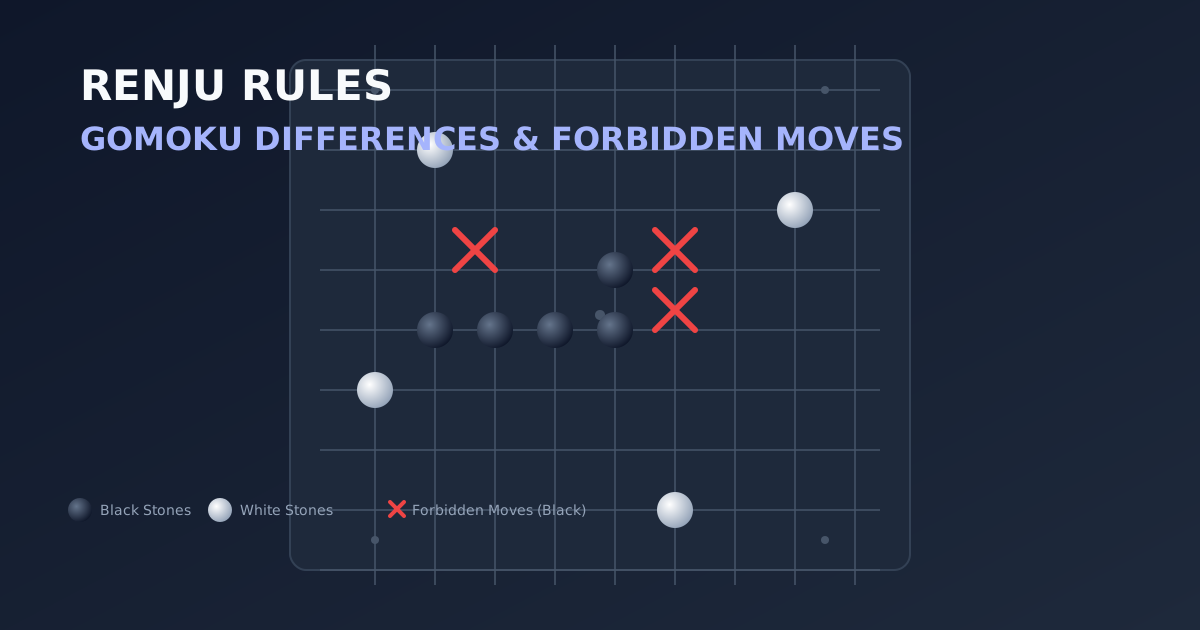
Direct Answer: Renju is the competitive Japanese variant of Gomoku, and the difference is a set of rules that fix Gomoku's biggest flaw: the first player's overwhelming advantage. Where standard Gomoku lets Black make any pattern, Renju bans Black from making double threes, double fours, and overlines (six or more in a row) — break a rule and you lose instantly. It also uses a five-stone opening with a swap rule to balance the first move. The version on this site is standard free-play Gomoku, not Renju — but you can self-enforce Renju rules against a friend in two-player mode.
Try the real thing — play Gomoku vs AI free here (no login): standard five-in-a-row on 15x15, right in your browser.
The Double Three, Explained Precisely
The forbidden moves sound simple, but the double three deserves a closer look, because it is the rule that most changes how Renju is played — and the one beginners get wrong.
A three in Renju terminology is a line of three stones that can become an open four next move. An open three is the dangerous kind: a line of three stones with open squares at both ends, so the opponent cannot stop the four from forming. When Black's move creates two such open threes at the same time — in two different lines — that is the double three, and it is forbidden.
Why ban it? Because two simultaneous open threes are an unstoppable attack: White can block one, and the other becomes a four, then a five. That exact pattern is the backbone of the first player's solved win in free-style Gomoku. Renju removes it from Black's arsenal entirely.
- One open three is legal. Black may create a single open three — it is a strong move, but White can answer it.
- Two open threes in one move is a foul. The instant the second one appears, the game ends with Black losing.
- A "closed" three doesn't count. A three blocked at one end (a three that can only become a four with a forced reply) is not part of the ban — only open threes count toward the double-three foul.
The double-four rule works the same way: Black may make a single four, but a move creating two fours at once is a foul. And the overline rule means Black's winning line must be exactly five — reaching six is a loss. The three bans together close every forcing pattern that made free-style Gomoku a first-player win.
Why Renju Exists: The First-Player Problem
Gomoku has a dirty secret: the first player wins with perfect play. In the 1990s, Victor Allis and colleagues proved free-style Gomoku is a first-player win — Black can force a win in 18 moves against optimal defense, using threat-space and proof-number search. In casual play the edge feels small, but at the top level it is decisive.
Renju (from the Japanese for "connected five pieces") was developed to make the game fair enough for competitive play. The Renju International Federation (RIF) governs the rules, which work in two parts: restrictions on the first player and a balanced opening protocol. Both exist for one reason — to give the second player a fighting chance.
For the full math on why the first player is so strong, Gomoku vs Tic-Tac-Toe: The Math Behind Five in a Row explains the solved-game theory in plain terms.
Rule 1 — The Forbidden Moves (Black Only)
Renju's heart is the list of moves Black may not make. These are called forbidden moves (or "fouls"), and they apply only to Black — White has no restrictions. If Black makes one, the move is illegal and Black loses the game immediately.
- Double three: Black may not make a move that creates two open threes at the same time. An open three is a line of three stones with open squares at both ends — the shape that guarantees a four next turn. One open three is legal; two at once is a foul.
- Double four: Black may not create two fours in a single move. A four is a line with one square completing five in a row; creating two at once is an instant foul.
- Overline: Black may not make six or more stones in a row. In free-style Gomoku, an overline still wins; in Renju, it loses — for Black. (White can still win with an overline.)
These three bans target exactly the patterns that give Black its winning edge. The double three is the first player's favorite weapon — ban it, and Black's attack loses its sharpest tool. The double four and overline close the other forced wins.
The practical result is fascinating: in Renju, White plays to trick Black into a foul. Setting up a position where Black's only good move is a forbidden one is a legitimate, powerful strategy. Defenders don't just block attacks — they bait fouls.
Rule 2 — The Opening Protocol: Five Stones and the Swap Rule
The forbidden moves reduce Black's edge but don't remove it. Renju adds a second balancing mechanism in the opening: a fixed five-stone sequence followed by a swap option.
- The first five stones are played according to RIF-approved opening patterns — two black stones and three white stones placed on specific board positions. The setup is designed so neither color has a meaningful opening advantage.
- The swap rule: after those five stones, the second player chooses which color to play. If Black's position looks stronger, White takes it; if White's looks better, Black takes it. Nobody wants to hand the opponent a good position, so both players are forced to aim for fairness.
- Then the game plays normally — with the forbidden moves still in force for whoever ends up as Black.
Modern competitive Renju often uses a more complex "swap2" protocol for tournament play, but the five-stone plus swap idea is the core concept: the player who sets the opening must not profit from it.
Renju vs Gomoku: The Rules Compared
Here is the practical comparison at a glance:
- Winning line: both games are won by five in a row — except Renju counts an overline as a loss for Black, while free-style Gomoku counts it as a win for anyone.
- Double threes: legal everywhere in free-style Gomoku; a losing foul for Black in Renju.
- Double fours: legal in Gomoku; a losing foul for Black in Renju.
- Opening: Gomoku starts anywhere; Renju uses the five-stone protocol with a swap.
- Balance: Gomoku favors the first player (solved as a first-player win); Renju is designed to be balanced for competitive play.
- Who can foul: nobody in Gomoku; Black only in Renju.
If you are new to the five-in-a-row family, How to Play Gomoku Online: The Five-in-a-Row Guide covers the basic rules that Renju builds on top of.
What This Site's Version Uses (and How to Self-Enforce Renju)
The Gomoku on this site is standard free-play rules, not Renju. That means: no forbidden moves, overlines win, and the first player plays anywhere. The site's game page is explicit about it — it does not enforce Renju restrictions, and overlines count as wins.
That is not a flaw — free-play is the right introduction to the game, and the AI is tuned to free-style play. But if you want the authentic competitive experience, you can self-enforce Renju rules in two-player mode:
- Agree before the game that Black may not make double threes, double fours, or overlines.
- Agree that a forbidden move ends the game with Black losing.
- For the balanced opening, play the standard five-stone setup and let the second player choose colors.
It takes a little discipline to track the forbidden shapes, but the payoff is real: games become longer, more tactical, and far more balanced. Since the double three is banned, the threat shapes change completely — The Open Four in Gomoku: Winning Threats Explained shows the patterns that still win under restricted rules.
Strategy Shifts When You Play Renju
Switching from Gomoku to Renju changes more than the rulebook — it changes how the game is played. Four strategic consequences matter:
- Black must play "clean." Every attack has to avoid the forbidden shapes, so Black's lines get narrower. Strong Black play in Renju is a precision art, not a blitz. Before every move, Black should check not just "does this win?" but "does this create two open threes?" — one careless move ends the game on the spot.
- White plays the foul. White's best weapon is setting up a position where Black's only good move is illegal. Baiting a double-three foul is the modern Renju equivalent of a checkmate trap. This inverts the normal defensive mindset: instead of merely blocking, White builds "forbidden traps" that Black cannot safely enter.
- The opening matters more. With the swap rule, both players fight for the best five-stone setup they can give away — opening knowledge is half the game. The first player wants a setup that looks strong but is secretly balanced; the second player wants to be able to take the better color confidently.
- Overlines change the endgame. Black must stop at five; White may extend to six or more. In tight endgames, White can win with patterns Black cannot use — a Black defender must watch for White's six-in-a-row finish, while White never has to fear it from Black.
- Counting wins games. Because the fouls depend on precise shapes, Renju rewards players who count lines carefully. Before a critical move, enumerate every line your move opens — if a line becomes an open three and another does too, that move is illegal for Black.
For the opening shapes that matter under both rulesets, Gomoku Opening Theory: The Best Opening Moves is the place to start building your five-stone repertoire.
Frequently Asked Questions
What is the difference between Gomoku and Renju?
Renju is the competitive Japanese version of Gomoku with balancing rules. The big differences: Black cannot make double threes, double fours, or overlines (each is an instant loss), and the opening uses a five-stone setup with a swap rule. Free-style Gomoku has none of those restrictions — overlines win and double threes are legal for everyone.
Why are moves forbidden only for Black in Renju?
Because Black moves first and free-style Gomoku is a proven first-player win. The forbidden moves (double three, double four, overline) are exactly the patterns that give Black its decisive edge. Restricting only Black is the elegant fix that rebalances the game without changing White's play.
Is an overline a win in Gomoku?
In free-style Gomoku, yes — six or more in a row wins, and that is how the version on this site works. In Renju it is different: an overline is an instant loss for Black, while White may still win with six or more in a row.
Can I play Renju on this site?
There is no dedicated Renju mode — the site plays standard free-style Gomoku, where overlines win and no moves are forbidden. You can self-enforce Renju rules in two-player mode by agreeing that Black may not make double threes, double fours, or overlines, with the five-stone opening and swap rule.
Why does Gomoku favor the first player so much?
Because the game was solved as a first-player win: Victor Allis and colleagues proved in the 1990s that Black can force a win in 18 moves with perfect play. Renju's forbidden moves and swap rule exist specifically to cancel that mathematical advantage.
Summary and Key Takeaways
- Renju is the competitive Japanese variant of Gomoku, governed by the Renju International Federation.
- Renju bans three moves for Black only: double threes, double fours, and overlines — each is an instant loss.
- The opening uses a five-stone protocol with a swap rule: the second player chooses which color to take.
- White's key strategy is baiting Black into a foul — setting up positions where every good move is illegal.
- This site plays free-style Gomoku (overlines win, no forbidden moves) — you can self-enforce Renju in two-player mode.
- Renju exists because free-style Gomoku is a solved first-player win — the restrictions make it balanced.
Practice the Openings — Play Gomoku
Warm up with the site's free-play Gomoku, then challenge a friend in two-player mode with self-enforced Renju rules. The five-stone opening is your first project.
Play GomokuCurious why the first player needs restricting? Read Is Gomoku Solved? What the Math Says.