Connect 4 Traps: Winning Patterns That Force a Win

Discuss this article with your favorite AI assistant
Direct Answer: Connect 4 traps are patterns that force a win no matter what your opponent does. The three that matter are the double threat (two winning squares at once), the 7-shape (three stones forming an L that completes two lines at once), and the diagonal clamp (two diagonals sharing one winning square). Learn to build these three, and you will convert winning positions into finished games — and stop falling into them yourself.
What Makes a Pattern a Trap
A trap is not just a good move — it is a forcing sequence. A real trap creates a position where every legal move your opponent can make still loses. In Connect 4, that happens through threats: a threat is three of your stones plus one playable square that completes four in a row.
One threat is never enough — your opponent simply blocks it. The magic starts at two threats at once. If you present two winning squares on your turn, your opponent can block only one of them, and you play the other on your next move. That is the essence of every trap in this article: force a double threat, then collect the win.
Two rules govern which traps work. First, the row-parity rule: your completing squares must sit on your own parity row (odd rows 1, 3, 5 for Player 1; even rows 2, 4, 6 for Player 2) — a threat on the wrong parity gets filled by your opponent first. Second, the undercut: when two threats share a column, the lower one fires first. Both rules are covered in depth in Is Connect 4 Solved? The First-Player Advantage and in the second-player companion, Connect 4 as Player 2: The Odd-Even Strategy Explained.
Trap 1 — The Double Threat (The Fork)
The double threat — often called a fork — is the simplest and most important trap in the game. You place a stone that creates two winning squares simultaneously. Your opponent blocks one; you play the other and win.
The classic setup: build three in a row horizontally with an open square at each end, then add a stone on top of one end. That one stone also completes a vertical or diagonal line — now you have two four-in-a-row candidates. Both cannot be blocked in one move.
- Horizontal three with two open ends — the basic fork. Add a stone to one end, and the other end becomes your second threat.
- The two-column fork — three stones that threaten four in a row down two different columns. Blocking one column leaves the other open.
- The stack fork — two of your stones stacked in one column, with the third stone beside them, creating a vertical and a horizontal threat from one move.
The fork is how most casual games are won and lost. Open Connect Four vs AI and try those opening forks on Easy before you hunt them in a real match.
Trap 2 — The 7-Shape: Three Stones, Two Lines
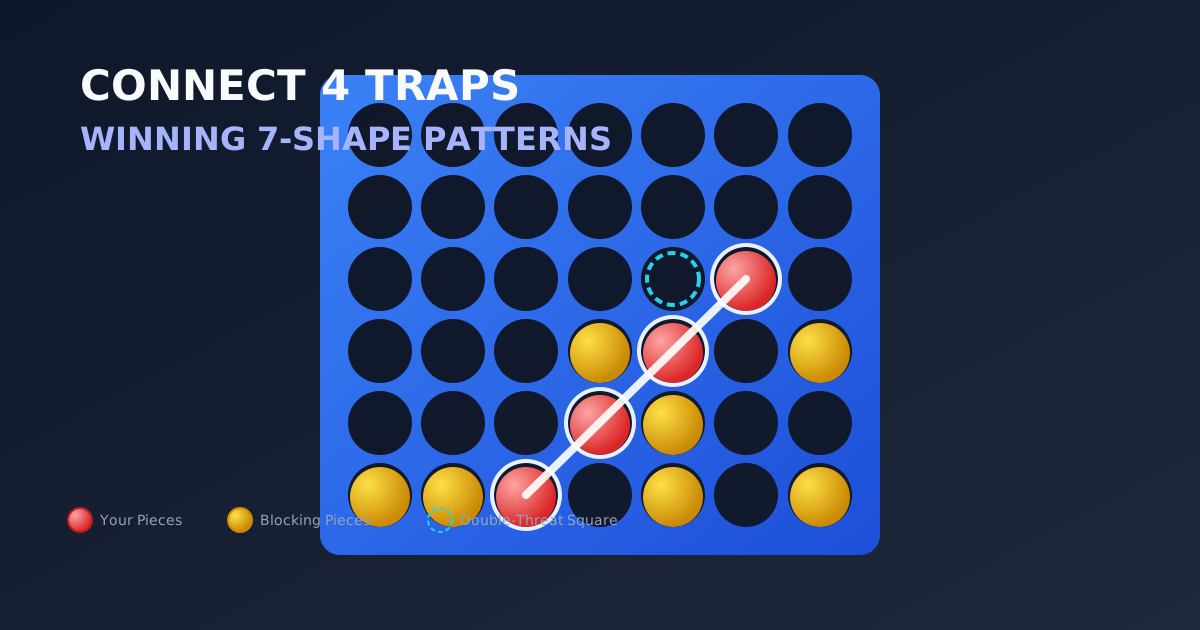
The 7-shape is the fork's prettier cousin — three of your stones arranged in an L that looks like the digit 7. The empty corner of the L is the key: one stone there completes four in a row both vertically and horizontally at the same time.
How it's built: place two stones stacked in one column, and one stone directly beside the bottom stone (or beside the top stone — the shape mirrors either way). The empty corner square now completes a horizontal three into four and a vertical three into four. Your opponent can block one of those lines — never both.
The 7-shape is especially dangerous because it is quiet: before the corner is filled, the position looks harmless — just three scattered stones. Opponents (and shallow-depth AIs) rarely see the L until the corner is played, and by then it is too late.
- Set it on your parity row so the completing corner is unanswerable.
- Use it as a decoy: a visible vertical threat elsewhere distracts from the L forming in the middle columns.
- Watch for it on rows 2-4, where the L hides most easily against the board's edge.
Trap 3 — The Diagonal Clamp: Two Lines, One Square
The diagonal clamp is the most deceptive trap because it uses the line most players ignore. Two of your diagonal lines of three intersect at a single empty square. The opponent cannot block the shared square twice — no matter which diagonal they defend, the other completes.
How it's built: you need two diagonal lines of three stones whose completing squares are the same square. This happens naturally when you play toward the center of the board, where diagonals from the left and right cross. The shared square usually sits in the middle rows (3-4), where it is hardest to spot.
The clamp is also the mechanism behind most endgame finishes: with the board half full, diagonals cross constantly, and the player who sees the intersection first wins. This is why reading the board — not just your own threats — matters so much. The full reading method is in Pattern Recognition in Connect 4: How to Read Your Opponent.
How to Build Traps Quietly
The best traps are invisible until they fire. Building one out in the open just invites a block. The three quiet-building principles:
- Develop toward the center first. Center columns let your stones participate in multiple lines at once — horizontal, vertical, and both diagonals. Edge columns only ever make one line.
- Hide the pattern in plain sight. A fork looks like a bad spread of stones; a 7-shape looks like random placement; a diagonal clamp looks like two separate small threats. Do not "complete" anything until the trap is loaded.
- Stack before you strike. Two stones in one column are the raw material for a vertical threat, and a vertical threat can later be turned into a double threat by a single adjacent stone.
When you are ready to put the traps on a live board, play Connect Four vs AI — start on Medium, then test the 7-shape against Impossible.
How to Spot Traps Before You Fall In
You cannot set traps reliably until you stop walking into them. Every trap in this article has the same warning signs — train yourself to scan for them before every move.
- Look for your opponent's open threes in all four directions — horizontal, vertical, and both diagonals. One open three means a threat next turn.
- Find shared squares. Where do two of their lines intersect? That shared square is a trap square. Block it, even at the cost of a good move elsewhere.
- Distrust scattered stones. Three stones that look like garbage are usually a 7-shape waiting for its corner. Count what happens if they play the empty corner of every L you can see.
- Never play a column that completes their pattern. If placing your stone fills in a square that makes their two lines intersect, you just handed them the clamp.
The golden rule of defense: a prevented trap beats a clever move. Every time you choose between attacking and blocking a shared square, block.
Using Traps Against the Connect 4 AI
The Connect 4 AI on this site — especially Impossible difficulty — is a minimax search with alpha-beta pruning, limited to about 6 plies of lookahead (7 on machines with 8+ cores). That depth limit is exactly what your traps exploit.
- Double threats beat the AI. A depth-limited engine evaluates the board after its search and blocks the most obvious threat. Present two, and it blocks one — the other wins. This is the single most reliable way to beat the Impossible AI, and the complete method is in How to Beat the Impossible Connect 4 AI: Strategies That Work.
- The 7-shape hides past its horizon. The L looks harmless in the evaluation, so the AI under-weights it until the corner is played — past its search depth.
- Diagonal clamps exploit its blind spots. Many engines evaluate columns strongly and diagonals weakly. A shared diagonal square is a classic gap in its scoring.
On lower difficulties the same traps simply work faster — the shallow search misses them entirely. Whatever the level, the playbook is identical: develop center, build quiet, strike with two threats.
Frequently Asked Questions
What is the most powerful trap in Connect 4?
The double threat (fork) — two winning squares at once. It is the foundation of every other trap: a 7-shape is a fork, and a diagonal clamp is a fork on diagonals. If you master only one pattern, make it the double threat.
What is a 7-shape in Connect 4?
Three of your stones arranged like the digit 7: two stacked in a column plus one beside either end. The empty corner square completes four in a row both vertically and horizontally at once, so the opponent cannot block both lines.
How do you beat the Impossible Connect 4 AI?
Build double threats it cannot search past. The Impossible AI looks about 6 plies ahead (7 on 8+ core machines), so present two winning squares at once — it blocks one and loses to the other. The 7-shape and diagonal clamp both work because they look harmless inside its search window.
What is the difference between a threat and a trap?
A threat is three stones plus one playable square that completes four in a row — one winning square. A trap is a position with two or more threats that cannot all be blocked at once, forcing a win. One threat gets blocked; a trap wins.
Why is the center column so important for traps?
Because center-column stones participate in all four lines — horizontal, vertical, and both diagonals. Edge-column stones only ever make one line. Traps are built from intersecting lines, so the center is where forks, 7-shapes, and clamps are born.
Summary and Key Takeaways
- A trap is a position where every legal move still loses — built from unblockable double threats.
- The double threat (fork) is the foundation: two winning squares, one move to block, one move to win.
- The 7-shape is three stones in an L whose corner completes both a vertical and horizontal four at once.
- The diagonal clamp uses two diagonals sharing one square — a square that cannot be blocked twice.
- Build traps quietly toward the center; never complete a pattern before it is loaded.
- Defend by scanning all four directions for shared squares and open threes — a prevented trap beats a clever move.
- Double threats are the proven method to beat the depth-limited Connect 4 AI at every difficulty.
Set Your First Trap — Play Connect Four
Practice the double threat against the Medium AI, then test the 7-shape against Impossible. Every game is a chance to make your traps quieter and your finishes faster.
Play Connect FourPlaying second? The traps change shape — read Connect 4 as Player 2: The Odd-Even Strategy Explained.