The Hardest Unbeatable AI Games, Ranked

Discuss this article with your favorite AI assistant
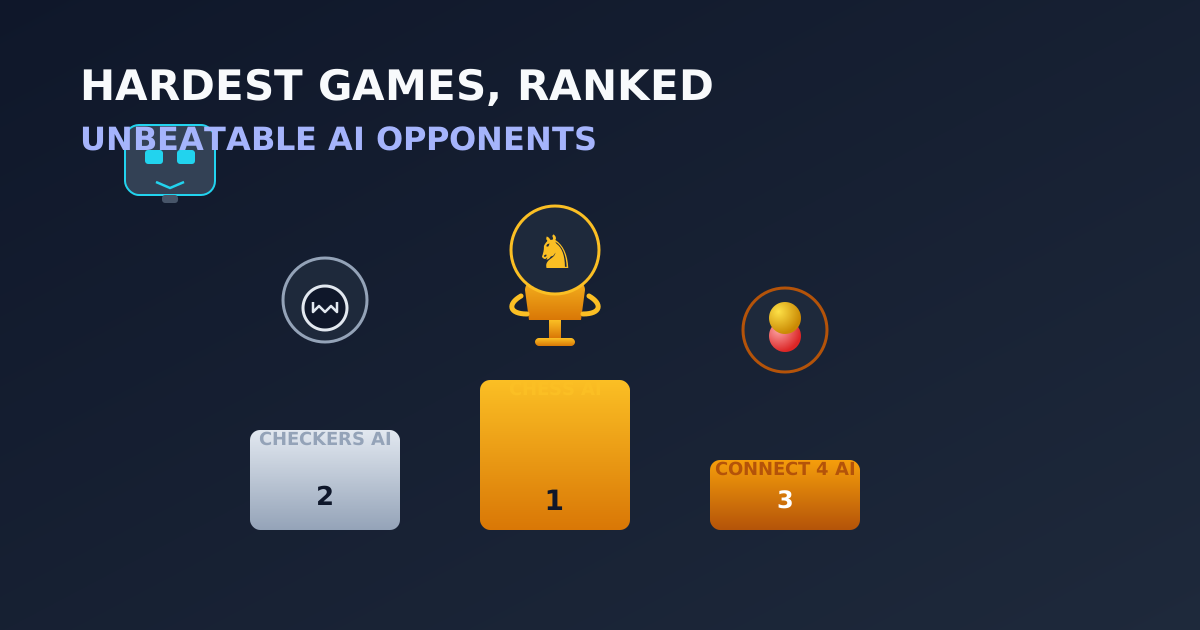
Direct Answer: Only one AI on funaigames is truly unbeatable: Tic-Tac-Toe on Impossible, which runs a perfect minimax search and can never lose — the best you can achieve is a draw. After that, the ranking is Connect 4 Impossible (minimax depth 6-7), Checkers Impossible (depth 6), then the very strong but definitely beatable Chess Hard, Gomoku, Battleship, and Rock Paper Scissors AIs. "Unbeatable" is a marketing label; only one opponent deserves it mathematically.
What "Unbeatable" Actually Means
Before the ranking, one distinction decides everything: perfect play versus very strong play.
A perfect AI has searched the whole game — or solved it mathematically — so it never makes a mistake. Against it, the best possible result is defined by the game's value: a draw in Tic-Tac-Toe, a win for the first player in Connect 4. These games are solved: Tic-Tac-Toe is a draw with perfect play, and Connect 4 is a first-player win, proven independently by James D. Allen and Victor Allis in 1988.
A very strong AI, by contrast, uses deep search and heuristics but has limits — a fixed search depth, a finite time budget, or an evaluation function that misses subtle positions. It plays brutally well and beats almost everyone, but it is not perfect. Almost every "Impossible" label on a browser game site means this second category. This ranking separates the two honestly.
For the background on solved games, Is Tic-Tac-Toe Solved? The Math Behind the Game and Is Connect 4 Solved? The First-Player Advantage cover exactly how these proofs work.
#1 — Tic-Tac-Toe Impossible: The Only Truly Unbeatable AI
Tic-Tac-Toe on Impossible difficulty is the only mathematically perfect opponent on the site. It runs full minimax search over the entire game tree — every possible sequence of moves — and always picks the move that guarantees the best possible outcome.
Because Tic-Tac-Toe is solved as a draw, the Impossible AI can never lose. If you play perfectly yourself, the game ends in a draw. If you make any mistake — any move at all that a perfect player would not make — the AI punishes it immediately and wins. There is no sequence of moves that beats it, ever.
- Perfect play: full-depth minimax, no search limit, no evaluation shortcut.
- Result against it: draw with perfect play, loss with any mistake.
- Verdict: truly unbeatable — the only AI on this list that deserves the word.
If you want to at least guarantee the draw, the fork strategy is the human path to perfection: The Tic-Tac-Toe Fork Strategy: A Complete Guide shows every move that keeps you safe.
#2 — Connect 4 Impossible: Near-Perfect, Not Perfect
Connect 4 on Impossible difficulty is the site's second-hardest opponent. It runs minimax search with alpha-beta pruning — the same algorithm family as the Tic-Tac-Toe AI — but it is depth-limited: it looks about 6 plies ahead (6 half-moves) on normal devices, and 7 plies on machines with 8 or more CPU cores.
That depth limit is the whole story. The Impossible Connect 4 AI plays a ferocious tactical game and beats nearly everyone, but it does not see the entire game tree. Humans — and skilled players in particular — can beat it by building overlapping double threats that sit just beyond its search horizon. The site's own guidance is explicit: trap it with two simultaneous threats and it blocks one, leaving the other to win.
Interestingly, the game itself is solved: with perfect play, the first player wins by opening in the center column (Allen and Allis, 1988). But the AI is not the perfect player — it is a very strong one. How to Beat the Impossible Connect 4 AI: Strategies That Work is built entirely on exploiting that gap.
#3 — Checkers Impossible: Strong But Tactically Beatable
Checkers on Impossible difficulty searches 6 plies deep with minimax and alpha-beta pruning, then picks its move via a position evaluation. It is a serious opponent — the strongest on the checkers board — but it is not perfect.
Checkers was solved in 2007 by the Chinook team (Jonathan Schaeffer), and the game's value is a draw with perfect play. The Impossible AI is far from that perfect player: at 6 plies it misses long tactical sequences, king-race subtleties, and the slow positional squeezes that decide endgames. A player who sets layered traps — one threat that, when blocked, reveals a second — can beat it consistently.
- Depth: 6 plies of minimax with alpha-beta pruning, then a heuristic evaluation.
- Game value: draw with perfect play (Chinook, 2007).
- Verdict: very strong; beatable with multi-move traps and endgame knowledge.
The full method for each difficulty level is in How to Beat the Checkers AI: A Complete Difficulty Guide.
#4 — Chess Hard: Deep, Human-Level, Definitely Beatable
Chess on Hard difficulty is the strongest chess opponent on the site and arguably the most mentally demanding game in the collection. The AI combines deep minimax search, alpha-beta pruning, and a positional evaluation function that scores material, mobility, and king safety.
Chess is not solved — the game tree is far too large — so no chess AI on the site can be perfect. Hard mode plays at roughly strong-club-human strength: it punishes blunders ruthlessly, but it can be outplayed with sound opening principles, solid development, and patience. Beginners should start on Easy or Medium and climb; the training progression is laid out in How to Beat the Chess AI: Easy, Medium, and Hard Training Plan.
#5 — Gomoku: Heuristic, and Your Advantage by Theory
The Gomoku AI tracks lines, blocks open threes, and plays a credible five-in-a-row game, but it is built on heuristics rather than deep exhaustive search. It is beatable — and the math is on your side.
Free-style Gomoku (the rules this site uses) was solved in the 1990s as a first-player win: with perfect play, the first player can force a win in 18 moves, proven by Victor Allis and colleagues using threat-space and proof-number search. The site's AI is not that perfect player, so a first-player who builds double open threes will outplay it. But it will punish sloppy lines — see The Open Four in Gomoku: Winning Threats Explained for the threat shapes it hunts for.
#6 — Battleship: Probability, Not Perfection
The Battleship AI aims with probability-density targeting: after a hit, it computes which squares are most likely to hide the rest of the ship and fires there, instead of firing randomly. That makes it dramatically faster at finding your fleet than a random shooter — typical hunting takes roughly 40-50 shots instead of 60-70.
It is still beatable: the AI cannot see your placement, and a well-spread fleet denies it the clusters it hunts for. The counter-strategy is all about placement — How to Win Battleship Every Time: Strategy Guide covers the placement principles that blunt probability targeting.
#7 — Rock Paper Scissors: A Random AI, Beaten by Randomness
The Rock Paper Scissors AI does not track your history or predict your next move — it plays pure random chance. Every throw is an independent draw with no memory of what came before, which makes it unpredictable by construction.
The fix is beautifully simple: play true randomness. If your sequence is genuinely unpredictable — dice, a shuffled list, anything non-human — the AI has nothing to exploit. Random play against a random opponent is the game-theoretic equilibrium: you can never be beaten systematically, no matter how often you play. How to Beat the Rock Paper Scissors AI: The Algorithm Explained covers the math behind why this works.
And the Rest: Mancala, Ludo, Snakes, CupQuest
The remaining AIs are lighter by design. Mancala offers Easy, Medium, and Hard — Medium and Hard run a depth-4 and depth-6 minimax search, which makes them the site's strongest engine after Chess and Checkers, but still beatable with solid endgame knowledge. Ludo and Snakes and Ladders are driven largely by dice, so their "AI" opponents are mostly straightforward pieces on a luck-based board. CupQuest has no adaptive AI at all — it is a pure skill-and-tracking game against a fixed routine. None of these belong on an "unbeatable" list, which is exactly why they are not on it.
The Honest Ranking Table
Here is the full picture in one place:
- Tic-Tac-Toe Impossible — full minimax, solved game — truly unbeatable (draw at best).
- Connect 4 Impossible — minimax depth 6-7 — near-perfect, beatable with double threats.
- Checkers Impossible — minimax depth 6 — very strong, beatable with traps.
- Chess Hard — deep search + positional eval — strong-club level, beatable with sound play.
- Gomoku — heuristic line-tracking — beatable; first player has a proven theoretical edge.
- Battleship — probability targeting — beatable with smart fleet placement.
- Rock Paper Scissors — pattern tracking — beatable with true randomness.
- Mancala / Ludo / Snakes / CupQuest — light or luck-based — casual-level opponents.
Frequently Asked Questions
Is any AI on the site truly unbeatable?
Exactly one: Tic-Tac-Toe on Impossible. It runs perfect full-depth minimax, and because Tic-Tac-Toe is a solved draw, the best result against it is a draw — it can never lose. Every other "Impossible" or "Hard" AI on the site is very strong but has real limits you can exploit.
Can you beat the Impossible Connect 4 AI?
Yes. It searches only about 6 plies deep (7 on machines with 8+ cores), so it misses tactics beyond its horizon. Build two threats at once — a double threat or overlapping trap — and it blocks one and loses to the other. The game is a first-player win with perfect play, but this AI is not the perfect player.
Is the Impossible Checkers AI perfect?
No. It searches 6 plies and then evaluates heuristically, which means it misses long tactical sequences and endgame squeezes. Checkers is solved as a draw (Chinook, 2007), but this AI is far from that perfect player — layered traps and endgame knowledge beat it.
Why is Tic-Tac-Toe Impossible only a draw at best?
Because Tic-Tac-Toe is a solved draw: with perfect play from both sides, the game always ends in a draw. The Impossible AI plays perfectly, so you cannot win — your only goal is to avoid losing by matching its perfection. Any mistake hands it the win.
What is the hardest game to beat on the site overall?
By pure "cannot win" standard, Tic-Tac-Toe Impossible is hardest — you cannot beat it at all. By "how likely am I to lose" standard, most players lose more to Connect 4 Impossible and Chess Hard, because those games have the depth and complexity to punish mistakes even when the AI is technically beatable.
Summary and Key Takeaways
- Only Tic-Tac-Toe Impossible is truly unbeatable — perfect minimax on a solved game.
- Connect 4 Impossible searches depth 6-7 and is beatable with double threats and overlapping traps.
- Checkers Impossible searches depth 6 and is beatable with layered traps and endgame play.
- Chess Hard is strong-club level, not perfect — sound principles and patience win.
- Gomoku, Battleship, and Rock Paper Scissors AIs are heuristic and each has a known counter-strategy.
- "Unbeatable" is a marketing label — the solved-game math shows only one AI deserves it.
Take On the Hardest AI — Play Chess
Chess Hard is the deepest challenge on the site. Start on Easy to warm up, climb the difficulties, and put the training plan from the guide into practice.
Play ChessWant the math behind the perfect opponents? Start with Is Tic-Tac-Toe Solved? The Math Behind the Game.