Best First Move in Checkers, Ranked: Opening Strategy

Discuss this article with your favorite AI assistant
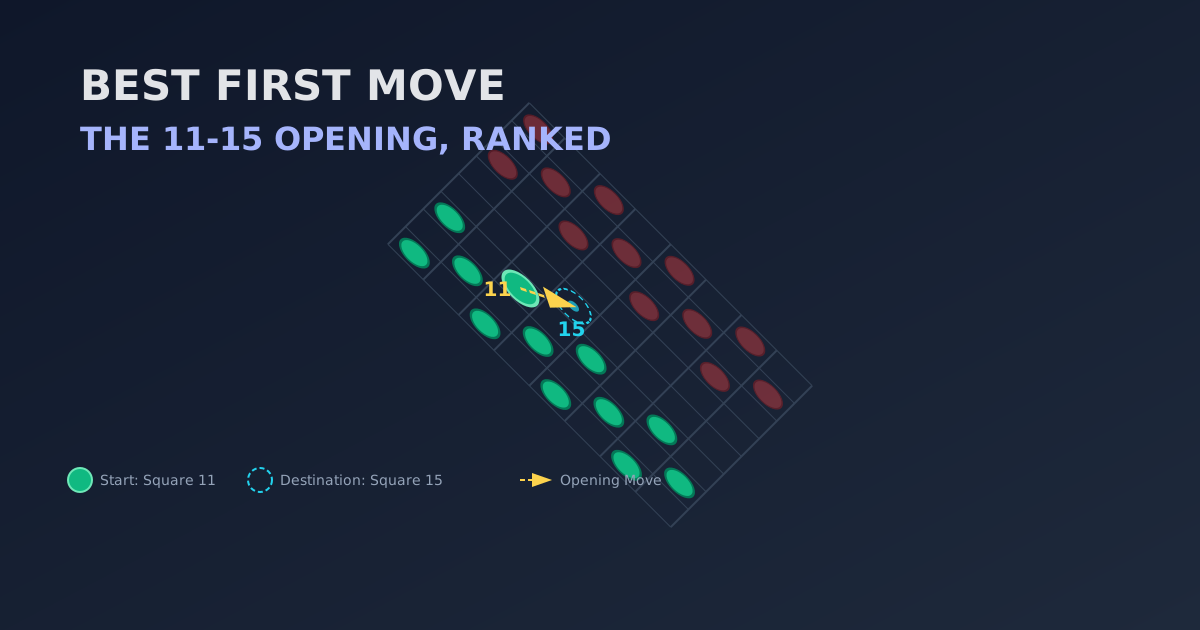
Direct Answer: The best first move in checkers is 11-15 — known to experienced players as "Old Faithful." Expert consensus ranks Black's seven legal opening moves from strongest to weakest as 11-15, 9-14, 11-16, 10-15, 10-14, 12-16, 9-13. There is no forced win: with perfect play every opening draws (Chinook proved checkers is a draw in 2007). But 11-15 gives you the most room to outplay a human or AI that is anything less than perfect.
How Opening Rank Is Decided (and Why No Move "Wins")
A quick reality check before the ranking: checkers is a solved game, and the solution is a draw. In 2007, the Chinook program and its team led by Jonathan Schaeffer proved that with perfect play from both sides, checkers always ends in a draw. No opening move can force a win against a perfect opponent.
So what does "best first move" mean? It means the move that:
- Preserves the draw against the strongest defenses, and
- Maximizes your practical winning chances against humans and AIs, who are never perfect.
Ranked openings come from decades of expert games, published opening theory, and computer analysis of the draw lines each move allows. The order below reflects that expert consensus — strongest to weakest — and mirrors how strong players and engines treat the seven legal first moves. If you need the rules and notation refresher first, How to Play Checkers Online: The Complete Beginner's Guide covers the board, notation, and movement basics.
#1 — 11-15: "Old Faithful" (Best)
The move 11-15 advances the man on square 11 to square 15 — a central, forward square that contests the middle of the board immediately. Experienced players call it "Old Faithful" because it is by far the most-played and most-respected opening move.
Why it ranks first: 11-15 develops toward the center, keeps your back row intact, and gives you maximum flexibility. It allows the broadest range of sound replies, which means your opponent must know many continuations to equalize — and most opponents do not. Against imperfect play, the practical win rate is the highest of all seven moves.
The strongest replies to 11-15 — the moves you should expect — are 22-18, 23-18, and 23-19, all of which meet your center claim with a center defense. Know these three responses and you will never be surprised out of the opening.
#2 — 9-14: The Strong Runner-Up
9-14 moves the man on square 9 to square 14, staking a claim in the left-center region. It is the second-strongest first move and a frequent choice for players who want a more positional game.
Why it ranks second: 9-14 is fully sound — it preserves the draw — but it commits you to a narrower set of continuations than 11-15. Strong opponents can steer into lines where your early commitment gives them easier equality. It is an excellent, respectable opening; it just gives slightly less practical upside than Old Faithful.
#3 — 11-16: Solid and Safe
11-16 pushes the same man as 11-15 but one square further, to 16. It is a fully sound move that keeps the draw, and it feeds into some of the most famous classical openings.
Why it ranks third: moving the man to 16 rather than 15 leaves the square 15 route available for later development, which is a real asset. The trade-off is that your immediate central presence is slightly weaker, so a well-prepared opponent finds equality a touch more easily. Still, against casual players, 11-16 creates plenty of winning chances.
#4 — 10-15 and #5 — 10-14: The Middle Pair
The next two moves — 10-15 and 10-14 — are playable and keep the draw, but they begin to show small weaknesses that good opponents can exploit.
10-15: moves the man on 10 to 15, claiming the same central square as Old Faithful but with a different supporting structure. It is sound, yet the man on 10 is your most exposed back-row piece in this line, and strong play can force it to recapture awkwardly.
10-14: similar in spirit to 9-14 but from the other side of the formation. It is playable and keeps the draw, but the early commitment on the left wing gives experienced opponents a clean route to equality. Neither move is bad — both are simply a notch below the top three in practical winning chances.
#6 — 12-16: The Weakest Sound Move
12-16 moves the man on 12 (your right-most front man) forward. It is the weakest of the moves that still preserve the draw.
Why it ranks so low: advancing to 16 leaves the right wing slightly overextended and opens a small structural weakness that strong players target with 22-17 or 23-18 replies. You can still draw with accurate play, but you will be defending early — the opposite of what you want in the opening. For the principles behind why the right wing is so sensitive, see Checkers Opening Strategies: Control the Center Early.
#7 — 9-13: The One to Avoid (Weakest)
9-13 is the weakest first move in checkers, and most opening guides flag it as the move to avoid. It pushes your left-most man into a diagonal that leaves your formation cramped and your back row exposed.
Why it ranks last: 9-13 makes no real central claim, opens a hole in your left wing, and hands White (the second player) an early initiative with natural replies like 23-18 or 24-19. You can still draw against perfect play, but against any competent opponent you will spend the opening on the back foot — giving them all the practical chances. If you ever feel tempted to start with 9-13, play 9-14 instead: same piece, far better square.
The Full Ranking at a Glance
From strongest to weakest, with the one-line reason for each:
- 11-15 — Old Faithful: center claim, maximum flexibility, highest practical win rate.
- 9-14 — sound positional play, slightly narrower continuations.
- 11-16 — keeps 15 open for later; a touch less central presence.
- 10-15 — sound, but the exposed man on 10 invites pressure.
- 10-14 — playable, but early wing commitment eases the defender's task.
- 12-16 — the weakest sound move; expect to defend the right wing.
- 9-13 — avoid: cramped formation, exposed back row, easy replies for White.
Notice the pattern: the stronger moves develop toward the center with a flexible back row, and the weaker ones overcommit a wing or leave a back-row man exposed. That principle — not memorizing a single move — is what carries you through the entire opening. Once your first move is played, the game shifts to controlling the middle: Checkers Midgame Strategy: How to Control the Board After the Opening picks up exactly there.
What the Best First Move Answers Actually Are
Your opponent's reply matters as much as your own first move. For the top-ranked 11-15, the expert-approved defenses are:
- 22-18 — the most solid reply; fights for the center and maintains a compact formation.
- 23-18 — equally sound; develops toward the center and prepares your own counterplay.
- 23-19 — the most aggressive of the three; immediately challenges your man on 15.
Weaker replies like 21-17, 24-19, or 24-20 are playable but give Black (the first player) extra room. Know your three strong replies, and you will reach the midgame with a comfortable position more often than not.
How to Use This Ranking Against the AI
The checkers AI on this site searches at different depths depending on difficulty — Easy at depth 1, Medium at depth 3, Impossible at depth 6. The ranking is useful at every level:
- Easy and Medium AI: open 11-15 and play natural center development. The shallow search will miss long-term wing weaknesses, and your solid opening converts into material gains by the midgame.
- Impossible AI: 11-15 is still correct — it preserves the draw and keeps the widest range of options. Against a depth-6 engine you are not looking for a forced win; you are avoiding the small inaccuracies that engines punish.
For a full strategy on beating each AI level consistently, read How to Beat the Checkers AI: A Complete Difficulty Guide.
Frequently Asked Questions
What is the best opening move in checkers?
11-15, known as "Old Faithful." It develops toward the center, keeps your back row flexible, and gives the widest range of sound continuations. Expert consensus ranks it the strongest of Black's seven legal first moves, and it offers the best practical winning chances against any opponent who is not playing perfectly.
Is there a first move that always wins in checkers?
No. Checkers was solved in 2007 by the Chinook team, and the game value is a draw — with perfect play, no first move wins. Ranking openings is about practical strength: how much room you keep to outplay an imperfect opponent, not about forcing a win.
What are the strongest replies to 11-15?
The three expert-approved replies are 22-18 (most solid), 23-18 (equally sound), and 23-19 (most aggressive). Each maintains the draw and fights for the center. Weaker replies like 21-17 or 24-20 give the first player extra room.
Why is 9-13 the worst first move?
Because it makes no real central claim, leaves your formation cramped, and exposes your left back row to early pressure. White has natural replies (23-18, 24-19) that seize the initiative. You can still draw, but you will be defending from the first moves — the opposite of what you want.
Does the best first move depend on difficulty level against the AI?
No — 11-15 is correct at every difficulty. Against shallow AIs it leads to natural center development and easy midgame wins. Against the depth-6 Impossible AI it preserves the draw and keeps your options open, which is exactly how you survive engines: avoid inaccuracies, never force.
Summary and Key Takeaways
- The best first move in checkers is 11-15 — "Old Faithful" — by expert consensus.
- Full ranking, strongest to weakest: 11-15, 9-14, 11-16, 10-15, 10-14, 12-16, 9-13.
- Checkers is solved as a draw (Chinook, 2007) — no opening forces a win; ranking measures practical strength.
- The strongest replies to 11-15 are 22-18, 23-18, and 23-19.
- Strong openings develop toward the center with a flexible back row; weak ones overcommit a wing or expose a back man.
- Avoid 9-13 — it is the weakest first move and puts you on the defensive immediately.
- Open 11-15 against every AI difficulty, and let the ranking guide your position instead of chasing forced wins.
Try the Best Opening — Play Checkers
Open with 11-15 against the Easy AI and watch how the center claim builds into an advantage. Then climb the difficulties and see how far Old Faithful carries you.
Play CheckersReady to go deeper? Read Checkers Opening Strategies: Control the Center Early.