Tic Tac Toe vs AI: Fork Defense That Forces a Draw

Discuss this article with your favorite AI assistant
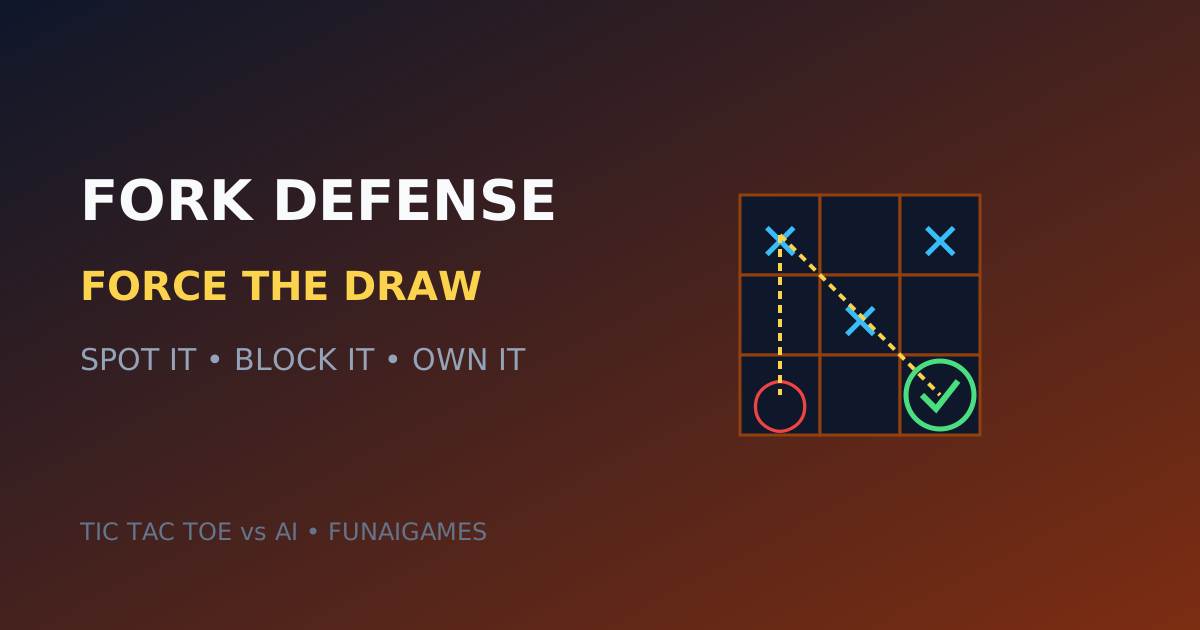
Direct Answer: A fork creates two winning threats at once — the defender blocks one, the other wins. Against Tic Tac Toe AI, fork defense is the whole game: spot the setup move before it lands, occupy the forking square first, and answer pressure with counter-threats. Master the 3-step drill below and the AI stops beating you — every game becomes a draw you control.
What a Fork Looks Like (30-Second Version)
You hold two non-blocked lines that intersect on an empty square; whatever the opponent blocks, you win through the other. The attacking bible is our fork strategy guide — read it first so you know what the AI is trying to build. Newer than that? Start with how to win every game and the beginner mistakes cleanup.
The AI's Two Favorite Forks
Fork 1: Opposite Corners + Center
AI owns center and two opposite corners; any edge you play completes its fork geometry. Defense: never play an edge here — take the remaining corners first and force it to defend instead. This is the position our hard-mode guide calls the corner trap.
Fork 2: The Edge Lure
AI baits you onto an edge that "blocks" — but the edge itself completes the second arm of its fork. Defense: block with a corner, not the "obvious" edge. If both a corner and an edge seem to block, the corner is correct 90% of the time.
The 3-Step Defense Drill (Do This 20 Times)
- Freeze: before every AI move, name its two most threatening squares aloud.
- Intersect: ask "do those threats share an empty square next move?" — if yes, that square is the fork point.
- Occupy or counter: take the fork point yourself; if taken, create your own threat so the AI must block instead of forking.
Run the drill on Easy (where forks arrive slowly), then Medium, then Hard. Ten clean reads in a row per level before promoting — same promotion discipline as our Connect 4 ladder method.
When Defense Becomes Attack
Perfect fork defense flips games: the AI, denied its fork, plays passively — and passive AI walks into your forks. After blocking, immediately ask "what do I threaten now?" The player who sets the last fork wins; make it you, using the two-trap system from the fork attack guide. Teaching a child the same ideas? Our kids' guide shrinks this to game-sized lessons.
Conclusion — Own the Fork Square
Forks look like magic until you see the setup move — then they look like blunders you get to punish. Drill the freeze-intersect-occupy loop until it is boring. Boring defenders draw everything; bored AI makes the first mistake.
Your Next Step
Play 5 Hard games doing only the drill — no attacking. Count clean reads. When you hit 10 in a row, add your own forks back in and watch the results flip.
Frequently Asked Questions
What is a fork in Tic Tac Toe?
Two winning threats at once sharing one key square. The defender blocks one line; you win through the other. All strong Tic Tac Toe — attack and defense — revolves around forks.
How do I stop the AI's forks?
Spot the setup move early (freeze-intersect-occupy drill), take the forking square first, and prefer corner blocks over edge blocks. Never play an edge against opposite-corners-plus-center.
Why do edge moves lose so often?
Edges touch only two winning lines but complete fork geometries — they look defensive while building the opponent's second threat. Corners first, always.
How long until fork defense is automatic?
About 20 focused drill games across Easy → Medium → Hard. Most players see clean reads within a week of daily 10-minute sessions.
Where can I practice free?
Our Tic Tac Toe game runs in the browser with Easy through Impossible AI plus online rooms — no login or download needed.