Chutes and Ladders vs Snakes and Ladders: What's the Difference?

Discuss this article with your favorite AI assistant
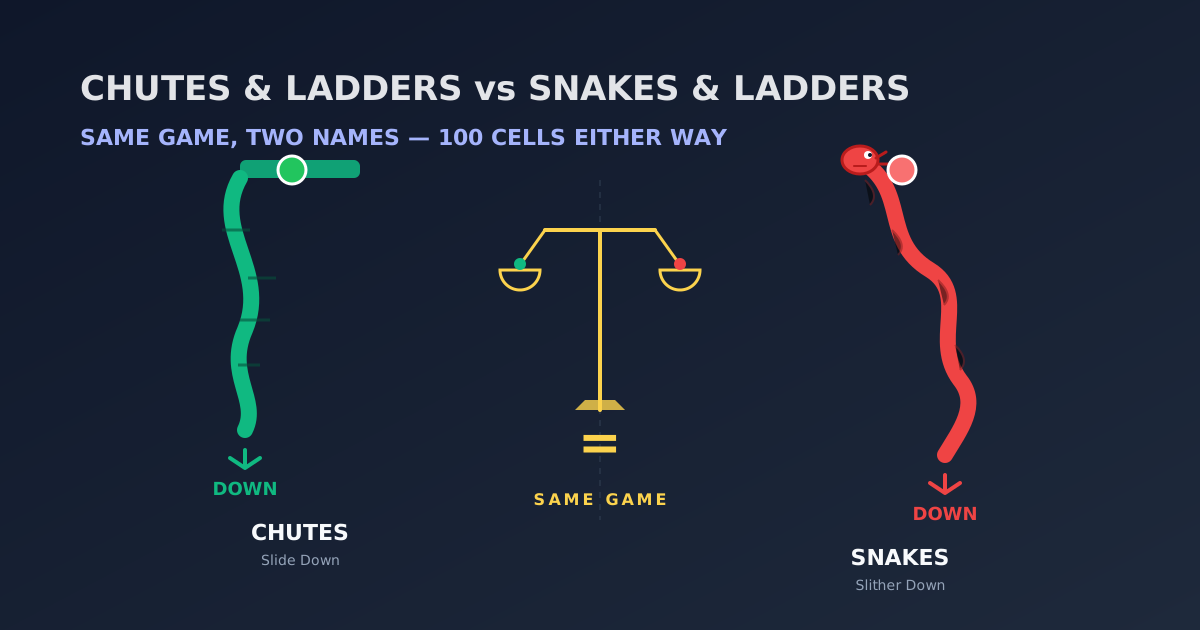
Direct Answer: Chutes and Ladders and Snakes and Ladders are the same game — the difference is branding and history, not rules. "Snakes and Ladders" is the traditional name from India (where it originated as the ancient game Moksha Patam), while "Chutes and Ladders" is the Americanized name Hasbro/Milton Bradley uses to replace the snakes with chutes on the box art. Both use an identical 100-square board, a single die, and the same rule: climb ladders, slide down snakes or chutes, and be the first player to reach square 100. Every version of the game is pure luck — no choices, no strategy — which is why it remains a beloved first board game for young children.
Same game, different name — play Snakes & Ladders free here (no login): 2–4 players with AI opponents, right in your browser.
The Same Game Under Two Names
If you grew up in North America, you probably played Chutes and Ladders — the colorful board with kids climbing ladders and sliding down playground slides. If you grew up in India, the UK, or much of the rest of the world, you played Snakes and Ladders — the same layout, but with snakes hissing down the board instead of chutes. Both are published under the umbrella of the same game.
The rules are identical. There is no gameplay difference whatsoever between the two names:
- One 10x10 board numbered 1 to 100.
- Players roll a single six-sided die and move that many squares.
- Land on the base of a ladder — climb to its top.
- Land on a snake's head or a chute's top — slide down to the bottom.
- First player to land on (or pass) square 100 exactly wins.
That is the whole game — and the whole reason the comparison guide you are reading can be short on rules. The real story is the history of why the name changed.
Where Snakes and Ladders Comes From
Snakes and Ladders is an ancient Indian game, known in its original form as Moksha Patam (or Gyan Chaupar, meaning "game of knowledge"). Its roots go back centuries — historians generally place its origin in India around the 13th century, with some sources pointing earlier.
The original game was not a child's pastime; it was a moral and religious teaching tool. The board represented a spiritual journey: ladders stood for virtues — faith, humility, generosity — that lifted a soul toward liberation (moksha), while snakes represented vices — desire, anger, greed — that dragged a soul back down into rebirth. The number of squares varied across versions, and the lesson was that salvation depended on virtue, not on skill or luck in the mundane sense.
British colonists carried the game to England in the late 19th century, where it became a commercial children's game. The Victorian edition kept the morality theme — players could see virtues and vices labeled on the board — but the religious framing faded into family entertainment.
Why "Chutes and Ladders" Exists
In 1943, the American game company Milton Bradley (later part of Hasbro) published its own version under the name "Chutes and Ladders." The company swapped the snakes for chutes — playground slides — and dropped the moral labels entirely, replacing them with cheerful illustrations of children.
The reasons were practical and commercial:
- Marketing to parents: chutes read as playful and child-friendly in a way snakes did not.
- Regional comfort: American parents of the 1940s were likelier to buy a board with no scary reptiles.
- Fresh branding: a distinct name let Milton Bradley sell the game as its own product line rather than a foreign import.
The result is that the same mechanical game is known by two names on two continents. Ask for "Chutes and Ladders" in Mumbai and you will get blank stares; ask for "Snakes and Ladders" in Ohio and most people will still know exactly what you mean — because the rules are unforgettable and universal.
Are There Any Real Rule Differences?
No. Across every mainstream edition of both names, the rules are functionally identical. The differences you may notice are cosmetic:
- Board art: chutes are drawn as playground slides; snakes are drawn as snakes.
- Theme: the American edition uses children doing everyday activities; the classic editions use adventure or animal themes; original Indian boards used virtues and vices.
- Edition-specific tweaks: some anniversary editions change the number of ladders or chutes, and some digital versions add dice-roll animations — but the underlying 100-square, roll-and-move structure never changes.
- Player count: printed editions vary from 2 to 6 players; the version on this site supports 2 to 4 players in local hot-seat mode, plus AI opponents.
One genuinely constant rule that surprises people: you do not need to land on 100 exactly. Rolling a number that overshoots the final square still counts as a win in the standard rules — the first player to reach or pass 100 takes the game. Many house rules require exact landing, but the official rule allows overshoot.
How to Play (Recap for Either Name)
Since both names share one rule set, this quick recap covers the game in either form. The full walkthrough lives in How to Play Snakes and Ladders Online — here is the two-minute version:
- Each player starts off the board. Roll the die; on your first roll you enter the board at your square count.
- On every turn, roll and advance. If you land exactly at the foot of a ladder or the top of a chute/snake, you are transported to the other end.
- Players race in turn order until someone reaches or passes square 100 — that player wins.
There are no choices to make. No strategy, no skill, no bluffing — which is precisely the point. The game teaches number recognition, counting, taking turns, and graceful winning and losing. That is also why this site's version, like the board game, is decided entirely by the dice.
Which Name Should You Use?
Use whichever your audience knows. If you are writing for a global audience — or playing the version on this site — Snakes and Ladders is the name that maps to both the traditional game and the digital implementation. If your audience is North American families shopping for a toddler's first board game, Chutes and Ladders is the shelf name they will recognize.
For search purposes the two names are the same game, so content and links work interchangeably — that is exactly why this guide exists: so you never get confused when you see both names for the same board. And if you want to play right now, the site's Snakes and Ladders game runs the exact classic rules with 2-4 players and AI opponents.
The Cultural Journey: From Temple Lessons to Family Shelf
The distance between Moksha Patam and a modern Chutes and Ladders box is a story of three cultures, and it explains every difference you will ever notice between the two names.
In India, the board began as a teaching instrument for moral philosophy. Ladders represented virtues like faith and honesty; snakes represented vices like lust and anger. The game's message was that karma — not luck — governed the soul's journey, and the player's roll was simply a stand-in for the moral choices of life. This is why the traditional game is sometimes called the "game of heaven and hell" and why it appears in discussions of Indian board-game history.
When the British carried it to England in the late 19th century, the Victorian publishers kept the moral labels but repackaged the game as wholesome family entertainment. The religious doctrine was thinned into Victorian etiquette: virtues like "industry" and "truth" lifted you up; vices like "indolence" and "disobedience" dragged you down. It was still a lesson — just a more secular one.
Milton Bradley's 1943 American edition finished the secularization: no lessons at all, just play. The children on the Chutes and Ladders board do everyday things like brushing teeth and flying kites, and the only "lesson" is the counting practice every roll provides. So when you ask "what is the difference between Chutes and Ladders and Snakes and Ladders?" the honest answer is: one is the modern, secular, American shelf version of a very old Indian moral game — and the other is everything that came before it.
Digital Versions and the Name on the Screen
In the digital era the naming split persists, and it follows the same pattern: Indian and international apps say "Snakes and Ladders"; American apps say "Chutes and Ladders." The version on this site uses the traditional name — "Snakes and Ladders" — and follows the classic 100-square layout with snakes. If you grew up on the American name, nothing about the board will surprise you: same 100 squares, same ladders, same slides, same single die.
One genuinely useful difference in digital play is that the site enforces the rules for you — no need to argue about whether you landed on the ladder's base or the snake's head, because the game resolves it instantly. It also handles the player-count question cleanly: 2 to 4 players, with AI filling any empty seats, which is exactly the flexibility printed editions lack. Whether you call it Chutes and Ladders or Snakes and Ladders, the digital version plays the classic game the way the rules intend — dice and all.
Frequently Asked Questions
Is Chutes and Ladders the same as Snakes and Ladders?
Yes — it is the same game with different branding. "Snakes and Ladders" is the traditional name from India; "Chutes and Ladders" is the American name used by Milton Bradley/Hasbro since 1943, with chutes replacing the snakes in the artwork. The rules are identical.
Why did they change snakes to chutes?
For marketing. Milton Bradley chose chutes in 1943 to make the game feel friendlier and more child-appropriate for American families. Snakes read as scary; playground slides read as fun. The gameplay was left untouched.
Do you have to land exactly on 100 in Chutes and Ladders?
No. In the official rules you win by reaching or passing square 100. Some families play a "land exactly" house rule, but the standard game ends as soon as any player's count reaches 100 or more.
Is Chutes and Ladders a game of skill?
No. It is a pure luck game — there are no decisions to make, only dice rolls. That is a feature, not a bug: the game is designed as an early-learning tool for counting, number recognition, and turn-taking for young children.
How many players can play Chutes and Ladders?
Printed editions typically support 2 to 6 players. The digital version on this site supports 2 to 4 players in hot-seat mode, with optional AI opponents filling any empty seats.
Summary and Key Takeaways
- Chutes and Ladders and Snakes and Ladders are the same game — the difference is branding and history, not rules.
- Snakes and Ladders originated in India as Moksha Patam, a moral-teaching game where ladders were virtues and snakes were vices.
- Milton Bradley renamed it Chutes and Ladders in 1943 with friendlier artwork for the American market.
- The 100-square board, single die, ladders, and slides are identical under both names.
- Reaching or passing 100 wins — exact landing is only a house rule.
- The site's version uses the classic rules with 2-4 players and AI; learn the full walkthrough in How to Play Snakes and Ladders Online.
Play the Classic, Whatever You Call It
Roll the dice on the classic 100-square board right now — hot-seat for up to 4 players, or take on the AI. The rules are the rules, under any name.
Play Snakes and LaddersPrefer a two-player round? Read How to Play Snakes and Ladders with 2 Players.