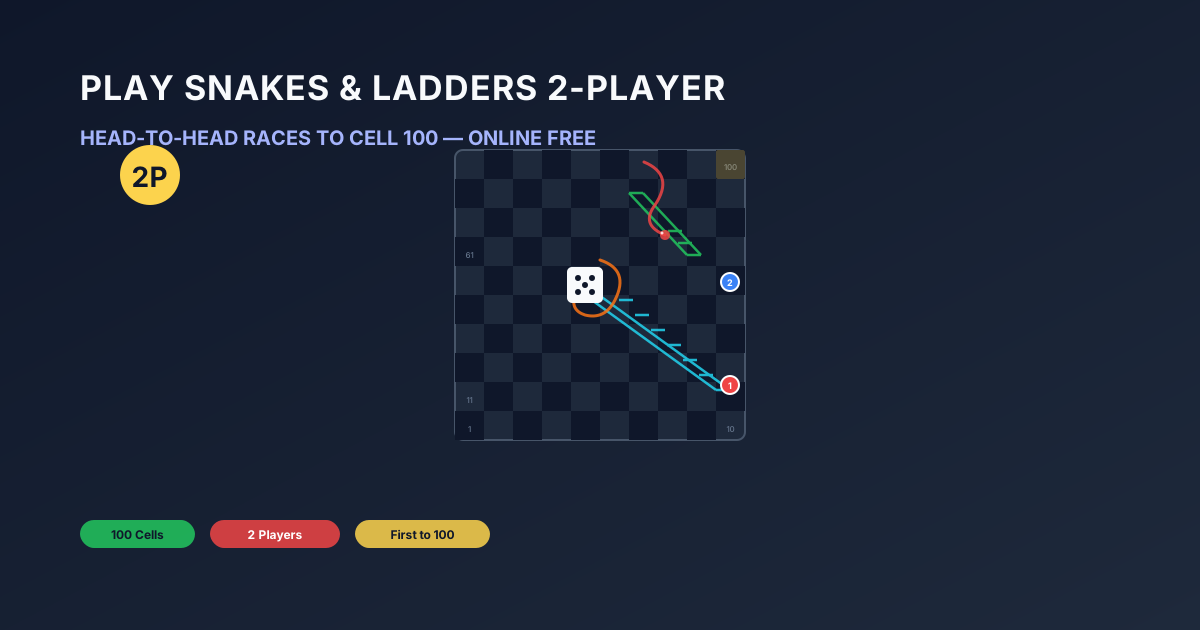
Play Snakes and Ladders 2-Player: Setup, House Rules, and Strategy

Discuss this article with your favorite AI assistant
Direct Answer: To play Snakes and Ladders with 2 players, set the player count to two and take turns rolling a single die — whoever reaches or passes square 100 first wins. On this site you can play 2-player hot-seat on one device (both players share the screen, passing it back and forth), or 1 human vs. the AI, or even AI vs. AI to watch. The game is pure luck, so the only real decisions happen before the first roll: turn order, house rules, and whether to play a single race or best-of-three. The classic 100-square board, ladders, and chutes all work exactly as they do in the 4-player version.
Two Players Is the Classic Format
Snakes and Ladders (or Chutes and Ladders — the names describe the same game, as covered in Chutes and Ladders vs. Snakes and Ladders: What's the Difference?) supports anywhere from 2 to 6 players in printed editions. Two players is the classic head-to-head format: fast, tense, and easy to fit into a lunch break.
The full rules walkthrough is in How to Play Snakes and Ladders Online. The 2-player version changes nothing about the mechanics — it only changes who you are racing. Here is the whole rule set in condensed form:
- Players start off the board. On your turn, roll a single six-sided die and move that many squares.
- If you land at the foot of a ladder, climb to its top. If you land on a snake's head, slide down to its tail.
- First player to reach or pass square 100 wins. (Requiring an exact roll on 100 is only a house rule — the official game allows overshoot.)
That is the entire game — which is exactly why 2 players works so well. No waiting for three other people, no downtime between your turns, just back-and-forth dice rolls with one opponent.
The Three Ways to Play 2-Player on This Site
The Snakes and Ladders game on this site supports 2 to 4 players and lets you fill seats with humans or AI. For a 2-player session, you have three setups:
- Hot-seat (2 humans, 1 device): both players sit together and pass the device after each roll. The classic couch experience — and the most social way to play.
- Human vs. AI (1 + 1): you roll, the AI rolls. Perfect for solo practice or for learning the board before you challenge a friend.
- AI vs. AI (0 + 2): set both seats to AI and watch the dice decide. Great for a quick demonstration, for testing house rules, or just for fun.
Hot-seat play is local only — Snakes and Ladders is not one of the online room games on this site (those are Gomoku, Tic-Tac-Toe, Connect 4, Checkers, and Rock-Paper-Scissors; the room system is explained in How Online Game Rooms Work: Room Codes Explained). To play 2-player Snakes and Ladders over the internet with a friend, take turns hot-seat and share the screen, or run one match on each side and compare scores.
Who Rolls First — and Why It Matters More Than You Think
Since the game is pure luck, the only "strategy" available is deciding the order of play. And in a 2-player race, first-mover advantage is real:
- First player wins ties. If both players reach 100 on the same round, the player earlier in turn order wins — they got there first.
- The first player controls the pace. In a quick race, the player who rolls first is always one roll ahead of their opponent for the entire game.
Standard practice is to roll for high — each player rolls once, and the higher number goes first (reroll ties). In a best-of-three series, alternate who starts each round so the advantage is shared. It is a small ritual, but in a game with zero decisions, it is the fairest lever you have.
Best-of-Three Is the Real "Strategy"
Single games of Snakes and Ladders swing wildly on a couple of snake slides. If you want a satisfying head-to-head that feels like a competition rather than a coin flip, play best-of-three:
- Whoever wins two races first takes the match.
- Alternate the starting player each race.
- Keep a running tally of total ladder-climbs and snake-slides for fun stats.
Over three races, the law of large numbers evens out the luck — and the match builds genuine tension, because a 2-1 scoreline means the losing player was only one bad slide away from the title. It also gives kids a natural way to practice adding, comparing numbers, and handling both winning and losing gracefully.
House Rules Worth Trying in a 2-Player Match
Because the base game is pure luck, house rules are where 2-player Snakes and Ladders gets its personality. Three popular ones:
- Exact-roll finish: you must land on 100 exactly; overshooting bounces you back. This lengthens games and adds a "one away" cliffhanger state.
- Snake insurance: when you slide down a snake, you roll again immediately. Softer games, faster comebacks, fewer rage quits.
- Scoreboard mode: instead of a single race, play 5 rounds and sum each player's final square positions. The most consistent player wins, not the luckiest.
All three are easy to track on paper while the site handles the board. Pick the set you both agree on before the first roll — agreed-upon house rules are the closest thing this game has to strategy.
How to Set Up a 2-Player Game in Three Clicks
On this site, setting up a 2-player game takes seconds:
- Open the Snakes and Ladders game.
- Set player count to 2.
- Choose each seat: Human or AI. For hot-seat, make both seats Human; for solo practice, make seat 2 the AI.
- Start the game and roll.
The board handles turn order, dice rolls, ladders, and snakes automatically — you just tap your square-to-square movement (or tap to roll) and watch the race unfold. With a 2-player setup, a typical game finishes in 3-6 minutes, which makes it ideal for quick breaks, classroom transitions, or a warm-up before a longer board-game session.
Why Two Players Is the Best Way to Learn the Board
If the goal is teaching a child (or a friend) how Snakes and Ladders works, the 2-player format is the clear winner over 4 players. With fewer players, each person rolls roughly twice as often, which means more counting practice, more ladder excitement, and more snake drama per minute. A child who plays a 2-player race will count their way across a hundred squares several times over — the exact number-recognition workout the game was designed to provide.
It also makes the rules transparent. With one opponent, it is easy to narrate every roll: "You rolled a 3, so you move three squares — and look, that lands you on a ladder!" A crowded 4-player board makes the same lesson noisy and easy to miss. For a first game, two players — human or AI — keeps attention on the one thing that matters: what the dice do to your position on the board.
And because a 2-player race finishes in minutes, it is the perfect warm-up before a bigger session. Kids internalize the rhythm — roll, count, move, climb, slide — and carry it straight into a 4-player family game without any re-teaching. In that sense the 2-player mode is not just a format; it is the training wheels for the whole game.
Keeping Score Across a Series
If a single race feels too luck-heavy, a series with a running score turns Snakes and Ladders into a proper head-to-head contest. Two popular scoring systems:
- Match points: first to win 3 races takes the match. Simple, and every race has a clear winner to cheer.
- Position points: play 5 races and add up each player's final square each time (100 for a win, otherwise your landing square). This rewards consistency over single lucky finishes and produces close, tense tallies.
The position-points system is particularly good for two players of very different skill levels at rolling (which is to say, no skill difference at all) — it gives the "losing" player a way to win the overall series by being unlucky less often. It also adds a layer of math practice, since someone has to add the running totals. Keep the scores on a scrap of paper while the site runs the board, and the series takes on a tournament feel that a single race never has.
Frequently Asked Questions
Can you play Snakes and Ladders with 2 players?
Yes. Two players is the classic head-to-head format: take turns rolling a single die, climb ladders, slide down snakes, and be first to reach or pass square 100. On this site, set the player count to 2 with either two humans (hot-seat), one human and one AI, or two AIs.
Is Snakes and Ladders 2-player the same as 4-player?
Mechanically yes — the board, dice, ladders, and snakes are identical. The only differences are pace (2-player games are faster) and turn order (with 2 players there is no waiting around between turns). The same rules apply at every player count, which is why the 2-player format works as a clean introduction.
Who goes first in a 2-player Snakes and Ladders game?
Roll for high: each player rolls once and the higher number goes first, rerolling ties. In a best-of-three match, alternate who starts each round so the first-mover advantage is shared fairly. This is the fairest ritual available in a game with no decisions.
Can I play Snakes and Ladders with a friend online?
On this site, Snakes and Ladders is a local hot-seat game (up to 4 players on one device) — it is not one of the online room games. For online play with friends, try the room-based games like Gomoku, Tic-Tac-Toe, Connect 4, Checkers, or Rock-Paper-Scissors.
How long does a 2-player Snakes and Ladders game take?
A typical 2-player game lasts 3-6 minutes. Because there is no strategy and no decision-making, the pace is set entirely by the dice — most races end well before the 100th roll. A best-of-three series fits comfortably inside a 20-minute break.
Etiquette for a Friendly 2-Player Match
Since the outcome is pure chance, the quality of a 2-player Snakes and Ladders session is really the quality of its table manners. Three habits keep a head-to-head race fun for both sides:
- Roll visibly. In hot-seat play, the whole drama is watching the die tumble. Roll where both players can see, and let the site's dice animation do the revealing when playing digitally.
- Take the bad slides in good humor. A snake at square 98 is the game's cruelest joke, and it will hit both players eventually. Laughing at your own bad luck is the entire sport.
- Announce your landing. Say your square number out loud as you move — it keeps both players' counting sharp and makes the race legible for spectators.
None of this changes the winner, but it changes whether anyone wants a rematch. And in a game where skill plays no part, the rematch is the real trophy.
Summary and Key Takeaways
- 2-player Snakes and Ladders uses the exact same rules as any player count — roll, move, climb, slide, reach 100.
- The site offers hot-seat (2 humans), human vs. AI, or AI vs. AI setups.
- The only real decisions are turn order, house rules, and match length — not the rolls.
- Roll for high to decide who starts; alternate starters in best-of-three for fairness.
- House rules like exact-roll finish, snake insurance, or scoreboard mode add depth to a pure-luck game.
- 2-player games finish in 3-6 minutes — perfect for quick rounds.
Set Up Your 2-Player Race Now
Two seats, one board, one die. Grab a friend for hot-seat or take on the AI — the first to 100 takes the match.
Play 2-Player Snakes and LaddersJust learning the board? Start with How to Play Snakes and Ladders Online.