Is Mancala Solved? What the Math Says

Discuss this article with your favorite AI assistant
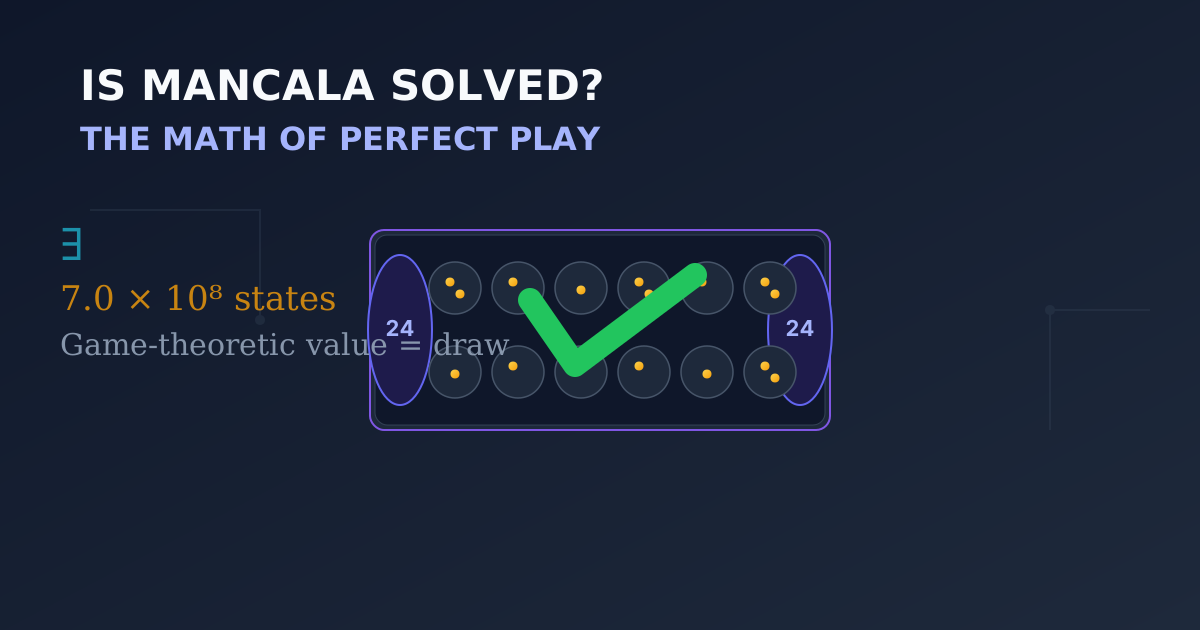
Direct Answer: Yes — the exact mancala variant played on this site, Kalah(6,4) (6 pits per side, 4 seeds per pit, empty-pit capture, extra turn on landing in your own store), was mathematically solved in 2000. Computer retrograde analysis by Geoff Irving and Jeroen Donkers proved that with perfect play on both sides, the first player always wins — by exactly 10 seeds (a margin later confirmed in 2015). However, "solved" here means "computers know the perfect strategy," not "humans can use it" — the solution is a giant lookup table, not a memorizable rule. And other mancala games — Oware, Wari, and Kalah with different board sizes — remain unsolved. For casual players, Kalah(6,4) is effectively a solved-but-unusable game: perfect play wins, but no human plays perfectly.
What Does "Solved" Actually Mean?
Play the solved game yourself — free Kalah vs AI in your browser, no login.
A game is "solved" when someone has proven what the outcome is with perfect play from both sides. There are three common levels:
- Ultra-weakly solved: we know the final outcome (win/loss/draw for the first player) but not the strategy.
- Weakly solved: we know the outcome and a strategy that achieves it from the starting position.
- Strongly solved: we know the outcome for every possible position, not just the start.
Kalah(6,4) is weakly solved: the outcome from the standard opening position is known, and a perfect-play strategy exists in the form of a computed database. For comparison, Tic-Tac-Toe is strongly solved (perfect play always draws), and Connect 4 is solved as a first-player win. Mancala joins that club — with one important caveat explained below.
The Verdict for Kalah(6,4): First Player Wins by 10
The mancala variant on this site is Kalah(6,4): six pits per player, four seeds per pit, capture by landing in an empty pit on your own side (taking the opposite pit's seeds), and an extra turn whenever the last seed lands in your store.
In 2000, Irving and Donkers published a retrograde-analysis proof that this exact configuration is a first-player win. A 2015 follow-up (Rawlings) confirmed the result and pinned the exact margin: with perfect play, the first player wins by 10 seeds.
What that means in plain terms: if two perfect players face off from the standard Kalah(6,4) starting board, the game is decided before the first seed is sown. The second player cannot win — they can only minimize the margin.
How the Proof Was Done
You cannot prove a game like this by hand — the branching is far too large. The proof used retrograde analysis, a technique that works backward from all possible end states:
- Enumerate every possible board position that ends the game (one side empty).
- Classify each ending position as a win, loss, or draw for the player to move.
- Walk backward one move at a time: a position where you have any move to a losing position for your opponent is a win; a position where all moves lead to opponent wins is a loss.
- Continue until the starting position is classified.
This is the same family of technique that solved Connect 4 and Checkers. The result is not a human-readable proof — it is a database of positions and their outcomes. A computer can look up the perfect move in any position; a human cannot feasibly memorize it, because Kalah(6,4) has an astronomically large state space.
How Big Is the Game Tree? (And Why That Matters)
To understand why the solution is a database and not a paragraph, consider the game tree — the branching structure of every possible move sequence. Kalah(6,4) is small by board-game standards but still enormous:
- Each turn offers up to 6 legal moves (one per non-empty pit on your side).
- Games can last 50-100 plies (single moves), and extra turns stretch them further.
- The total number of distinct reachable positions runs into the billions, with the full state space far larger when all legal positions are counted.
Compare that with games you already know: Tic-Tac-Toe has only 255,168 legal positions, which is why it was solved by hand in the 1920s. Connect 4 has about 4.5 trillion — solved by computer in 1988. Kalah(6,4) sits between them in raw size, but its capture and extra-turn mechanics make its state space irregular, which is why a complete solution took until 2000 and required dedicated retrograde computation rather than a cleverer algorithm.
The practical consequence: no human can hold the solution in memory, and no human can out-calculate a computer over the full tree. But that is true of every solved game — the solution's value is theoretical certainty about the outcome, not a recipe for your next move.
What Retrograde Analysis Actually Computed
The Irving and Donkers result is worth understanding a little more precisely, because "solved" papers are easy to misread. Their analysis did not find a single winning move — it classified every reachable position as a win, loss, or draw for the player whose turn it is, working backward from the ends of games:
- Start with all terminal positions (one side's pits empty). These are wins for the player who owns the remaining seeds, because the final sweep sends them all to their store.
- Label each predecessor position: if any move leads to a position labeled "loss" for the opponent, this position is a win.
- If every move leads to a position labeled "win" for the opponent, this position is a loss.
- Repeat until every reachable position is labeled. The starting position's label is the answer.
The 2015 confirmation (Rawlings) went further and computed the exact margin of victory under perfect play: 10 seeds. That number is the whole story of the game in theory: the first player starts with a 10-seed advantage that perfect play can never surrender.
Which Mancala Variants Are NOT Solved
"Mancala" is a family of hundreds of games, and the solved status does not generalize. These remain unsolved:
- Oware (the most widely played mancala in West Africa and the world) — no solved result; expert play is a live field of study.
- Wari and other two-row capture variants with different capture rules — unsolved.
- Kalah with different board sizes — Kalah(6,5), Kalah(7,4), and others have been computationally explored but not fully solved to the same standard.
Even within Kalah, the result is sensitive to rules: slight house-rule changes (like allowing a different empty-pit capture behavior) can flip the outcome. So "Mancala is solved" is only true for the specific configuration Kalah(6,4) with the standard rules — which happens to be exactly the one this site implements.
Why the Solution Doesn't Change How You Play
Here is the honest part: the mathematical solution does not make you a better mancala player. The perfect strategy is a lookup table, not a set of rules you can hold in your head. No human plays perfectly, and against any real opponent — including the strongest AIs — the game is still decided by the same practical skills covered in 7 Mancala Rules of Thumb: protecting the pit behind your store, banking seeds, grabbing extra turns, and forcing the empty-side ending.
The solved status matters in two ways only:
- Theoretically: it proves Kalah(6,4) is a first-player advantage game, so competitive players should prefer to start when they can.
- Practically: it means a perfect AI is theoretically possible — but the site's Hard AI (6-ply alpha-beta search) already plays far better than any human, so the theoretical ceiling is not a practical limit.
If you want to know which other games on this site are mathematically decided, the same analysis that solved Connect 4 applies to Gomoku (solved with certain rule sets) — and the practical difficulty of each game is ranked in The Hardest Unbeatable AI Games, Ranked.
What This Means for Playing on This Site
Concretely, the solved status changes nothing about your games against the AI, but it is worth knowing:
- Start when you can. If the choice of who moves first is available, take it — perfect play makes the first player a 10-seed favorite.
- Never play "perfectly" against the AI expecting a win. No human can execute the solution database; the Hard AI plays at a level no human can beat reliably.
- Play the heuristics, not the table. The practical strategies in the rules-of-thumb guide are the real path to beating other humans.
In short: the game is solved, you are not, and neither is your opponent — so the winner is still whoever applies the seven heuristics more consistently. And if the phrase "solved game" makes you want to test yourself against the sharpest opponent available, the Hard AI on this site is a far better sparring partner than any human you will find — it plays close enough to the theoretical line that every heuristic mistake is punished, and every correct read is rewarded.
Frequently Asked Questions
Is Mancala solved?
The specific variant Kalah(6,4) — six pits per side, four seeds per pit, with standard empty-pit capture — is solved: it was proven in 2000 that the first player wins with perfect play, by a 10-seed margin. Other mancala games like Oware, Wari, and other Kalah board sizes are not solved.
Who solved Mancala?
Geoff Irving and Jeroen Donkers proved in 2000 that Kalah(6,4) is a first-player win, using retrograde analysis (computing outcomes backward from all end positions). A 2015 follow-up by Rawlings confirmed the result and quantified the win margin at 10 seeds.
Does the Kalah(6,4) solution help humans win?
Not practically. The solution is a database of millions of positions, not a memorizable strategy. No human can play perfectly, so against real opponents the game is decided by practical skills like protecting your back pit, banking seeds, and forcing the ending.
Is Mancala a game of skill or luck?
Pure skill — there is no randomness and no hidden information. The solved status of Kalah(6,4) actually proves this: with perfect play the outcome is fixed. Every move is a decision, and the better calculator wins.
Is Oware solved?
No. Oware, the most popular mancala variant worldwide, has no solved result. It uses different capture mechanics than Kalah, and its state space remains an open computational challenge. Only Kalah(6,4) among the common variants has a proven solution.
Summary and Key Takeaways
- Kalah(6,4) is solved: proven first-player win, perfect-play margin of 10 seeds (Irving & Donkers 2000; confirmed 2015).
- The proof uses retrograde analysis — a position database, not a human-readable strategy.
- Other variants are not solved: Oware, Wari, and other Kalah board sizes remain open.
- The solution does not change practical play — no human can use the table, so heuristics still decide real games.
- It does confirm first-mover advantage is real in Kalah(6,4): prefer to start.
- Practical skill, not the mathematical result, is what wins against human opponents.
Put the Math Aside — Play Mancala
The theory says the first player wins; practice says the better calculator wins. Test your heuristics against the AI and see how far skill takes you.
Play MancalaWant the practical edge the solution can't give you? Read 7 Mancala Rules of Thumb.