Best 2-Player Games Online, No Login: Ranked for Every Mood

Discuss this article with your favorite AI assistant
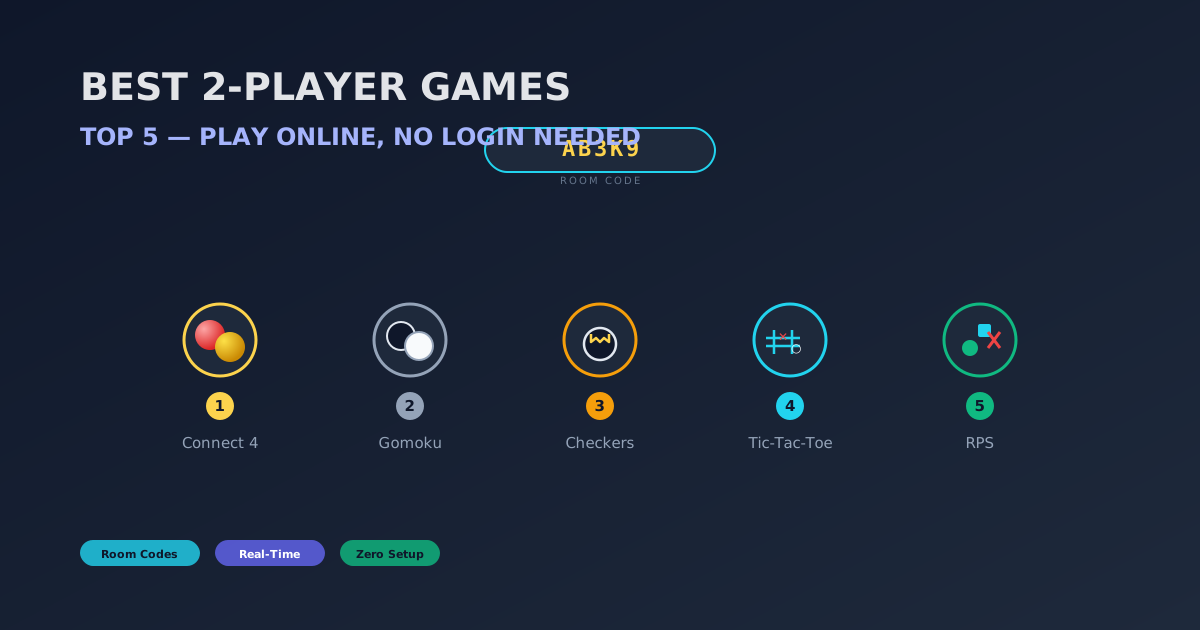
Direct Answer: The best 2-player games online with no login are Connect 4, Gomoku, Checkers, Tic Tac Toe, and Rock Paper Scissors — all five run instantly in a browser via a private room code, ranked here as: 1) Connect 4 (best all-around), 2) Gomoku (deepest), 3) Checkers (classic strategist's pick), 4) Tic Tac Toe (fastest), and 5) Rock Paper Scissors (most social). Every one of them works the same way: you create a room, share a 5-character code with a friend, and play in seconds — no account, no download, no sign-up. On top of the five room games, the site also offers pass-and-play hot-seat games like Snakes and Ladders and Ludo that need no internet at all.
Why No-Login 2-Player Games Win
The biggest barrier between "thinking about playing a friend" and "actually playing" is setup friction. Traditional online platforms want you to create an account, verify an email, build a friend list, send requests, and wait for acceptance — a ritual that can take longer than the game itself. No-login multiplayer removes every one of those steps.
The whole system is described in detail in How Online Game Rooms Work: Room Codes Explained, but the short version is this: you click "Create Room," the server hands you a code, you text it to a friend, and they type it into the "Join" box. Both of you are playing before the conversation about what to play even finishes. No-login also means no profiles to maintain, no passwords to forget, and nothing to delete when you are done — the room exists only as long as you are playing it.
This is the same philosophy the site has used since its multiplayer launch, covered in Online Multiplayer Launch: Play with Friends, No Login — and it is why these five games consistently beat their login-walled equivalents for casual head-to-head play.
How Rooms Work in 30 Seconds
If you have never used a room code before, here is the entire workflow:
- Open any of the five online games (Gomoku, Tic Tac Toe, Connect 4, Checkers, or Rock Paper Scissors).
- Choose Create Room. The site generates a 5-character code and routes you to your private match.
- Send the code to your friend — by text, chat, or carrier pigeon.
- Your friend picks the same game, chooses Join Room, types the code, and lands in your match.
- Play. Moves sync instantly over a WebSocket connection, and the server enforces turns and legality.
The codes deliberately skip confusing characters like 0, 1, I, and O (so "7KQ2M" is easy to read aloud), and there are 33.5 million possible combinations, so nobody is guessing your code. The technical details — including the 60-minute inactivity timeout and the 1,000-room cap — are in the rooms explainer if you are curious.
The Five Room Games, Ranked
All five are good — that is why they made the shortlist. But "good" means different things depending on the mood. Here is the ranking and the reasoning:
- Connect 4 — best all-around. Two-minute games, real strategic depth, and the most intuitive "one piece per turn" rhythm of the bunch. It is the game to pick when you are not sure what to play.
- Gomoku — deepest. The 15x15 board gives you room to build, trap, and counter like nothing else in the lineup. It rewards reading your opponent over memorizing openings.
- Checkers — classic strategist's pick. Forced captures and king promotions create the most punishing mistake economy: one bad move can cascade into a losing exchange.
- Tic Tac Toe — fastest. Games finish in under a minute, which makes it the perfect warm-up, filler, or teaching game. Best-of-7 turns it into a genuine duel.
- Rock Paper Scissors — most social. The most psychological game on the list. A best-of-7 RPS series is a battle of pattern-reading, not probability.
If you want the game-by-game psychology of playing each of these against a human — the tells, the biases, the traps — the deep dive in No-Login Multiplayer Games: Play with Friends Online covers all five in detail. This guide's job is the ranking; that one is the autopsy.
Deepest Strategy: Gomoku and Checkers
If you and your friend want a game that will still be interesting after a hundred matches, pick Gomoku or Checkers.
Gomoku (five-in-a-row on a 15x15 board) is the deepest game in the online lineup because the board is big enough for genuine misdirection. Against a human, the game becomes a conversation of threats: you build an obvious line to force a block while quietly setting up a second, hidden threat elsewhere. The 15x15 grid also means the board never feels crowded, so games stay clean and readable even at high level. Gomoku rooms even support a third player if you want a three-way rotation.
Checkers brings the opposite kind of depth: forced decisions. The mandatory-capture rule means you cannot always play the move you want — sometimes you must take a bad trade because the rules make you. That constraint creates the cascade sequences that define the game, and it punishes carelessness more brutally than any other title here. Two experienced checkers players can grind out a genuinely tense 20-minute match.
Fastest and Most Social: Tic Tac Toe and RPS
On the other end of the spectrum, Tic Tac Toe and Rock Paper Scissors deliver the quickest, loosest fun.
Tic Tac Toe is solved in theory — perfect play always draws — but nobody plays perfectly, and that gap is where the fun lives. A best-of-7 series against a friend becomes a battle of who cracks first: who stops paying attention, who gets overconfident, who starts telegraphing moves. Games take under a minute, so a full series fits inside a coffee break.
Rock Paper Scissors is the purest psychological game of the five. The math is trivial; the mind-reading is not. Beginners favor Rock, players repeat winning throws, and everyone falls into patterns under pressure — an observant opponent exploits all of it. Against a friend who knows your tendencies, RPS becomes a meta-game of predicting what they think you will throw. It is the only game on this list where the trash talk is a legitimate strategy.
Best for Beginners and Kids: Connect 4
If one of the two players is new to strategy games — or young — Connect 4 is the clear pick. The rules take ten seconds to explain (drop a disc, line up four), the vertical board makes threats visually obvious, and there is no hidden information, no forced captures, and no opening theory to memorize.
Yet Connect 4 is not shallow. The center column is genuinely stronger than the edges, and experienced players set up "double threats" — positions where your opponent can block one line but not both. That depth keeps the game interesting for the stronger player while staying completely approachable for the weaker one, which is exactly what a good beginner-versus-expert game needs. The site's strategy guides (Connect 4 Traps and Connect 4 as Player 2) can upgrade the expert's edge even further.
Honorable Mentions Beyond Rooms: Pass-and-Play
Not every 2-player session needs the internet. The site also offers pass-and-play games — local hot-seat titles where two (or more) players share one device and take turns:
- Snakes and Ladders (2-4 players) — the classic dice race, perfect for kids and quick rounds.
- Ludo (2 or 4 players) — the cross-and-circle race with captures and safe squares.
- Chess, Checkers, Gomoku, Tic Tac Toe, and Connect 4 all also support a local "2P" mode for same-device play.
The full rundown of which games work best hot-seat — and the house rules that keep shared-screen play fair — is in Best Pass-and-Play Games: Hot-Seat Multiplayer on One Device. The short version: pass-and-play is the zero-friction option for a couch or a classroom, while room codes are the option for two different rooms.
First-Session Tips: From Code to Competition in a Minute
Your first no-login match should take less than a minute from "want to play?" to "your move." Three tips make sure it does:
- Agree on the game before creating the room. The code is game-specific, so you cannot change games mid-room. Decide on the title first, then one of you creates the room and the other joins with the code.
- Put the code in the same place you talk. Text it in the chat you are already using. A code like "7KQ2M" is designed to be readable aloud, but pasting it avoids the "is that a Q or an O?" moment entirely — the alphabet deliberately skips 0, 1, I, and O.
- Play a best-of-3 as your default. One game is a warm-up; three games is a real contest. Every game on this list plays well as a series, and the alternated-start format keeps first-mover advantage fair, as the Connect 4 with friends guide explains.
If a room is full, expired, or the code was mistyped, the fix is always the same: create a fresh room. Rooms are ephemeral by design — they live for about an hour of inactivity and then vanish, so there is never a "stuck" room to untangle. That instant reset is a feature, not a bug: it keeps every session as clean as the first one.
How to Pick: A Two-Question Decision
Still unsure? Answer two questions:
- Are you in the same place? Yes → pass-and-play (Snakes and Ladders, Ludo, or any 2P local mode). No → a room code game.
- How much time do you have? Under 5 minutes → Tic Tac Toe or RPS. 5-15 minutes → Connect 4. 15+ minutes → Gomoku or Checkers.
That decision tree covers every realistic 2-player session, from a two-minute break to a serious evening duel. And because every option here is no-login and instant, the only cost of choosing wrong is starting the next game — there is no investment to protect, no account to abandon, no progress to lose. Pick a game, send a code, and let the rematches decide who really won.
Frequently Asked Questions
What is the best 2-player game online with no login?
Connect 4 is the best all-around choice: it is instantly learnable, plays in minutes, and has genuine strategic depth. If you want something deeper, pick Gomoku; if you want something faster, pick Tic Tac Toe. All five room games require no login.
How do I play a 2-player game online for free?
Create a room on any of the five online games, share the 5-character room code with your friend, and have them join with that code. There is no account, no download, and no cost — the room exists on the server only while you are playing.
Can two players play on the same device?
Yes. Chess, Checkers, Connect 4, Tic Tac Toe, and Gomoku all have a local 2P mode, and Snakes and Ladders (2-4 players) and Ludo (2 or 4 players) are pass-and-play games built for shared screens. These need no internet at all.
Which 2-player game has the most strategy?
Gomoku on its 15x15 board offers the most room for deep play, followed closely by Checkers. Both reward long-term planning and reading your opponent over memorized openings.
Summary and Key Takeaways
- The five no-login room games are Connect 4, Gomoku, Checkers, Tic Tac Toe, and RPS — all free, all instant, all code-based.
- Ranked: Connect 4 (all-around), Gomoku (deepest), Checkers (strategist's pick), Tic Tac Toe (fastest), RPS (most social).
- Every game works the same way: create a room, share a 5-character code, join, play.
- Pick by situation: same place → pass-and-play; different places → room code; under 5 minutes → Tic Tac Toe or RPS.
- Pass-and-play games (Snakes and Ladders, Ludo, and the local 2P modes) need no internet at all — see Best Pass-and-Play Games.
Play a Friend Right Now
Open the online lobby, create a room, and text the code to your friend. You are two clicks from a live match — no accounts, no setup.
Open the Online LobbyNew to room codes? Read How Online Game Rooms Work.