Ludo vs. Parcheesi: What's the Difference?

Discuss this article with your favorite AI assistant
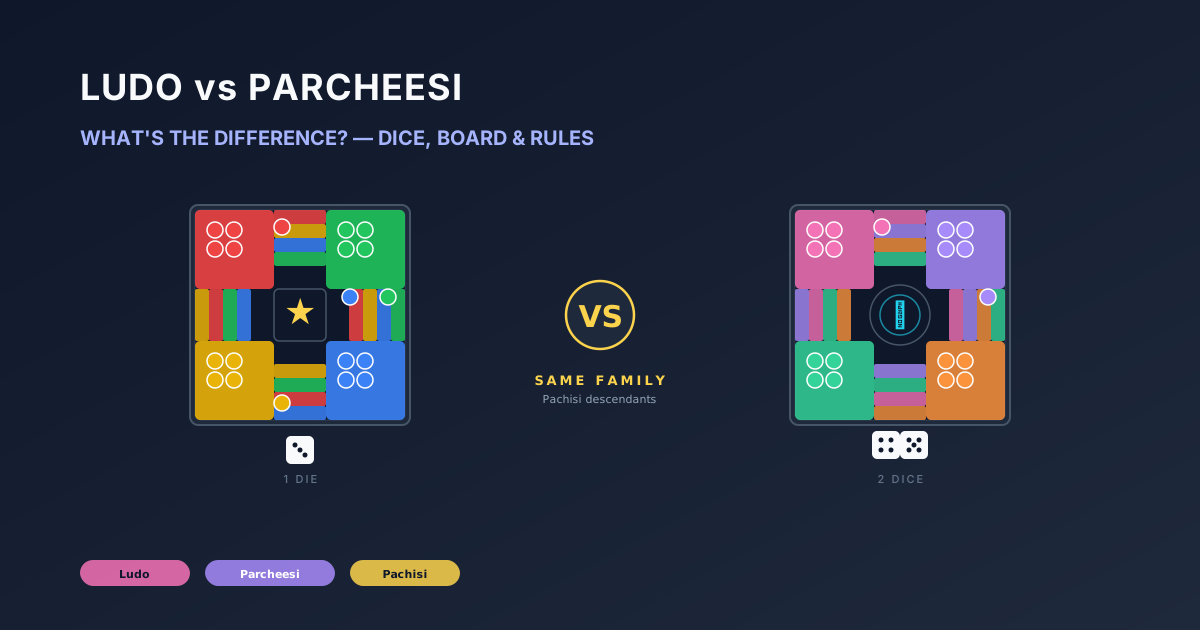
Direct Answer: Ludo and Parcheesi are different games from the same family — both descend from the ancient Indian game Pachisi, but they split into distinct rule sets. The key differences: Parcheesi uses two dice and 68 main-track squares, while standard Ludo uses one die and a 52-square track; Parcheesi requires a roll of 5 to enter a token, Ludo requires a 6 (or a double in its two-dice variant). Both feature four tokens per player, captures, safety squares, and a home column — and both reward the same core skills of counting, blocking, and managing risk. This site offers Ludo (standard single-die rules, playable at Fun AI Games Ludo); Parcheesi is covered here as a rules comparison.
Try it yourself — play Ludo free here (no login): 2–4 players with AI opponents, right in your browser.
Same Family: The Pachisi Ancestry
Ludo and Parcheesi are siblings, not strangers. Both are Western commercial descendants of Pachisi, the ancient Indian cross-and-circle board game played for centuries — a game of luck, strategy, and religious symbolism in which pieces race around a cross-shaped track toward a central home. The underlying shape is identical in both descendants: four arms, a central home, and tokens that circle the board.
The split happened in the 19th century as the game travelled west and got commercialized:
- Ludo was patented in England in 1896 and popularized by the British game company Waddingtons. It simplified Pachisi into the single-die, 52-square game most of the world knows today.
- Parcheesi was the American version, trademarked in the late 19th century and published by Selchow and Righter. It kept the two-dice mechanics of its Pachisi heritage more faithfully, producing a longer, more complex game.
That heritage also produced the two-dice Ludo variant many South Asian families play — a middle ground between the British single-die game and Parcheesi's dice play. The full rules of that variant are covered in Ludo with Two Dice: Rules and Strategy for the Double-Dice Variant, and they make a useful bridge for understanding Parcheesi, which takes the same idea further.
Board and Setup Differences
The boards look similar at a glance — both are cross-shaped with four colored arms — but the track lengths differ:
- Ludo: a main track of 52 squares, four starting areas, and four home columns of 6 squares each. Each player has 4 tokens, and 2-4 players race around the board.
- Parcheesi: a main track of 68 squares, with four "nest" starting areas and home columns of 7 squares. Each player has 4 tokens, and the longer track makes games noticeably longer.
The extra 16 squares in Parcheesi are not just padding — they change the pacing. Parcheesi pieces spend longer in transit, which means more opportunities for captures, more time for blocks to form, and a more deliberate, tactical game. Ludo's shorter track keeps rounds snappier and friendlier to casual play. Both share the same basic "four tokens, first to bring them all home wins" objective, but the rhythm is genuinely different.
Dice Rules: Two Dice vs. One
The most visible difference between the two games is the dice:
- Ludo: one standard six-sided die, rolled per turn. To move a token out of the start area you must roll a 6. Rolling a 6 grants an extra turn (and some house rules require another 6 to re-enter after a capture). The site's version plays exactly this standard single-die rule set.
- Parcheesi: two dice rolled per turn. To enter a token you must roll a 5 — either as a single die result or as any double (the classic rule is entry on a 5 or a double; some house rules allow other entry values). Doubles also grant an extra turn.
The two-dice mechanic changes everything downstream. With two dice you can move two different tokens in one turn (one per die) or one token by the sum — exactly the decision space covered in the two-dice Ludo guide, and the same choice Parcheesi players make every turn. It makes the game faster, more flexible, and more tactical than single-die Ludo, at the cost of simplicity.
Safety Squares, Blocks, and Captures
Both games handle captures and protection similarly, with a few differences in the details:
- Captures: in both games, landing exactly on an opponent's token sends it back to its start area. In Ludo, a roll of 6 is needed to bring it back out; in Parcheesi, a 5 or double.
- Safety squares: both games have marked safe squares where tokens cannot be captured. Ludo marks four safety squares (one on each arm, just past the start); Parcheesi has five, including the entry square of each arm.
- Blocks: this is where the games diverge most. In Ludo, two of your tokens on the same square form a block that opponents cannot pass — a purely defensive shield. In Parcheesi, the block is both defensive and offensive: opponents cannot pass, and if they are forced to land on your block from behind, they are captured — and you get a 20-point bonus for breaking through when the block finally splits.
Parcheesi's point-scoring adds another layer Ludo lacks: players earn points for captures, for moving tokens home, and for completing a full circuit. Ludo is purely a race to the finish; Parcheesi is a race with a scoreboard. That scoring system is why Parcheesi games feel more like chess-with-dice — every capture is worth tracking, and endgame position matters beyond just who finishes first.
Entry and Home-Column Rules
Getting tokens onto the board and into the home column differs as well:
- Entry: Ludo needs a 6 (or a double in the two-dice variant); Parcheesi needs a 5 or a double. Parcheesi's lower entry threshold means tokens leave the nest roughly twice as often — a faster, more dynamic opening phase.
- Home column: both games require tokens to travel up their own colored home column, and both require an exact roll to land on the final home square — overshooting sends the token back down the column. This is the most frustrating and most dramatic rule in both games, and it is identical in spirit.
The "exact roll to finish" rule is worth calling out because it is where both games generate their biggest swings. A token one square from home can bounce back repeatedly while opponents race past — the source of both the game's cruelty and its comeback potential. For the full Ludo rule set and how the site implements it, see How to Play Ludo Online: Rules for Beginners.
House Rules: Where Both Games Get Complicated
Both Ludo and Parcheesi are famously house-rule-heavy, and no comparison is complete without naming the big ones — because what you actually play at home is often a hybrid:
- Ludo's rolling-a-6 penalty: some families punish rolling three 6s in a row (forfeit your turn, or even send your most advanced token home). It is a common house rule, not an official one — the official game simply grants an extra turn on a 6.
- Ludo's exact-roll finish: the official rule lets a token reach home on any roll that reaches or passes the final square; many families require an exact roll. The same split exists in Parcheesi, where it is called "the home-stretch rule."
- Parcheesi's double-entry: some editions allow entry on any double rather than requiring a 5. That dramatically speeds up the opening and is the most common source of "that's not how we play" arguments.
- Two-dice Ludo: the variant covered in Ludo with Two Dice sits exactly between the two games — it uses Ludo's board and goals but Parcheesi-style two-dice movement, which is why South Asian players often describe it as "the real Ludo."
The takeaway: if a game of Ludo or Parcheesi feels different from what this guide describes, you are almost certainly playing a legitimate house rule, not a different game. Agree on the variant before the first roll — exactly as this guide's sibling comparison Chutes and Ladders vs. Snakes and Ladders recommends for its own family of house rules.
Which One Should You Play?
Neither game is "better" — they suit different tables:
- Pick Ludo if you want a fast, family-friendly race that children learn in a minute. The single-die rules keep turns simple, and games finish in 10-20 minutes. It is also the game available on this site — playable against the AI, with the two-dice variant's rules explained in Ludo with Two Dice for those who grew up with it.
- Pick Parcheesi if you want a longer, richer contest with more tactical decisions — two-dice splits, scoring, and offensive blocks. It rewards planning and counting more heavily, and its games run 30-60 minutes. Since the site does not host Parcheesi itself, grab a physical copy or a licensed app; the rules above give you everything you need to compare.
And if you are simply curious about how other classic races differ — the same comparison format applies to Chutes and Ladders vs. Snakes and Ladders, which is covered in Chutes and Ladders vs. Snakes and Ladders.
Frequently Asked Questions
Is Parcheesi the same as Ludo?
No — they are cousins. Both descend from the Indian game Pachisi, but Parcheesi uses two dice, a 68-square track, and 5-entry rules, while Ludo uses one die, a 52-square track, and 6-entry rules. They play noticeably differently.
Which game is older, Ludo or Parcheesi?
Both are 19th-century commercial descendants of Pachisi, which is centuries older. Ludo was patented in England in 1896; Parcheesi was trademarked in the United States in the late 19th century.
Can you enter a token in Parcheesi with any roll?
No. You need to roll a 5 (on a single die or as the sum of a double) or roll a double to enter a token from the nest. Ludo, by contrast, requires a 6.
Does the site have Parcheesi?
No — this site hosts Ludo (standard single-die rules) rather than Parcheesi. This guide covers Parcheesi as a comparison so you can understand how the two games differ and what to expect if you play it elsewhere.
Summary and Key Takeaways
- Ludo and Parcheesi are siblings from Pachisi, not the same game.
- Key differences: two dice vs. one, 68 vs. 52 track squares, 5-entry vs. 6-entry.
- Parcheesi adds scoring, offensive blocks, and 20-point bonuses; Ludo is a pure race.
- Both share captures, safety squares, and the exact-roll home finish.
- This site hosts Ludo — play it at Fun AI Games Ludo; the two-dice variant is explained in Ludo with Two Dice.
Race the Ludo Board Right Now
The comparison is done — now play the game this site actually hosts. Challenge the AI or share the device with friends.
Play LudoNew to Ludo entirely? Start with How to Play Ludo Online.