History of Checkers: Ancient Origins to Modern Draughts

Discuss this article with your favorite AI assistant
Direct Answer: Checkers is one of the oldest board games still played today, with a history that runs from ancient Alquerque (known by the 10th century) through 12th-century France — where the capture-by-leaping rule created the modern game — to the standard 8x8 board with 12 pieces per side that became "American Checkers" (or "English Draughts"). It reached a milestone in 2007 when the computer program Chinook proved that perfect checkers play always ends in a draw — the first board game of its complexity ever solved by a machine. Along the way, the game split into dozens of variants, from the 10x10 "Polish Draughts" with 20 pieces per side to countless regional rules.
A Game Played for a Thousand Years
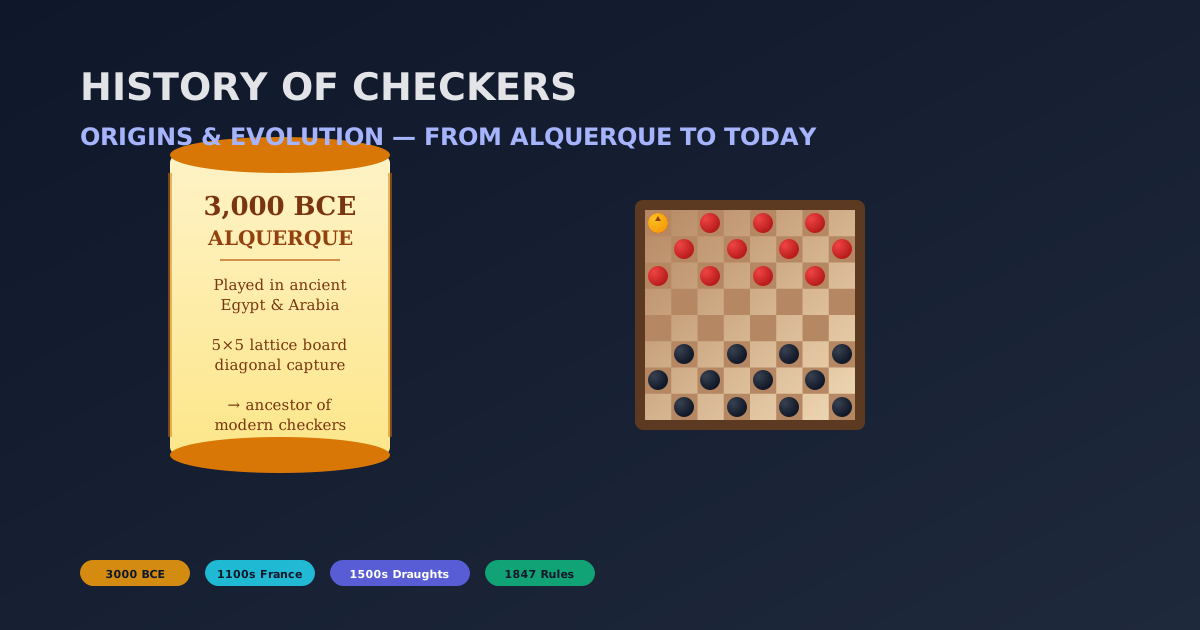
Checkers has a genuinely ancient pedigree, and its direct ancestor is Alquerque — a game played on a board of intersecting lines (5x5 points, often drawn with diagonal lines) that is documented from around the 10th century. Alquerque was popular in the Arab world and spread into Spain with Moorish influence, where the 13th-century manuscript Libro de los juegos (commissioned by King Alfonso X of Castile around 1283) described it in detail alongside chess and backgammon. In Alquerque, pieces moved along the drawn lines and captured by jumping over an opponent's piece — a mechanic that already feels familiar to any modern checkers player.
The lineage matters because it makes checkers older than most things we call "classic." It predates the modern form of chess by centuries in its recognizable form, and its core mechanic — the leap capture — was already ancient when medieval Europe adopted it. That is the through-line of the entire history: the board changed, the rules tightened, but the central act of jumping an opponent's piece has been the heart of the game for over a millennium.
The 12th-Century French Leap
The single most important moment in checkers history is the adoption of the capture-by-leaping rule in France during the 12th century. Before this, players moved pieces but the capture mechanic was not yet standardized into the game we know. French players applied Alquerque's jumping capture to a grid board, and the result was a new game — known in French as jeu de dames ("ladies' game," because the pieces were called "dames" or ladies) — that quickly became one of Europe's most popular pastimes.
The French version was not identical to today's game. It was played on an 8x8 board with 12 pieces per side — the setup we know — but for centuries it lacked two rules modern players take for granted: crowned kings and mandatory captures. Both arrived later: the king (a piece that moves backward and forward after reaching the far rank) was added around the 16th century, and the rule that a capture is compulsory was standardized in the 18th century. Every checkers game on this site — including the 2P mode and the online rooms — plays with these modern rules, which are explained in full in How to Play Checkers Online: A Beginner's Guide.
Why It Is Called Checkers (and Draughts)
The game has two names, and both have straightforward origins:
- Draughts — the British name, from Middle English. "Draught" refers to the movement of the pieces (a "draught" or pull/draw across the board). It is the official name in the UK, Europe, and most of the English-speaking world.
- Checkers — the American name, from the checkered board the game is played on. American players adopted "checkers" so thoroughly that the 8x8, 12-piece version is now formally called American Checkers or English Draughts to distinguish it from other variants.
The two names describe the same game, but the variants that followed the name split are genuinely different — which is why you will also hear about Russian draughts, Brazilian draughts, and the heavyweight of them all, Polish draughts.
The 100-Square Variant: Polish Draughts
Not every checkers variant uses the familiar 8x8 board. The most important alternative is Polish Draughts (also called International Draughts or dames polonaises), played on a 10x10 board with 20 pieces per side — nearly double the material of the standard game.
Despite the name, the 10x10 variant became popular in France in the 18th century, where it was embraced by European masters as the "serious" form of the game. Polish draughts differs from American checkers in several ways beyond the board size: pieces capture backward as well as forward, captured pieces are removed in any order during multi-jumps, and kings are "flying" — they can slide any distance along a diagonal, making endgames dramatically more complex. International draughts tournaments are held to this day, and the 10x10 game is the standard for professional play in much of Europe and West Africa. For most players, though, the 8x8 American game remains the checkers they learned as kids — and the version the site's strategy guides, like Checkers Traps: Sneaky Moves to Win More Games and Best First Move in Checkers, Ranked, are written for.
Modern Competition and the Chinook Solve
For most of its history, checkers was a folk game — played everywhere, taken seriously almost nowhere. That changed in the 20th century, when organized tournaments, federations, and a formal ranking system made it a genuine competitive sport. Books of opening theory grew thick enough to rival chess's, and the best players memorized reams of positions.
The defining event of modern checkers came in 2007, when a team at the University of Alberta announced that their program, Chinook, had solved the game of checkers. Using a technique called retrograde analysis — computing the outcome of every position backward from all possible endings — Chinook proved that with perfect play from both sides, checkers always ends in a draw. It was the first board game of checkers' complexity to be fully solved, and it settled a question players had argued about for centuries: the first player has no hidden winning advantage. This is the same family of analysis that proved Connect 4 is a first-player win and Tic Tac Toe is a draw — the site covers that mathematical side of games in Is Gomoku Solved? and The Hardest Unbeatable AI Games, Ranked.
The solve does not make checkers boring — no human plays perfectly, and against any real opponent the game is as rich as ever. It simply means the theoretical question is closed: checkers is a draw with perfect play, and the winner is whoever makes fewer mistakes. That is exactly what the site's own checkers AI exploits when you challenge it at higher difficulties.
Checkers in Culture: The Game Everyone Knows
Part of checkers' enduring success is that it is the rare game that belongs to everyone. Chess carries an aura of intellectual prestige; checkers is the game of the kitchen table, the park bench, and the barbershop — played by children and grandparents, experts and first-timers, with the same board. That universality has kept it in constant cultural circulation for centuries.
It also made checkers a natural early computer science problem. Long before Chinook, programmers used checkers to test artificial intelligence: Arthur Samuel's checkers program of the 1950s was one of the first real demonstrations of machine learning, improving its own play by replaying its games against itself. The game's simple rules and clear goal made it the perfect test bed — a tradition the site continues in a lighter form with its own checkers AI, whose difficulty levels are analyzed in Beat the Checkers AI: Difficulty and Strategy.
And because everyone knows the rules, checkers travels effortlessly between formats: the same 8x8 game plays hot-seat on one phone, against the AI, or online with a friend via room code — a flexibility few thousand-year-old games can claim.
Playing Checkers Today
A thousand years after Alquerque, checkers is thriving for the same reason it always has: it is simple enough for a child and deep enough for a champion. On this site you can:
- Play against the AI at multiple difficulties — from a beginner-friendly level to an Impossible mode that punishes every slip.
- Play local 2P hot-seat with a friend on one device, with an optional forced-jumps toggle for traditional rules.
- Play online against a friend using a room code, with real-time sync — the same format that traces back to those first networked games.
The opening principles that have survived centuries of tournament play are covered in Checkers Opening Strategies, and the traps that win games at every level in Checkers Traps. Whether you are here for a quick pass-and-play round or a serious match, you are playing a game with a millennium of history behind every move.
Frequently Asked Questions
Who invented checkers?
Checkers evolved from Alquerque, a game played in the Arab world and Spain from around the 10th century. The modern 8x8 game with the leap capture was created in 12th-century France. There is no single inventor — the game accumulated its rules over centuries.
Why is it called "draughts" in some places and "checkers" in others?
"Draughts" is the British name, from an old word for moving pieces across the board. "Checkers" is the American name, from the checkered board. Both names describe the same 8x8, 12-piece game.
Is checkers solved?
Yes. In 2007 the program Chinook proved that perfect checkers play always ends in a draw. That does not change practical play — no human plays perfectly — but it closed the theoretical question: neither side has a forced win.
What is the difference between checkers and Polish draughts?
Polish (International) draughts is played on a 10x10 board with 20 pieces per side, pieces capture backward and forward, and kings fly any distance. Standard American checkers is 8x8 with 12 pieces per side.
When were kings added to checkers?
The crowned king — a piece that moves backward and forward after reaching the far rank — was introduced around the 16th century. The mandatory-capture rule was standardized in the 18th century. Both are now universal in the 8x8 game.
Summary and Key Takeaways
- Checkers descends from Alquerque, documented by the 10th century and described in 13th-century Spain.
- The capture-by-leap rule arrived in 12th-century France, creating the modern game (8x8, 12 pieces per side).
- Kings arrived in the 16th century; mandatory captures in the 18th.
- "Checkers" (American) and "draughts" (British) are the same 8x8 game; Polish draughts is a different 10x10 variant.
- In 2007 Chinook solved checkers: perfect play always draws.
- Play it today vs. the AI, hot-seat with a friend, or online via room code.
Play a Game With a Thousand-Year History
Challenge the AI, pass the device to a friend, or open a room — however you play, you are continuing a tradition that predates the printing press.
Play CheckersNew to the game? Start with How to Play Checkers Online.