History of Multiplayer Games: From Couch Co-Op to No-Login Rooms

Discuss this article with your favorite AI assistant
Direct Answer: The history of multiplayer games runs from couch co-op and arcade cabinets in the 1970s, through LAN parties and the early internet, to today's no-login browser rooms. It began with Pong in 1972 — two people, one screen, one paddle each — and the social instinct behind that single screen never disappeared. Each era added distance: LAN networks let players in the same building compete, the internet let players on different continents compete, and modern browser rooms removed the last barrier by dropping accounts entirely. The thread connecting all of it is the same one Pong started: people want to play against each other, not just against a machine.
From the Same Screen to the Same Server
Multiplayer did not begin with the internet. It began with two players squeezing onto one screen — a pattern so natural it produced its own genre names: "couch co-op," "same-screen," and "pass-and-play." The arcade era of the 1970s and 1980s was built on this: games like Pong (1972) were explicitly two-player, and the coin-operated cabinet was as much a social fixture as a game — strangers queued, watched, and challenged the winner.
That social core is why the single-screen format survives today. Pass-and-play games — where players share one device and take turns — are still the most frictionless multiplayer that exists, and the site's own lineup of hot-seat games (Snakes and Ladders, Ludo, and the local 2P modes) is a direct descendant of the Pong-era same-screen tradition. The format is documented in Best Pass-and-Play Games: Hot-Seat Multiplayer on One Device, and it proves the oldest multiplayer model is still one of the best.
The First Online Multiplayer Games
The jump from one screen to many screens happened earlier than most people think — long before the commercial internet. In the 1970s, the PLATO system (an educational computer network) hosted multi-user games, and experimental titles like Maze War and Spasim connected players over ARPANET, the internet's predecessor. These were research curiosities: text-based, university-only, and played by a handful of people on terminals.
The genre that made online play real was the MUD — Multi-User Dungeon — created in 1978. MUDs were text worlds where dozens of players shared a persistent space, and they established the template for everything that followed: a server holding shared state, players connecting remotely, and a community forming around the game. For the next two decades, "online multiplayer" mostly meant MUDs and their graphical successors on bulletin-board and dial-up services — small-scale, but unmistakably online.
LAN Parties and the Internet Boom
Two things in the 1990s changed multiplayer forever: LAN and the consumer internet.
LAN (local area network) play let people in the same building — a school, an office, a living room — connect computers directly. Doom (1993) made networked deathmatch famous, and the LAN party was born: players hauling computers to one room for a night of head-to-head matches. It was the same-screen era's instinct applied to separate machines, and it proved that players would accept real setup friction for the reward of playing humans.
Then the internet opened the door wider. Services like Battle.net (1996) added matchmaking and friend lists on top of dial-up connections, and massively multiplayer games brought thousands of players into single persistent worlds. For the first time, "playing with friends" did not require being in the same room — or even the same country. But it did require accounts, client software, and patience with 56k modems. The deeper story of how competitive and strategic play evolved alongside this is told in The History of Strategy Games: A Complete Evolution.
Board Games Go Digital
While action games pioneered online multiplayer, classic board games followed a slower, parallel path. Chess had networked play from the early internet era (chess servers date to the 1990s), but casual board games — checkers, backgammon, and the rest — took longer to reach casual players. The reasons were technical: board games need a shared, authoritative board state, and early peer-to-peer connections were unreliable at keeping two players in sync.
The browser changed that. Java and Flash games in the late 1990s and 2000s brought checkers, Tic Tac Toe, and card games into the browser tab — no install required — and suddenly the audience was everyone with a web connection, not just gamers with clients. This is the era that created the modern expectation: a game should start in seconds, from any device, without a setup ritual. The site's own take on that promise — including how browser play beat the install model — is covered in Browser Games vs. Mobile Apps: Why Instant Play Wins.
The Rise of No-Login Browser Play
The most recent chapter of the story is the one that matters most for casual play: removing the account entirely. For twenty years, online multiplayer assumed an identity layer — you created a username, managed a password, and built a friend list before you could play anyone. That worked for committed gamers, but it was a wall for everyone else. A parent playing a quick game of checkers with a sibling does not want a profile.
No-login multiplayer removes the wall. The site's launch post — Online Multiplayer Launch: Play with Friends, No Login — explains the philosophy, and the technical mechanism is simple and elegant: instead of a friend list, the server issues a short room code; instead of a username, it issues a throwaway player token. The account is replaced by a code you can read aloud over the phone. That single design decision is the whole reason a game night can start in thirty seconds, as covered in Virtual Game Night Games: Play Online Free with Friends.
How Room Codes Killed the Friend List
Room codes are a small idea with a big history behind them. Every earlier system — friend lists, matchmaking queues, lobby browsers — tried to solve the same problem: how do two specific people find each other online? The heavyweight solutions require accounts, persistent identities, and social graphs. The room code solves it with a shared secret: the host creates a room, gets a code, and anyone with the code can enter.
The site's implementation is described in full in How Online Game Rooms Work: Room Codes Explained: 5-character codes drawn from an unambiguous alphabet (no 0, 1, I, or O, so they are easy to read aloud), 33.5 million possible combinations, rooms that live for about an hour of inactivity, and automatic cleanup. It is the friend list stripped to its essential function — connecting two people — with every piece of permanent state removed. Five games use it today: Gomoku, Tic Tac Toe, Connect 4, Checkers, and Rock Paper Scissors.
The Social Game Inside the Technical Story
Every technical milestone in this history had a social consequence, and it is worth naming them because they explain why multiplayer kept evolving even when single-player games were perfectly good:
- The arcade (1970s-80s): the cabinet was a social stage. Strangers gathered, watched, and challenged the high-score holder. Playing well was a public act.
- The living room (1980s-90s): consoles brought same-screen multiplayer home. Couch co-op turned gaming into a family and friend activity, and the "pass the controller" ritual became a genre of its own.
- The LAN party (1990s): hauling computers to one room was absurd — and people did it anyway, because the reward (real human opponents) outweighed the setup. That willingness to accept friction for human opponents proved multiplayer's draw.
- The internet (late 1990s-2000s): opponents moved from the same room to anywhere on Earth. The social circle expanded, but the account-and-client walls kept casual players out.
- The browser (2000s-2010s): installs vanished, and with them the last technical barrier. Anyone with a browser tab could join.
- The no-login room (2020s): the account vanished too. The only thing left between two friends and a match is a 5-character code.
Read that list top to bottom and the pattern is unmistakable: every era subtracted a barrier, and each subtraction grew the audience. The arcade needed you to leave the house; the LAN party needed you to bring a computer; the internet needed you to make an account; the room code needs you to send a text. At every step, the game stayed recognizably the same — two people trying to outthink each other — while the path between them got shorter.
Why Casual Multiplayer Boomed
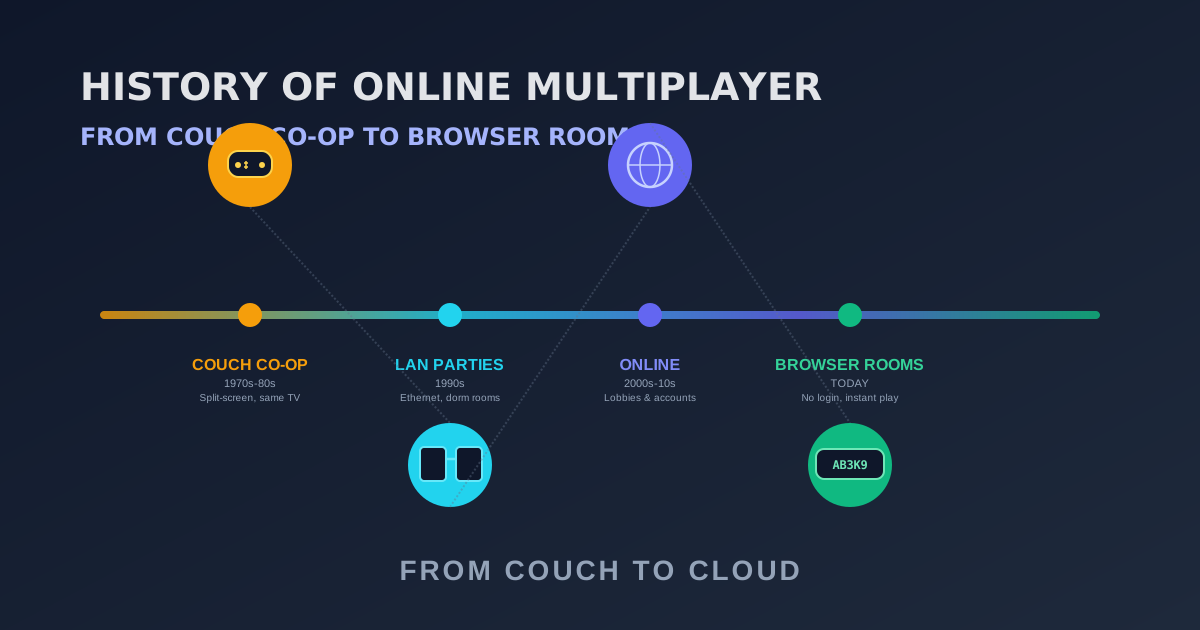
The arc from Pong to room codes is really the story of friction being removed. Each era kept the same social instinct and subtracted a barrier:
- Same screen (1970s): no networking at all — but both players had to be in the arcade.
- LAN (1990s): players in one building — but everyone had to bring a computer.
- Internet clients (late 1990s-2000s): players anywhere — but accounts and installs were required.
- No-login browser rooms (2020s): players anywhere, zero setup — the current floor of friction.
Every reduction in friction expanded the audience. That is why casual multiplayer is bigger than ever: it is not that the games changed, but that the barriers fell away. The future direction of this trajectory — covered in The History of Chess as an example of a game that crossed every era — is simply more of the same: fewer barriers, more players, the same two people facing each other across a board.
Frequently Asked Questions
What was the first multiplayer video game?
Pong (1972) is generally credited as the game that popularized two-player same-screen play. The first online multiplayer experiments — Maze War and Spasim — appeared on research networks in the early 1970s, followed by MUDs in 1978.
When did online multiplayer become mainstream?
The mid-1990s, driven by LAN play (Doom, 1993), dial-up services, and the first big matchmaking platforms like Battle.net (1996). Broadband and browser games in the 2000s brought online play to casual audiences.
Why are room codes better than friend lists?
Friend lists require accounts, identities, and social graphs. Room codes connect two specific people with a shared secret — no account needed. That removes the entire signup barrier and is why no-login games can start in seconds.
How long have browser games been around?
Since the late 1990s, when Java and Flash made games playable in a browser tab without installs. Browser play is what brought board games like checkers and Tic Tac Toe to a mass casual audience.
Summary and Key Takeaways
- Multiplayer began with same-screen play (Pong, 1972) — a social instinct that survives today as pass-and-play.
- The 1970s-80s produced the first online experiments on PLATO and ARPANET, then MUDs (1978).
- The 1990s added LAN parties and internet matchmaking, bringing online play to the mainstream.
- Browser games (late 1990s-2000s) made board games playable without installs.
- No-login rooms replaced the friend list with a shared code — the latest and lowest-friction chapter of the same story.
- Each era removed a barrier and expanded the audience; the instinct never changed.
Be Part of the Next Chapter
The history of multiplayer ends with a code you can text a friend. Create a room and see how far the genre has come.
Open the Online LobbyCurious how the strategy games themselves evolved? Read The History of Strategy Games.