Chess Tactics for Beginners: Forks, Pins, and Skewers Explained

Discuss this article with your favorite AI assistant
Direct Answer: Chess tactics for beginners reduce to four repeating patterns called motifs: the fork (one piece attacks two targets at once), the pin (a piece cannot move without exposing something more valuable behind it), the skewer (a valuable piece is attacked, and when it steps aside the piece behind it is hit), and the discovered attack (moving one piece reveals an attack from a piece behind it). These are single-move patterns that appear inside games dozens of times; a trap is a longer, prepared sequence built around one of them — the two ideas are related but not the same. Learn the four motifs first, and you will recognize winning moves the moment they appear on the board.
Motifs vs. Traps: The Difference That Matters
The site has a dedicated guide to 5 Chess Traps That Win in Under 10 Moves, so it is worth being precise about where this post fits. A trap is a complete miniature plan — the Scholar's Mate, the Fried Liver Attack — a sequence of several moves designed to lure an opponent into a losing position. A motif is the single-move pattern that the trap leans on. The Scholar's Mate is a trap; the double attack on f7 that delivers it is a fork. Every trap is built from motifs, but motifs also appear on their own, constantly, at every level of the game — and that is why beginners should study motifs first.
Think of it this way: traps are recipes, motifs are ingredients. You can memorize twenty recipes and still be lost when the kitchen runs out of a specific ingredient. Learn the four ingredients below — fork, pin, skewer, discovered attack — and you can cook something in almost any position. The rest of this guide assumes you know the basic rules; if any of them are fuzzy, the How to Play Chess: Beginner's Guide to Rules and Strategy is the place to start, and 7 Chess Opening Principles covers the first few moves.
One more framing note before the moves: motifs are not optional extras for advanced players — they are the language of the middle game. Every decisive game at every level is decided by a fork, a pin, a skewer, or a discovered attack, usually several of them stacked. A player who has internalized the four motifs can beat a stronger player who has not, because tactics convert a better position into material and material into checkmate. That is why the motif list is the single highest-ROI thing a beginner can study after learning the rules.
Motif 1: The Fork
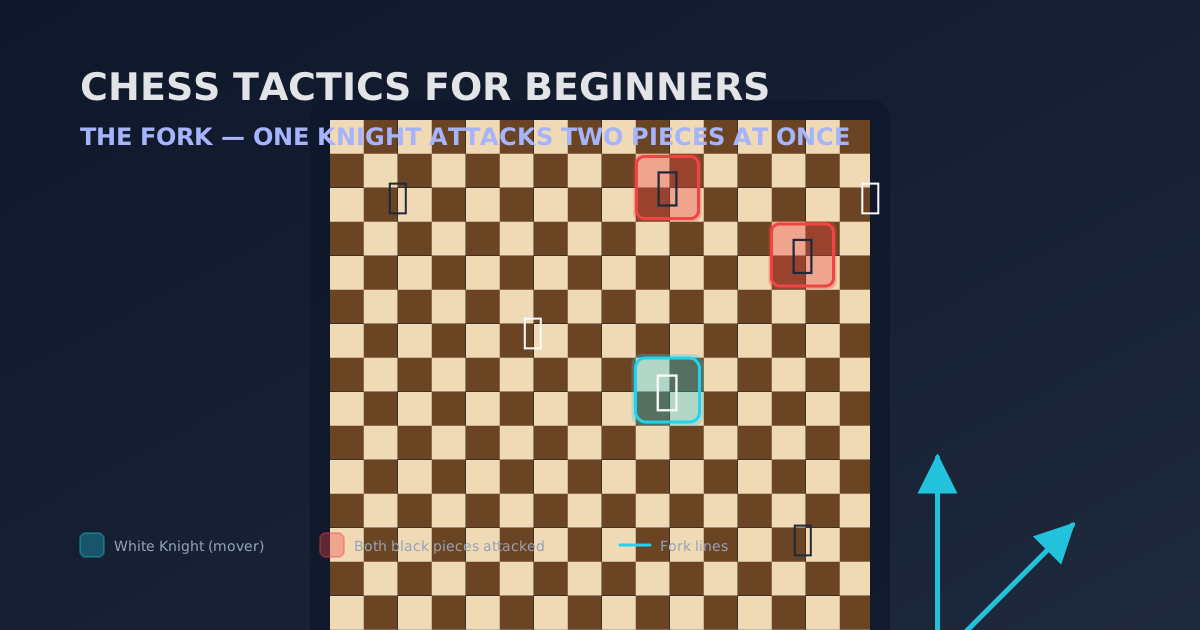
A fork is one piece attacking two or more enemy pieces at the same time. Because your opponent can only move one piece per turn, they must abandon at least one of the two — and you take the abandoned one next move. The knight is the classic forking piece because its L-shaped move is easy to miss: a knight on e5 attacks c4, c6, d3, d7, f3, f7, g4, and g6 simultaneously, and your opponent cannot block all of them.
The most valuable fork in the game is the royal fork — a fork on the king and queen. The classic example: White knight to f7, attacking both the king on e8's escape square area and the queen on d8. The king must respond to the check, and the queen falls. Even a fork that catches a rook and a bishop is a win of material — and material advantage is the fastest route to a checkmate. For practice, the trap guide shows the Scholar's Mate sequence where a fork on f7 delivers the whole game, and the chess AI training plan explains how to drill forks against the computer.
Motif 2: The Pin
A pin is a piece that cannot move because doing so would expose a more valuable piece behind it. The most powerful pin in the game is the absolute pin: a piece pinned to the king, which legally cannot move at all, because moving would leave the king in check. A bishop on g5 pinning the knight on f6 to the queen is a relative pin; a rook pinning a knight to the king is absolute.
Pins win games in two ways. First, the pinned piece is neutralized — it cannot defend anything, attack anything useful, or move without loss. Second, pins build up: a pinned knight in front of the king is a common theme in opening theory, where the defender's pieces are often tied down before the attack lands. Beginners win countless games by spotting a pinned piece and attacking it repeatedly with pawns, forcing the defender to choose between giving up the pinned piece or breaking the pin at material cost.
Motif 3: The Skewer
The skewer is the pin in reverse: a valuable piece is attacked in front, and when it moves to safety, the less valuable piece behind it is captured. Rooks, queens, and bishops are the skewering pieces because they attack along lines. The classic skewer: White rook on the a-file, Black king on a8, Black rook on a7. White plays Rook a1+, the king must move, and White captures the rook behind it.
Skewers are the easiest motif to miss as a beginner because the sequence reads backward: the "win" is one square behind the target you are looking at. The fix is a habit, not a trick — before every move, trace each of your rooks, queens, and bishops down its full line and ask: what is the second piece in that line? The endgame patterns in 5 Chess Endgame Patterns rely heavily on skewers, because open boards in the endgame are exactly where long-range pieces thrive.
Motif 4: The Discovered Attack
A discovered attack happens when you move one piece and, by moving it, open a line for a piece behind it to attack. The moved piece is the mask; the piece behind is the revealed attacker. The power comes from doing two things at once: the moving piece can itself make a threat — often check — while the revealed piece simultaneously attacks something else. Your opponent can only answer one.
The discovered check is the strongest version: moving a piece out of the way exposes check from a queen, rook, or bishop behind it. Because the opponent must deal with the check, the moved piece is effectively free to capture material with impunity. Bishops and rooks are the classic masks, and the pattern shows up all over middle-game tactics. It is also the backbone of several quick traps, where the mask piece moves with check while the revealed attacker wins a queen.
A practical example of combining motifs: imagine your bishop pins a knight to its king (pin), your rook sits behind the bishop on the same diagonal, and your knight is one move from forking the pinned knight and the queen. The defender is paralyzed — every piece that could break the pin is either tied down or under its own threat. That kind of accumulation is how motifs actually win games: not as isolated tricks, but as a web of overlapping threats that leaves the opponent with no good move. Beginners often think tactics are about a single brilliant stroke; in reality they are about building two or three simultaneous problems until one of them becomes unstoppable.
How to Train Motifs
Motifs are patterns, and patterns are trained by repetition. A practical beginner plan:
- Learn the four names cold. If you cannot label a position in five seconds, you cannot exploit it in a real game.
- Drill against the AI. The Easy-Medium-Hard training plan is built for exactly this: play slow games, and after each one, replay it to find every fork, pin, skewer, and discovered attack either player missed.
- Do the reverse scan. Before each move, check all four motifs for your opponent too. The player who spots a motif first usually wins the game.
- Move from motifs to traps. Once the four ingredients feel automatic, the trap guide shows how masters assemble them into complete miniature plans.
One more tip from the hardest AI games guide: play the chess AI at a level that beats you about a third of the time. That is the sweet spot where you actually see motifs fail and learn why.
A final drill that accelerates everything: the one-motif game. Play a full game against the AI with a single goal — win a piece with a fork, and only a fork. Do not aim for checkmate; aim for a fork that wins material. Then replay with a pin-only goal, then skewers, then discovered attacks. Forcing yourself to see only one pattern sharpens that pattern faster than any mixed practice, because your brain is not choosing among four options — it is scanning for exactly one shape. After one week of one-motif games, the motifs start appearing in your normal games without you looking for them, which is precisely when they start winning you matches.
Frequently Asked Questions
What is a chess tactic vs. a chess motif?
A motif is a single-move pattern — fork, pin, skewer, discovered attack. A tactic is any maneuver that exploits a motif to gain material or checkmate. The terms are often used interchangeably; this guide uses motif for the four core patterns.
What is the difference between a chess trap and a chess motif?
A trap is a prepared multi-move sequence designed to punish a specific mistake. A motif is the single-move pattern the trap is built on. Traps are recipes; motifs are ingredients — and motifs appear far more often in real games.
What is the most powerful chess motif for beginners?
The fork, especially the royal fork on the king and queen. It wins material immediately against players who have not learned to scan for it, and it is the easiest motif to spot once you know the pattern.
What is an absolute pin?
A pin to the king. The pinned piece legally cannot move, because moving would expose the king to check. It is the strongest form of the pin and a common winning theme.
How many tactics should a beginner know?
Four core motifs — fork, pin, skewer, discovered attack — are the foundation. Everything else, from discovered checks to double attacks, is a combination of these four.
Summary and Key Takeaways
- The four core chess motifs are the fork, pin, skewer, and discovered attack.
- Motifs are single-move patterns; traps are multi-move sequences built on motifs.
- The royal fork on the king and queen is the highest-value motif.
- Pins neutralize pieces; skewers win the piece behind the target; discovered attacks do two things at once.
- Train by labeling positions fast, drilling the AI, and scanning for your opponent's motifs too.
Put the Motifs to Work
Open a game against the chess AI, scan for forks and pins, and watch your win rate climb. Free, no login, endless games.
Play Chess NowNew to chess? Start with How to Play Chess.