Best Board Games for Group Play: No-Login Picks for Family Nights

Discuss this article with your favorite AI assistant
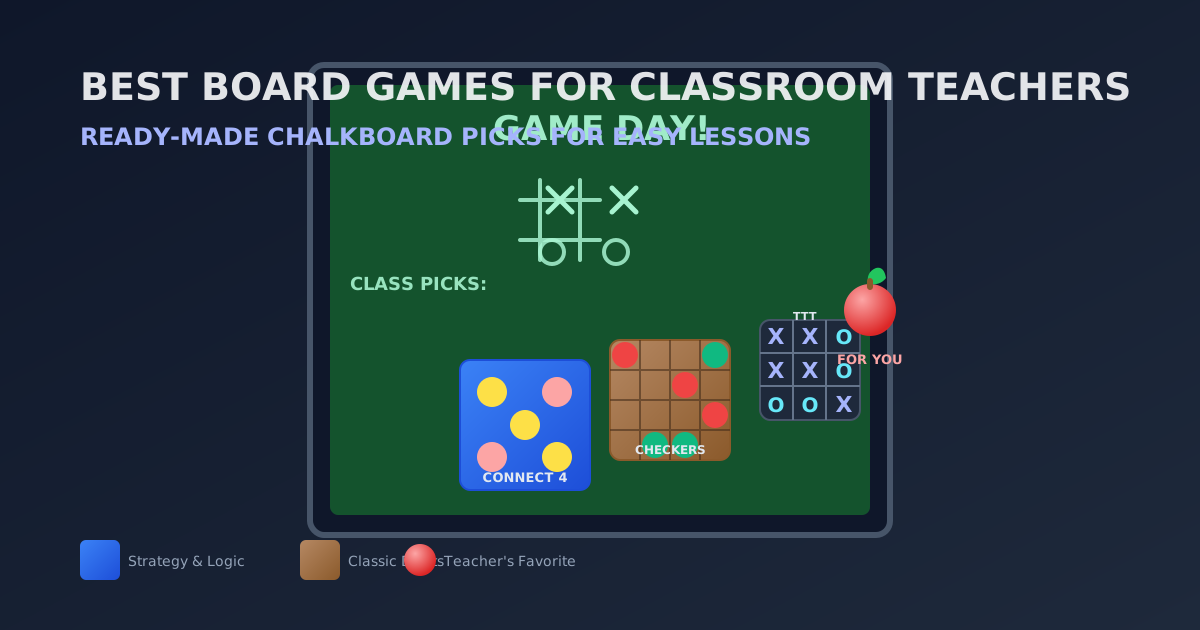
Direct Answer: The best board games for group and family play are no-login browser games that need zero setup, zero accounts, and zero physical parts: Tic Tac Toe for turn-taking and strategy, Checkers and Connect 4 for planning ahead, Snakes and Ladders for counting and number sense, Mancala for one-on-one math, and Ludo for a table of four. Every one runs free in a browser tab, plays on any device, and works on a TV, projector, or shared laptop — which makes them ideal for a living-room night or a meetup that actually starts on time.
What Makes a Board Game Work for a Group?
A good group game survives contact with a real evening: limited time, mixed skill, one aging laptop, and a host who has eleven other things to manage. Physical board games fail these conditions constantly — pieces go missing, boards slide off the table, and the moment two teams share one set, arguments start. Browser games remove that friction.
The standard that matters most is zero setup. Every game on this site opens in a single tab with no login and no download. The full reasoning is in Free No-Login Games for Families and Beginners. No accounts means no password resets and no email verification — anyone at the table can open the game and be playing inside ten seconds. Fun AI Games is a general-audience site for adults and families. It is not directed at children under 13. The second standard is clear rules in one glance. People should understand what to do before the snacks run out, not after a rulebook read-through. The games below all pass that test.
The third standard is short rounds. A game that takes twenty minutes is the whole evening; a game that takes five is a rotation. Everything on this list finishes fast enough that you can run a full bracket in an hour — or use the online room system to pair people across devices, the same way the room codes guide works for remote players.
One more standard hosts notice once they see it: the games must be genuinely good. Adults can smell an "educational" toy from across the room. Every game below is a real game people play for fun — Tic Tac Toe, Checkers, and Connect 4 are casual and tournament classics. The learning is real because the fun is real. When someone asks to keep playing after the planned round, the game has done its job.
The 6 Best Group Board Games, Ranked by Use
Rather than a generic "best of" list, here is the roster organized by what you actually need it for — because the right game depends on the moment in the night.
1. Tic Tac Toe — Best for Turn-Taking and Strategy
Tic Tac Toe is the entry point for almost every strategic concept a new player needs: turns, blocking, planning two moves ahead, and learning to lose a round without drama. A round takes thirty seconds, which means a whole table can cycle through a tournament in minutes. The fork pattern — one move creates two winning lines — is genuinely instructive, and it is covered move by move in Tic Tac Toe for Beginners: Teaching Strategy Through Play.
On a shared screen, Tic Tac Toe earns its place as the warm-up. Use it to teach the difference between a good move and a winning move, then let pairs play Tic Tac Toe online with friends for a best-of-five. It is also the easiest game to project: run it on the TV and let the room call the moves together.
2. Checkers — Best for Planning Ahead
Checkers is the first game where a wrong move can cost the match ten turns later — and that delay between cause and effect is exactly what mixed-skill groups need. It teaches forced captures, reading multiple jumps, and looking at the whole board before touching a piece. Rules and strategy: How to Play Checkers Online: A Beginner's Guide. History — from medieval Europe to modern tournaments — is in the history of checkers.
The killer feature for a group: checkers forces people to wait. Watch the opponent's move, reassess, respond. Run it as a pair activity where each player says their plan aloud before moving.
3. Connect 4 — Best for Vertical Thinking
Connect 4 trains a different muscle: building in three directions at once, watching your rows and their columns. Simple enough for a first-timer and deep enough for a house tournament — patterns and traps are in Connect 4 traps and winning patterns. Two colors make results instantly readable: you can see who won and why just by looking at the board.
4. Snakes and Ladders — Best for Counting and Mixed Skill
Snakes and Ladders is the pure counting game of the list. Every turn is move-exactly-this-many-squares. The online version, in How to Play Snakes and Ladders Online, handles the dice — which frees people to watch the board instead of arguing about the roll. It supports up to four players, so it is the natural choice for a small-group station.
5. Mancala — Best for One-on-One Math
Mancala is a counting game wearing a strategy game's clothes. Each move distributes stones — skip-counting and mental addition without a worksheet. It is one of the oldest games in the world, which gives you a free history tangent, and How to Play Mancala makes it painless to teach. In a rotation, seat two people on Mancala while the rest of the table runs other boards.
6. Ludo — Best for Groups of Four
Ludo is the game for a full table. It plays up to four, so it is the only entry that can seat a group without brackets, and it mixes counting, chance, and light strategy — rules in How to Play Ludo Online. Use it as the closer: four players, one game, fewer arguments about whose turn it is.
How to Run a Group Games Rotation
The most effective pattern is the station rotation, and it works because every game here finishes fast. Here is a structure that fits a standard hour:
- Teach once (5 minutes). Project one game and walk through the rules together. Do a different game each gathering so the table builds a library.
- Rotate (25–40 minutes). Split into pairs or groups of four. Each station runs a different game; rotate every 6–7 minutes.
- Debrief (10 minutes). Ask: What was your best move? What did you almost miss? That is where the learning lands.
Two practical notes. First, pass-and-play games on a single device are your friend when laptops are scarce — most of these games support hot-seat play on one screen. Second, for 5-minute resets rather than a full night, the 5-minute no-login games guide covers the shorter format.
Why Browser Games Beat Physical Boards for Hosts
Physical boards have charm, and tactile play has value. For a working host, browser games win on the four things that actually matter:
- Setup time: zero. A physical game needs unpacking; a browser game needs a URL.
- Lost pieces: impossible. Nobody walks off with half the Checkers set.
- Fairness: the computer enforces the rules, so there are fewer "you cheated" disputes.
- Cleanup: instant. Close the tab and a private room expires on its own.
None of this requires sacrificing depth. These are the same games played for decades — the browser is just a better delivery system for a shared screen. The Connect 4 with friends guide shows how that depth carries into online rooms when people are not in the same house.
What Each Game Teaches: A Quick Cheat Sheet
When you are choosing a game for a specific moment, this map is the fastest match:
- Tic Tac Toe — turn-taking, blocking, decision speed, and losing a round gracefully.
- Checkers — planning several moves ahead, forced-capture rules, and board awareness.
- Connect 4 — vertical thinking, threat recognition, and simultaneous offense and defense.
- Snakes and Ladders — one-to-one counting, number lines, and accepting chance outcomes.
- Mancala — counting, addition, and multi-step planning disguised as a stone-sowing game.
- Ludo — group turn-taking, counting, and patience with four players at one board.
The counting games — Mancala, Snakes and Ladders, and Ludo — sit on the same skill ladder in Best Strategy Games by Skill Level. Together with this guide, that is the group-play toolkit.
Frequently Asked Questions
What are the best board games for a family or group night?
Tic Tac Toe for turn-taking, Checkers and Connect 4 for planning ahead, Snakes and Ladders for counting, Mancala for one-on-one math, and Ludo for groups of four. All run free in a browser with no login and no setup.
Are online board games free?
Yes. Every game on this site is free to play in a browser tab and requires no account. Ads may appear around the page, not during a move. See the Privacy Policy for cookies and advertising.
Do these games work when people are in different houses?
Yes — the online room system pairs players on separate devices. Room mechanics are the same ones in How Online Game Rooms Work.
Which group game teaches counting?
Snakes and Ladders and Mancala are the counting specialists. Board flow: How to Play Snakes and Ladders Online.
How do I keep people from arguing about the rules?
You do not have to — the game enforces captures, blocks, and turns. The judge is the board.
Summary and Key Takeaways
- The best group board games here are no-login browser games: Tic Tac Toe, Checkers, Connect 4, Snakes and Ladders, Mancala, and Ludo.
- They win on zero setup, no lost pieces, impartial rules, and instant cleanup.
- Match the game to the goal: turn-taking → Tic Tac Toe, planning → Checkers, counting → Snakes and Ladders.
- Run a station rotation: teach once, rotate every 6–7 minutes, debrief for 10.
- Use pass-and-play for scarce devices and online rooms for people who are not in the same room.
Open a Game for the Table
Pick a game, project it or share the link, and people are playing in seconds. No sign-ups, no setup, no cleanup.
Browse Online GamesNew to the games? Start with Checkers — it is the best first strategy game for a mixed table.