Connect 4 vs Gomoku: Which Game Is Deeper?

Discuss this article with your favorite AI assistant
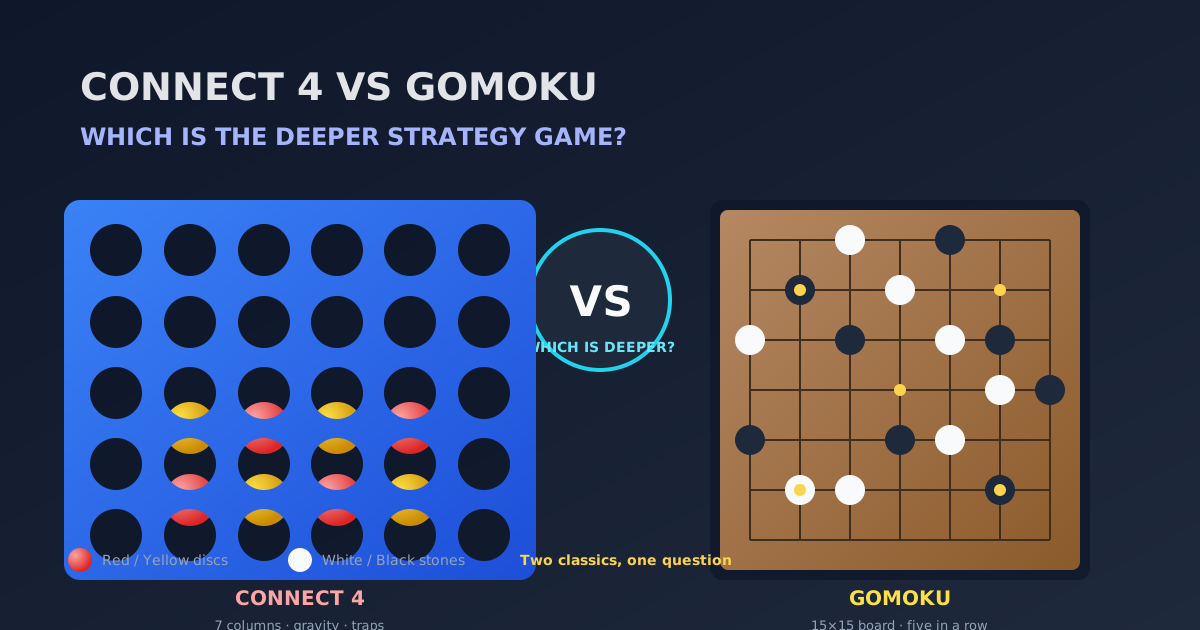
Direct Answer: Gomoku is the deeper game. Connect 4 and Gomoku are both "alignment" games — get your pieces in a row before your opponent does — but they operate in different leagues of complexity. Connect 4 is played on a 6x7 grid where gravity limits your options, and the first player has a proven forced win since 1988. Gomoku is played on an open 15x15 board where pieces can land anywhere, the position branches far more widely, and the strategy is rich enough that the game is not fully solved under tournament rules. If you want the deeper game, play Gomoku; if you want the faster, tighter one, play Connect 4.
The Case for Connect 4
Connect 4 is the game of constrained depth. The board is only 6 rows tall and 7 columns wide, and gravity means every piece drops to the lowest available slot in its column. Those two rules do something profound: they shrink the game into a tight, tactical puzzle where a handful of winning patterns repeat over and over. The patterns are documented in Connect 4 Traps and Winning Patterns, and they are learnable by anyone in an afternoon.
The depth that does exist in Connect 4 is vertical — it is about sequences. Because every move has exactly seven options, the game becomes a calculation race: count the threat, block the threat, set up your own. The second-player strategy guide shows how much thinking fits in that small space — but the small space is the point. Connect 4 is a sprint, not a marathon, and its appeal is that every game finishes in a few minutes with a decisive result. The online version, covered in Play Connect 4 Online with Friends, is built for exactly that pace.
There is a particular beauty in that constraint. Connect 4 is one of the few games where a beginner can genuinely master the fundamentals — the seven openings, the key patterns, the odd-even rule from the second-player strategy — and feel the game click into focus. That mastery arc is fast, satisfying, and repeatable: learn a pattern, apply it, win. For players who want quick improvement and clear feedback, Connect 4 delivers faster than almost anything else in the genre.
The Case for Gomoku
Gomoku takes the same alignment idea and removes every constraint that makes Connect 4 small. The 15x15 board gives 225 possible first moves — thirty-two times the options of Connect 4's opening — and because pieces stay where you place them, there is no gravity narrowing your choices. The result is a game of positional depth: every stone changes the shape of the board, threats build in four directions at once, and the winning line is a single link in a much longer chain of influence.
The opening theory alone is a field of study. Where Connect 4 openings reduce to a handful of column choices, Gomoku openings branch into patterns of influence — center control, diagonal runs, and the balance between attacking and defending are all live from move one. The fundamentals are in Gomoku Opening Theory: Best Opening Moves, and the full rules are in How to Play Gomoku Online. For the comparison with the competitive renju variant, Renju Rules vs. Gomoku covers the differences.
The other side of that depth is the learning curve. Where Connect 4's patterns are quick to internalize, Gomoku's positional sense takes real time to develop — knowing when to attack and when to shore up your defense, when a "three" is actually a threat and when it is a trap. Beginners often lose Gomoku games they think they are winning, because a threat that looks strong on one axis is answered by a quieter move that builds a stronger position elsewhere. That slow unfolding is exactly what makes the game deep — and exactly why it rewards patient players.
Comparing Depth: Board, Branching, and Strategy
Put the two games side by side and the depth gap becomes visible:
- Board size: Connect 4 is 42 cells; Gomoku is 225. Gomoku has more than five times the space.
- First move options: Connect 4 offers 7; Gomoku offers 225. That single number explains most of the depth difference.
- Branching factor: Connect 4 averages roughly 7 legal moves per turn; Gomoku's is effectively the number of empty cells, which is dozens for most of the game.
- Pattern complexity: Connect 4 patterns are short and column-bound; Gomoku patterns are long, open, and multi-directional.
The practical consequence: a new player can grasp Connect 4's winning patterns in a session, while Gomoku offers years of study before the well runs dry. That is not a knock on Connect 4 — it is a game of elegant constraint — but on the question of depth, Gomoku wins decisively. The best 2-player online games guide ranks both, and the difference in replayability is exactly what you would expect from the numbers above.
Solved Status: The Ultimate Depth Test
The most objective measure of depth is solved status — how long it took computers to fully exhaust the game. The numbers tell the story:
- Connect 4 was solved in 1988. James D. Allen and Victor Allis independently proved that the first player can force a win with perfect play, starting in the center column. The full story is in Is Connect 4 Solved? First-Player Advantage — and the site's Tic Tac Toe counterpart, Is Tic Tac Toe Solved?, shows the same arc at a smaller scale.
- Free-style Gomoku was solved in 1994. Allis, van den Herik, and Huntjens proved that the first player can force a win on the standard 15x15 board — but it took six more years of computing progress than Connect 4, and the winning sequence requires far more moves. The details are in Is Gomoku Solved?.
- Renju is still unsolved. The competitive variant with its opening rules and forbidden moves remains an open game even for modern engines — a depth that Connect 4 simply does not have. Renju vs. Gomoku explains why the extra rules matter.
A useful way to think about it: Connect 4's solution is short and forceful — the first player wins in about 41 moves with a relentless center-column plan. Gomoku's solution is long and delicate — the first player wins, but only with far more precise and varied play. The longer the winning path, the deeper the game for human players, because humans are nowhere near perfect play.
For context on what "solved" really means for everyday players: a solved game still offers enormous practical depth, because no human plays the perfect line. The Solve is a mathematical fact about the game tree, not a description of how real matches go. The distinction is the same one the site makes for Tic Tac Toe, Mancala, and Checkers — solved or not, the games remain genuinely competitive between people, and players who know the theory still beat players who do not. What the Solve dates do tell you is how much computational firepower each game required to fully map — and by that measure, Gomoku is a much bigger territory.
Which Should You Play?
The right answer depends on what you want out of a session:
- Choose Connect 4 if you want fast, tight, decisive games — a best-of-7 that fits in a lunch break, or a game you can teach a child in one minute. The patterns in Connect 4 Traps give quick wins and quick lessons.
- Choose Gomoku if you want a game you can study — opening theory, positional play, and games that unfold slowly across a wide board. The opening theory guide is where that study starts.
- Play both if you want the complete picture. Connect 4 sharpens your tactical calculation; Gomoku broadens your positional vision. They train different muscles, and both are free and no-login online.
One more consideration: session length. Connect 4 games run a few minutes and are natural for short, repeated matches — a best-of-7 series, a quick tournament, a classroom round. Gomoku games run longer and reward a single focused match played slowly. If your time is in five-minute chunks, Connect 4 will see more play; if you can give a game twenty unhurried minutes, Gomoku rewards the investment. Both games respect the time you give them; they just ask for different amounts.
And for parents or teachers choosing between the two for a young player: Connect 4 is the better first step — the small board and quick rounds teach pattern recognition fast, and the transition to Gomoku comes naturally once a child can spot and block a three. The full age-by-age ladder is in Best Strategy Games for Kids by Age, which places both games on the same progression path rather than in competition with each other.
Frequently Asked Questions
Is Gomoku deeper than Connect 4?
Yes. Gomoku's 15x15 board, 225 opening moves, and multi-directional patterns create far more strategic branching than Connect 4's gravity-constrained 6x7 grid.
Which game was solved first?
Connect 4, in 1988, by James D. Allen and Victor Allis independently — the first player can force a win via the center column. Free-style Gomoku followed in 1994, and tournament renju remains unsolved today.
Is Connect 4 or Gomoku easier to learn?
Connect 4 is easier to learn and to master at a basic level. Gomoku has the same simple rules — five in a row — but the open board makes good play far harder to reach.
Which game is better for a beginner?
Connect 4. Its small board and constrained moves teach pattern recognition quickly, and it transitions naturally into Gomoku once the basics feel automatic.
Are both games available to play online for free?
Yes — both are free, no-login, and browser-based on this site. You can play Connect 4 at the Connect 4 game page and Gomoku at the Gomoku game page.
Which game has more possible games?
Gomoku, by an enormous margin. Connect 4's game tree is vast but constrained by gravity and seven columns; Gomoku's open 15x15 board produces far more positions than the number of atoms in the universe. That size is the raw material of depth.
Summary and Key Takeaways
- Gomoku is the deeper game: 15x15 board, 225 opening moves, open patterns versus Connect 4's 6x7 gravity grid.
- Connect 4 is tactical and fast — solved in 1988 with a first-player center-column win.
- Gomoku is positional and long — free-style solved in 1994, renju still unsolved.
- Choose Connect 4 for quick duels, Gomoku for a game to study.
- Both are free, no-login, and browser-based — play either in seconds.
Test the Depth Yourself
Play a quick Connect 4 duel, then a Gomoku match, and feel the difference. Both free, both instant, no login.
Play Connect 4 Play GomokuWant to know how the games stack up overall? See Best 2-Player Games Online.