Luck vs Skill Board Games Ranked: From Pure Chance to Deep Strategy

Discuss this article with your favorite AI assistant
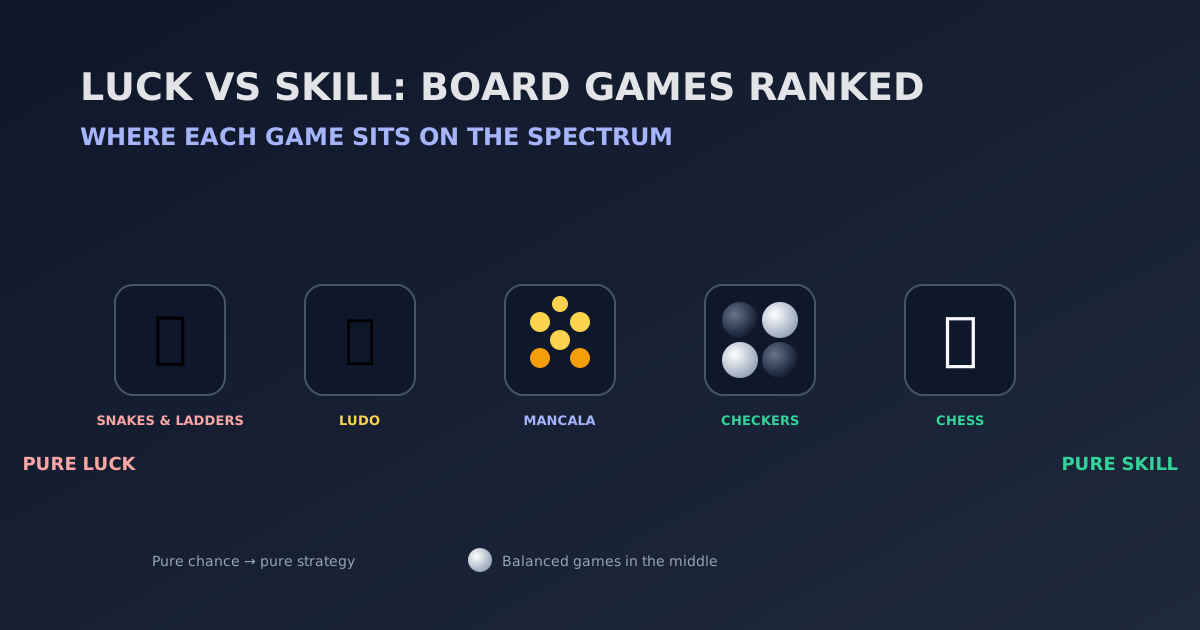
Direct Answer: Every game on this site sits somewhere on a luck-to-skill spectrum, and here is the ranking: Snakes and Ladders (pure luck) → Ludo (luck-heavy) → Rock Paper Scissors (luck vs humans, skill vs patterns) → Battleship (mixed) → Cup and Ball (mixed) → Mancala (skill-leaning) → Connect 4 (mostly skill) → Gomoku (skill) → Checkers (skill) → Chess (pure skill). The ranking is about decisions: the more choices a player makes that change the outcome, the more skill the game rewards. At one end, Snakes and Ladders offers zero decisions — the Snakes and Ladders rules guide is a dice-only race. At the other, chess offers thousands of decisions per game and rewards study, pattern recognition, and discipline.
How to Measure Luck vs Skill
"Luck vs skill" is not a vibe — it is a measurable property of a game's design. The cleanest measure is the decision density: how many choices a player makes, and how much each choice changes the probability of winning. A game where a skilled player beats a beginner 95% of the time is skill-dominant; a game where the win rate is near 50% regardless of skill is luck-dominant.
Three factors determine where a game lands:
- Decisions per game. Snakes and Ladders has zero; chess has hundreds. More decisions mean more room for skill to express itself.
- Decision impact. In Ludo, choosing which token to move matters, but the die roll determines what is possible. In Chess, every choice is fully under player control — no dice, no cards, no randomness.
- Information availability. Games with hidden information (Battleship's ship placement, Cup and Ball's shuffle) mix chance into what you can know; games with perfect information (Chess, Gomoku, Connect 4) leave nothing hidden to blame for a loss.
Using those three factors, the site's eleven games rank cleanly from pure luck to pure skill — and each game's dedicated strategy guide shows exactly where its skill lives.
The Ranking: From Pure Luck to Pure Skill
Tier 1: Luck-Dominated
1. Snakes and Ladders — pure luck. Zero decisions, independent dice rolls, and an average game length of about 39.2 rolls that no player action can change. It teaches counting, but it is a coin flip stretched across a board. The full rules are in How to Play Snakes and Ladders Online.
2. Ludo — luck-heavy. The die determines what is possible, but players choose which token to move, when to play aggressively, and how to position for safety. Over many games, those choices matter — the aggressive vs. safe styles are covered in Ludo Strategy: Aggressive vs. Safe. A skilled Ludo player beats a beginner more often than not, but the dice keep it close.
3. Rock Paper Scissors — luck or skill, depending on the opponent. Against a perfect randomizer, it is pure luck — nobody can beat true randomness. Against a human, it becomes a skill game of pattern-reading and psychology, because humans leak predictable tendencies. The dual nature is analyzed in Is Rock Paper Scissors Luck or Strategy? and The Psychology of Rock Paper Scissors.
Tier 2: Mixed Games
4. Battleship — mixed. Ship placement has an element of chance, but targeting is a pure skill: probability-guided search, coverage patterns, and the discipline to avoid random shots. The Battleship Strategy: Probability Targeting guide shows how skilled players win well over half their games. Test a placement on Battleship.
5. Cup and Ball — mixed. The shell game's shuffle is designed to fool the eye, but tracking skill is real and learnable — the 5 Techniques to Track the Ball guide turns a "lucky guess" into a trained skill. Against a skilled shuffler the odds tighten, but the techniques genuinely improve your read.
Tier 3: Skill-Dominated
6. Mancala — skill-leaning. Every move is a counting and planning exercise: sowing stones, setting up captures, and reading the board several moves ahead. The heuristics in Mancala Rules of Thumb give a player who has never studied the game an immediate edge over someone rolling through it randomly.
7. Connect 4 — mostly skill. The board is small and the patterns are learnable — the Connect 4 Traps guide shows how a prepared player forces wins against unprepared opponents. Since 1988 we have known the first player can force a win with perfect play (Is Connect 4 Solved?), but against real humans the edge comes from pattern mastery, not perfect play. Try those patterns now on Connect Four.
8. Gomoku — skill. The open board rewards positional thinking and threat-building — skills that take real study. The Gomoku Opening Theory guide is a gateway: players who learn the openings beat casual opponents consistently. Practice them on Gomoku.
9. Checkers — skill. Perfect play is a draw — the Chinook project that proved it is covered in History of Checkers — but humans are far from perfect, so the game rewards planning, forced-capture awareness, and endgame technique. The traps in Checkers Traps convert skill into material advantage. Play them on Checkers.
10. Chess — pure skill. No dice, no hidden information, and every move fully under player control. The outcome is decided entirely by the players' decisions. Study, tactics, and discipline translate directly into wins — the chess tactics guide is the fastest route to improvement.
What the Ranking Teaches About Game Design
The spectrum is not a quality ranking — it is a use-case ranking. A pure-luck game is not worse than a pure-skill game; it is different, and the difference matters depending on who is playing:
- Pure luck (Snakes and Ladders) is the great equalizer: children, grandparents, and tournament players all have the same chance. It is why the game appears in Best Board Games for Classroom Teachers as a fair, frustration-free classroom pick.
- Mixed games (Ludo, Battleship) give beginners a chance while rewarding improvement — the ideal "family game night" zone covered in Virtual Game Night Games.
- Pure skill (Chess, Gomoku) rewards study and creates skill gaps — perfect for players who want a game they can genuinely improve at. The Improve Strategic Thinking guide explains how to train in exactly these games.
The design lesson: a game's luck level is a feature, not a flaw. The right game for the moment depends on whether you want a fair lottery, a gentle learning curve, or a pure test of skill.
The Role of Hidden Information
One factor deserves its own section because it quietly reshapes the luck-to-skill ranking: hidden information. A game where both players see everything is a pure contest of decisions; a game where information is hidden turns every choice into a blend of logic and guesswork:
- Perfect information games (Chess, Gomoku, Checkers, Connect 4, Tic Tac Toe, Mancala) give both players the same complete picture. When you lose, the reason is fully visible in your own decisions — there is no bad luck to blame, which is why these games feel the most "fair" to skilled players and the most humbling to beginners.
- Hidden-information games (Battleship's ship placement, Cup and Ball's shuffle, Rock Paper Scissors' simultaneous reveal) inject uncertainty that no amount of skill fully removes. Battleship rewards probability-guided targeting — the Probability Targeting guide is built on this — but a lucky early hit can decide a game no matter how well you shoot.
- The information dimension interacts with decision density. Snakes and Ladders is a game of no information and no decisions; Chess is a game of full information and full decisions. Battleship sits in the interesting middle: full information during the targeting phase, but hidden information at the start. That mix is exactly why it ranks as a "mixed" game rather than a skill or luck game.
When you see the site's games through this lens, the ranking stops being a list and becomes a map — with decision density on one axis and information on the other. The Improve Strategic Thinking guide recommends training on the perfect-information, high-density end (Chess, Gomoku, Checkers) because those games convert practice directly into skill.
How to Pick by Audience and Mood
The ranking is most useful when it is turned into a practical decision tool. Here is the site's own cheat sheet, based on who is playing and what the moment calls for:
- Mixed ages or mixed skill levels? Choose from the luck end — Snakes and Ladders for pure fairness, Ludo when you want a little choice. Nobody gets crushed, and everybody has a real chance. The classroom games guide uses exactly this logic.
- Two players who want a real contest? Move to the skill end — Chess, Gomoku, or Checkers. The skill gap will show, which is the point. Start with Checkers if the gap is small, chess tactics if you want the deepest test.
- Short break, low stakes? The mixed tier is perfect: Rock Paper Scissors for a 90-second duel, Battleship for a 10-minute deduction round. Fast, fun, and no skill anxiety.
- A group of three or four? Ludo or Snakes and Ladders — the only site games that seat more than two, and both sit at the luck end where group play stays friendly. The Ludo strategy guide adds just enough depth to keep it interesting.
The rule of thumb: the wider the skill range at the table, the more luck you want in the game. Luck is not the enemy of a good game — it is the equalizer that keeps a mixed group playing together, and the spice that keeps a single duel unpredictable. The full use-case ranking for the two-player lineup is in Best 2-Player Games Online, No Login.
Frequently Asked Questions
What is the most skill-based game on this site?
Chess. It has no dice, no hidden information, and hundreds of decisions per game — the outcome is decided entirely by player choices. It is also unsolved, so there is no known perfect strategy to hide behind.
What is the most luck-based game?
Snakes and Ladders, by a wide margin. It has zero decisions, and the math shows the average game length is fixed at about 39.2 rolls regardless of who is playing.
Is Rock Paper Scissors luck or skill?
Both, depending on the opponent. Against a true randomizer it is pure luck; against a human it is a skill game of pattern-reading, because people leak predictable tendencies. The full analysis is in Is Rock Paper Scissors Luck or Strategy?.
Which game is best for a skill gap between players?
A luck-heavy game like Snakes and Ladders or Ludo, so the weaker player always has a chance. If you want the stronger player to win, choose a pure-skill game like Chess or Gomoku — the gap will show immediately.
Do luck-based games have any value?
Absolutely. Pure-luck games are fair, suspenseful, and teach counting and patience. Snakes and Ladders is a classroom staple precisely because it is fair for every age and ability.
Summary and Key Takeaways
- The site's games rank from pure luck (Snakes and Ladders) to pure skill (Chess).
- The measure is decision density: more meaningful choices means more skill.
- Luck-heavy: Snakes and Ladders, Ludo, RPS vs humans. Mixed: Battleship, Cup and Ball. Skill-heavy: Mancala, Connect 4, Gomoku, Checkers, Chess.
- Luck level is a use-case feature, not a quality ranking — every position on the spectrum has its purpose.
- Choose by audience: equalizer games for mixed groups, skill games for improvement.
Pick Your End of the Spectrum
Want a fair lottery? Play Snakes and Ladders. Want a short skill game? Open Connect Four. Chess is waiting if you want the deepest test. Every game is free, no-login, and one tab away.
Play Connect Four Play ChessNot sure which game fits the moment? See Best 2-Player Games Online, No Login.